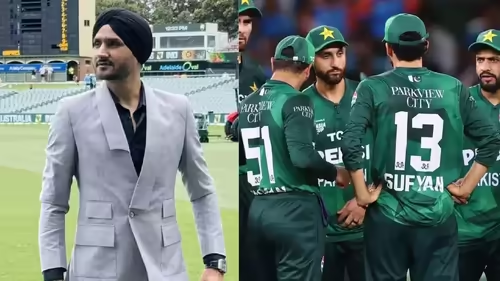
The cricket world is once again caught in the crossfire of politics, and this time, the drama is centered around the highly anticipated Pakistan boycott India T20 World Cup clash. The latest chapter in this saga has seen former Indian off-spinner Harbhajan Singh deliver a blistering critique, dismissing Pakistan’s stance as nothing more than a calculated piece of theater.
Table of Contents
- The Boycott Announcement: A Political Stand?
- Harbhajan’s Fiery Response: Calling Out the ‘Drama’
- The Bangladesh Connection: A Questionable Alliance
- ICC Rules and Potential Repercussions
- Conclusion: A Test of Guts and Gamesmanship
- Sources
The Boycott Announcement: A Political Stand?
On February 1, 2026, the Pakistani government officially announced that its national cricket team would not take the field for their scheduled Group A match against India on February 15 [[11]]. This decision was framed as an act of solidarity with Bangladesh, whose request to have its own World Cup matches moved out of India was firmly rejected by the ICC [[20]]. The move has sent shockwaves through the tournament, co-hosted by India and Sri Lanka from February 7 to March 8 [[12]].
Harbhajan’s Fiery Response: Calling Out the ‘Drama’
Never one to mince words, Harbhajan Singh has been at the forefront of the backlash against Pakistan’s decision. In a series of sharp comments, he labeled the entire affair as “unnecessary drama” and questioned its authenticity [[7]]. His core argument is simple: if Pakistan is so principled about its stance, why has it played lucrative bilateral series against India in the past, even during periods of heightened political tension? [[7]]
Harbhajan’s challenge is direct and personal. He has dared the Pakistani team, asking, “Let’s see if you really have the guts” to follow through on their threat [[1]]. This isn’t just a call to the players; it’s a public test of their resolve, suggesting that the announcement is more about posturing for a domestic audience than a genuine moral or political stand.
Why Harbhajan Believes It’s All a Ploy
According to Harbhajan, the conditional nature of Pakistan’s approval—tied directly to the ICC’s decision on Bangladesh—is a clear sign of a strategic ploy. He argues that this maneuver is designed to:
- Project an image of regional solidarity with Bangladesh without having to make any real sacrifice themselves, should the ICC have somehow agreed to move the matches.
- Mislead the public into believing their cricket board is taking a strong, principled stand, while simultaneously avoiding the financial and competitive consequences of actually forfeiting a World Cup match.
- Shift the narrative away from their own team’s performance and onto a geopolitical issue they can control.
The Bangladesh Connection: A Questionable Alliance
The entire controversy stems from the ICC’s firm rejection of the Bangladesh Cricket Board’s (BCB) request to relocate their group stage matches from India to a neutral venue [[20]]. Citing security concerns and a desire to avoid “national humiliation,” Bangladesh had pushed hard for the change [[21]]. However, the ICC stood its ground, emphasizing that the tournament’s schedule and venues are final and non-negotiable for political reasons [[23]].
Pakistan’s decision to boycott its India match appears to be a direct reaction to this outcome, positioning itself as Bangladesh’s staunch ally. However, critics like Harbhajan see this as a convenient excuse. After all, Pakistan and India have a long, complex history of playing cricket despite far more severe political rifts. The timing and specific linkage to the Bangladesh issue make this particular boycott seem less like a matter of principle and more like a tactical political move.
ICC Rules and Potential Repercussions
If Pakistan does indeed refuse to play, the consequences will be severe and immediate under ICC regulations. The official rulebook is clear on such matters:
| Consequence | Impact |
|---|---|
| Match Result | The match will be awarded to India as a win by forfeit. |
| Points Deduction | Pakistan will lose the two points from the match, crippling their chances of advancing from the group stage [[15]]. |
| Financial Penalties | The Pakistan Cricket Board (PCB) will face significant fines from the ICC. |
| Future Sanctions | Pakistan could face suspension or other disciplinary actions that affect their participation in future ICC events. |
For a team with aspirations of winning the T20 World Cup, these penalties are potentially catastrophic. This stark reality is what fuels Harbhajan Singh’s skepticism. He believes the threat is a bluff, knowing full well the immense cost of following through.
Conclusion: A Test of Guts and Gamesmanship
The looming shadow of the Pakistan boycott India T20 World Cup match has added a layer of unprecedented political tension to an already high-stakes sporting event. While Pakistan frames its potential action as a stand for regional solidarity, figures like Harbhajan Singh see it as a hollow, self-serving drama. The world is now watching to see if Pakistan will truly forfeit a crucial World Cup game or if, as Harbhajan suggests, it was all just a bluff. The ICC, for its part, has made its position clear: the rules of the game apply to everyone, regardless of politics. For fans of pure sport, the hope is that the game goes ahead, allowing the bat and ball—not geopolitics—to decide the winner. As the February 15th deadline approaches, the pressure is mounting, and the question remains: who will blink first?
Sources
- [[7]] Times of India: ‘Nothing but drama’: Harbhajan slams Pakistan’s T20 WC boycott of India clash
- [[11]] Al Jazeera: Pakistan to boycott T20 World Cup match against India on February 15
- [[20]] India Today: ICC rejects Bangladesh’s request to move T20 World Cup matches out of India
- [[12]] Wikipedia: 2026 Men’s T20 World Cup
- [[15]] The Cricket Standard: Pakistan ICC penalties boycott India T20 World Cup