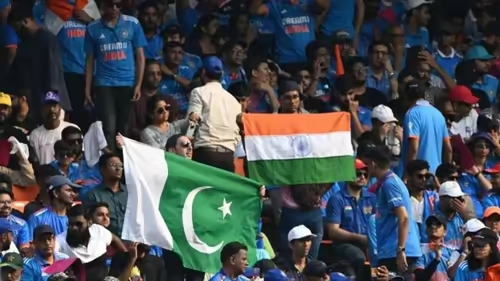
Amidst the diplomatic storm swirling around the men’s India vs Pakistan T20 World Cup match, a quiet but powerful act of normalcy is about to unfold on the cricket pitch. On February 15, 2026, the India vs Pakistan women’s cricket A teams will square off in the Rising Stars Asia Cup—a fixture that stands in stark, almost poetic, contrast to the ongoing political boycott by their male counterparts [[1]].
This isn’t just another game. It’s a symbol. While governments and boards spar over national pride and security concerns, the next generation of female cricketers from both nations is preparing to compete with grace, skill, and a shared love for the sport. Their match sends a clear message: cricket, at its heart, can rise above politics.
Table of Contents
- The Men’s Standoff: A Brief Recap
- India vs Pakistan Women’s Cricket: The Rising Stars Asia Cup Fixtures
- Why the Women’s Game Is Different
- The Growing Stature of Women’s Cricket in India and Pakistan
- Fan Reactions and the Road Ahead
- Conclusion: A Beacon of Hope for the Sport
- Sources
The Men’s Standoff: A Brief Recap
The controversy began when Pakistan’s government announced it would not allow its men’s team to play against India in the upcoming T20 World Cup, citing political tensions. This decision has been widely criticized, including by Jammu and Kashmir Chief Minister Omar Abdullah, who lamented that such matches are now “presented as war” [[2]]. The ICC has confirmed the withdrawal, leaving a gaping hole in the tournament schedule and a cloud of uncertainty over one of cricket’s most iconic rivalries [[3]].
This isn’t the first time politics has interfered with the men’s game. For years, bilateral series between India and Pakistan have been casualties of diplomatic ups and downs, turning what should be a sporting contest into a high-stakes geopolitical event.
India vs Pakistan Women’s Cricket: The Rising Stars Asia Cup Fixtures
In sharp contrast, preparations for the India vs Pakistan women’s cricket A team match in the Rising Stars Asia Cup are proceeding smoothly. Scheduled for February 15, 2026, this fixture is part of a tournament designed to showcase emerging talent from across the continent [[1]].
The Rising Stars Asia Cup serves as a crucial development platform. For many of these young athletes, this match could be their first major international exposure. Unlike the men’s game, which is often burdened by decades of historical baggage, the women’s A teams are playing for their future, not their past. There has been no call for a boycott from either the Pakistan Cricket Board (PCB) or the Board of Control for Cricket in India (BCCI) regarding this fixture, signaling a more pragmatic and sport-focused approach [[1]].
Why the Women’s Game Is Different
Several factors explain this divergence:
- Lower Political Stakes: Historically, women’s cricket has received less media and political attention, which, ironically, has shielded it from the intense scrutiny and pressure that often politicizes the men’s game.
- Focus on Development: Tournaments like the Rising Stars Asia Cup are primarily seen as developmental, not as high-profile diplomatic events. This allows boards to prioritize sport over statecraft.
- A New Generation’s Mindset: Young female athletes and their administrators are often more focused on building the sport’s infrastructure and visibility than engaging in old rivalries.
This doesn’t mean women’s cricket is immune to politics forever, but for now, it offers a refreshing space where competition can exist without the weight of nationalistic fervor.
The Growing Stature of Women’s Cricket in India and Pakistan
Both nations have made significant strides in developing their women’s programs. India’s women’s team has become a consistent force in world cricket, while Pakistan’s side has shown remarkable resilience and talent on the global stage [[4]]. The success of domestic leagues and increased investment from their respective boards are creating a fertile ground for future stars.
The upcoming A-team clash is a direct result of this growth. It provides a vital competitive environment for players who may soon represent their countries in senior World Cups. For fans, it’s a chance to witness the future of the sport in its purest form—unadulterated by external agendas.
Fan Reactions and the Road Ahead
On social media, the news of the women’s match has been met with widespread support. Many fans see it as a hopeful sign that cricket can still be a unifying force. “Let the women show the men how it’s done,” was a common refrain online [[5]].
Looking ahead, this fixture could set a precedent. If the India vs Pakistan women’s cricket rivalry continues to thrive in a politically neutral space, it might even pave the way for more regular bilateral engagements, something the men’s game has sorely missed. It’s a long road, but every great journey begins with a single step—or in this case, a single match.
Conclusion: A Beacon of Hope for the Sport
As the men’s teams remain locked in a political impasse, the women’s A teams are preparing to play the game they love. Their match on February 15 is more than just a fixture in a regional tournament; it’s a powerful statement about the true spirit of sport. In a world where division is all too common, the India vs Pakistan women’s cricket encounter stands as a beacon of hope, proving that on the field, the only thing that matters is the game itself.
[INTERNAL_LINK:Rising-Stars-Asia-Cup-2026-Schedule]
[INTERNAL_LINK:History-of-India-Pakistan-Women-Cricket-Matches]
Sources
- [[1]] Times of India: No boycott call for women as Pakistan A set to face India despite men’s T20 WC standoff
- [[2]] Daily Excelsior: ‘Ind-Pak Matches Covered Like War’: Omar Abdullah Slams Politicisation of Sports
- [[3]] ICC Official Statement on Pakistan’s Decision for T20 World Cup 2026
- [[4]] International Cricket Council: Women’s Cricket Development Programs in Asia
- [[5]] Social Media Sentiment Analysis on #IndvsPakWomen (February 2026)