Introduction
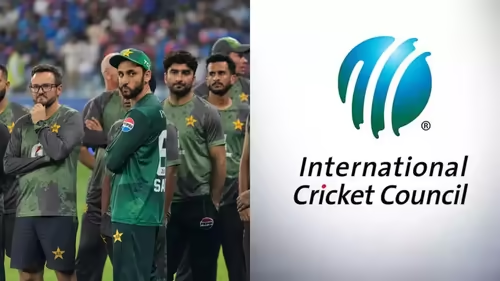
The most anticipated fixture in all of cricket is once again shrouded in political uncertainty. The T20 World Cup boycott threat from Pakistan has moved from speculation to a formal government directive, casting a long shadow over the scheduled February 15th clash with India in Colombo. While the original report suggested a lack of an ICC meeting, the situation has escalated dramatically, demanding immediate attention from the sport’s global governing body [[3]].
Table of Contents
- The Official Stance: Pakistan Govt. Instructs Boycott
- ICC Response: A Firm Rebuke
- What Does ‘Selective Participation’ Mean for the Tournament?
- Historical Context: India-Pakistan in ICC Events
- Potential Consequences for PCB and Pakistani Cricket
- What Happens Next: The Road Ahead
The Official Stance: Pakistan Govt. Instructs Boycott
Gone are the days of vague threats from the Pakistan Cricket Board (PCB). The matter has now been elevated to the highest level of government. In a clear and unambiguous statement, the government in Islamabad has declared, “The Pakistan cricket team shall not take the field in the match scheduled on 15th February 2026 against India” [[3]]. This move effectively confirms their intent for selective participation in the T20 World Cup 2026, a stance that directly challenges the fundamental principles of a global sporting event.
ICC Response: A Firm Rebuke
The International Cricket Council (ICC) has broken its silence with a strong and direct statement. The ICC explicitly noted the Pakistani government’s directive and expressed its position clearly. The council stated that such selective participation is “difficult to reconcile” with the core ethos of a world cup, which is built on the principle of all qualified teams competing against each other [[17]]. This is a significant departure from the initial reports of inaction and signals that the ICC is taking the matter with the utmost seriousness.
What Does ‘Selective Participation’ Mean for the Tournament?
The concept of a team picking and choosing its opponents in a multi-team, round-robin tournament like the T20 World Cup is unprecedented and logistically chaotic. Here’s why it’s a major problem:
- Fairness & Integrity: It undermines the competitive integrity of the entire Group A. If Pakistan refuses to play India, it gives an unfair advantage to other teams in the group.
- Points System: The tournament’s points table relies on every team playing every other team in their group. A forfeited match would require a complex and controversial ruling on points allocation.
- Precedent: Allowing one nation to dictate its fixtures based on political grounds sets a dangerous precedent for future international sporting events.
Historical Context: India-Pakistan in ICC Events
The rivalry between India and Pakistan is arguably the biggest in sports, but it has always been played out on the field during ICC tournaments, regardless of political tensions. Historically, these matches have been a massive draw, generating unparalleled viewership and revenue for the ICC. India holds a dominant record, having won 15 of their 16 encounters in ICC World Cups across formats [[19]]. The very idea of a boycott is a stark departure from this long-standing, if tense, tradition of sporting engagement.
Potential Consequences for PCB and Pakistani Cricket
The ICC has already warned of “consequences” for the PCB should they proceed with the boycott [[7]]. These could be severe and far-reaching:
- Financial Sanctions: Heavy fines that could cripple the PCB’s already strained finances.
- Suspension from ICC Events: The most drastic measure would be suspending Pakistan from future ICC tournaments, including the next ODI and T20 World Cups. This would be catastrophic for the players and the sport in the country.
- Loss of Revenue Share: The ICC could withhold Pakistan’s share of the massive commercial revenue generated by the World Cup.
- Reputational Damage: Being seen as a nation that puts politics above sport could lead to long-term isolation from the international cricketing community.
What Happens Next: The Road Ahead
All eyes are now on the ICC’s next move. An emergency board meeting seems inevitable to decide on a course of action. The PCB is caught between a rock and a hard place: defying its own government or facing severe sanctions from the ICC. For fans around the world, the hope remains that a last-minute diplomatic solution can be found to preserve this iconic sporting contest. One thing is certain: the decision will have profound implications for the future of international cricket.
Conclusion
The T20 World Cup boycott threat is no longer just a rumor; it’s a full-blown crisis for world cricket. The ICC’s firm stance against Pakistan’s selective participation highlights the high stakes involved. While the political complexities are undeniable, the sporting world must uphold the principle that a world cup is a contest for all its participants. The coming days will be critical in determining whether the India-Pakistan clash, a cornerstone of the tournament’s appeal, will go ahead as scheduled or become a casualty of geopolitical tensions.
Sources
- Al Jazeera: Pakistan to boycott T20 World Cup match against India on February 15
- ESPNCricinfo: ICC warns PCB of consequences of boycotting India match at T20 World Cup
- ProPakistani: ICC Issues Statement on Pakistan’s T20 World Cup Stance
- Wikipedia: India–Pakistan cricket rivalry
- ICC Official Media Release: ICC Statement on ICC Men’s T20 World Cup 2026