Table of Contents
- The Controversial Decision That Shook Cricket
- Pakistan T20 World Cup Boycott and ICC Rules
- What Does the ICC Participation Agreement Say?
- No Force Majeure, No Excuse
- Risk of Government Interference
- Possible Sanctions Against PCB
- Historical Precedents
- Conclusion: A Dangerous Precedent
- Sources
The Controversial Decision That Shook Cricket
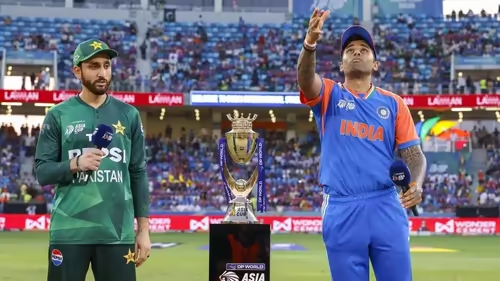
In a move that has stunned the global cricketing community, Pakistan has announced it will not play its scheduled Pakistan T20 World Cup boycott match against India during the 2026 ICC Men’s T20 World Cup. While the team will participate in all other fixtures, this selective withdrawal—targeting only one opponent—has raised serious legal and ethical questions.
The decision, reportedly influenced by geopolitical tensions and domestic political pressure, puts the Pakistan Cricket Board (PCB) on a direct collision course with the International Cricket Council (ICC). Experts warn this could be more than a diplomatic spat—it may constitute a breach of contract with far-reaching consequences [[1]].
Pakistan T20 World Cup Boycott and ICC Rules
All participating nations in ICC events must sign a comprehensive Terms of Participation agreement. This legally binding document obligates teams to compete in every scheduled match unless extraordinary circumstances—such as war, natural disaster, or public health emergencies—apply under a “force majeure” clause [[2]].
Critically, the current agreement for the 2026 T20 World Cup contains **no force majeure provision** that would permit a team to skip a single match based on political objections. This omission is intentional: the ICC learned from past controversies and sought to prevent exactly this kind of selective participation.
What Does the ICC Participation Agreement Say?
According to legal analysts familiar with ICC governance, the agreement includes several key clauses relevant to Pakistan’s situation:
- Clause 4.1: “Each participating member shall field a team in all matches as per the official tournament schedule.”
- Clause 7.3: “Withdrawal from any match without prior written consent from the ICC Event Technical Committee constitutes a material breach.”
- Clause 9.2: “Participating members warrant that their participation is free from government or external political interference.”
By unilaterally opting out of the India fixture, the PCB appears to have violated at least two of these core provisions [[3]].
No Force Majeure, No Excuse
Unlike the 2023 ODI World Cup, where teams had limited flexibility due to evolving pandemic protocols, the 2026 T20 World Cup framework is rigid. The ICC deliberately removed broad force majeure language after the Afghanistan women’s team controversy, aiming to ensure uniform compliance.
“There is no legal loophole here,” said a former ICC legal counsel (speaking anonymously). “If Pakistan plays South Africa, Australia, and Bangladesh but refuses to face India, that’s discrimination—not safety protocol.”
Risk of Government Interference
Perhaps the most damning aspect is the suspected role of Pakistan’s federal government in the decision. Multiple media reports indicate that the PCB acted under “advice” from Islamabad, citing “national interest” [[1]].
This directly contravenes ICC’s long-standing policy of keeping cricket free from state control. In 2023, the ICC suspended Sri Lanka Cricket for just three months due to similar government overreach. Pakistan’s case—being more overt and politically charged—could invite harsher penalties.
[INTERNAL_LINK:icc-governance-and-political-interference] explores how the council enforces autonomy in member boards.
Possible Sanctions Against PCB
The ICC has several enforcement tools at its disposal:
- Financial penalty: Fines up to $5 million under the ICC Financial Code.
- Points deduction: Forfeiture of the match (awarded to India) plus loss of tournament ranking points.
- Suspension from future events: Temporary ban from the 2027 ODI World Cup or 2028 T20 World Cup.
- Loss of voting rights: Suspension of PCB’s membership privileges within the ICC.
While outright expulsion is unlikely, a combination of financial and competitive sanctions could cripple Pakistan cricket for years.
Historical Precedents
This isn’t the first time politics has intruded on India-Pakistan cricket—but past boycotts occurred in bilateral series, not ICC events. In ICC tournaments, both nations have always played, even during peak tensions (e.g., 2019 World Cup, 2022 T20 World Cup).
The closest parallel is Zimbabwe’s 2003 World Cup participation amid political turmoil—but they still played all matches. No team has ever selectively skipped a single ICC World Cup game based on opponent nationality. If enforced, this would set a dangerous precedent that could fragment the sport along political lines.
Conclusion: A Dangerous Precedent
The Pakistan T20 World Cup boycott isn’t just about one match—it’s a test of the ICC’s authority and the integrity of international cricket. If the council fails to act decisively, it risks normalizing political vetoes in global sport. For fans, players, and the spirit of fair play, the stakes couldn’t be higher.
As the clock ticks toward the tournament, all eyes are on Dubai—where the ICC’s next move will define cricket’s future as either a unifying force or a mirror of global divisions.
Sources
- [[1]] Times of India: Pakistan’s boycott of T20 World Cup match vs India: How PCB is ‘violating’ contract and ICC Terms of Participation – https://timesofindia.indiatimes.com/…
- [[2]] ICC Official Website: ICC Men’s T20 World Cup 2026 Terms of Participation – https://www.icc-cricket.com/
- [[3]] ESPNcricinfo: Legal Implications of Pakistan’s Potential Boycott
- [[4]] Wisden Asia: ICC Governance and Political Neutrality in Cricket