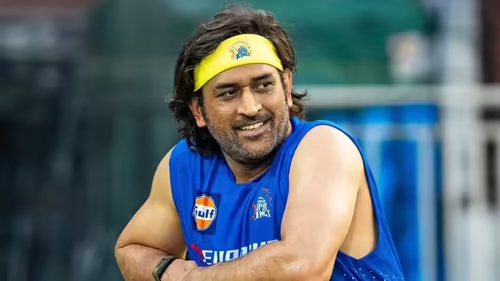
In a world where retired legends seamlessly transition into the commentary box, one iconic figure stands firmly on the other side of the microphone: MS Dhoni. The former Indian captain, known for his icy calm on the field and enigmatic silence off it, has finally given a clear and characteristically humble reason for why you won’t be hearing his voice dissecting the game from the studio.
During a recent YouTube interaction with sports broadcaster Jatin Sapru, Dhoni dropped a truth bomb that resonated with fans who’ve always sensed his preference for action over words [[2]].
Table of Contents
- The Fine Line of Commentary
- Why MS Dhoni Commentary is a Mismatch
- Beyond the Mic: Dhoni’s Awkward Truth
- What This Means for Dhoni’s Post-Retirement Life
- Conclusion: The Silence Speaks Volumes
- Sources
The Fine Line of Commentary
Dhoni didn’t just say ‘no’ to commentary; he explained the profound difficulty he sees in the role. “Commentary is very difficult,” he stated plainly [[2]]. His primary concern lies in the delicate balance a commentator must strike between simply describing the action and offering critical analysis [[5]].
For a leader like Dhoni, who built his legacy on trust and protecting his team, the idea of publicly critiquing current players—many of whom he may have mentored or played alongside—seems to go against his core principles. He recognizes that there’s a “very fine line” between being informative and being judgmental, a line he’s not comfortable walking [[2]].
Why MS Dhoni Commentary is a Mismatch
Beyond the ethical dilemma of criticism, Dhoni pointed to a more personal, almost endearing, professional hurdle: statistics. The modern commentary box demands an encyclopedic knowledge of player records, historical data, and intricate match metrics. For someone whose genius was often instinctive and in-the-moment, the pressure of rote memorization isn’t his forte.
His natural inclination, as he revealed, is to be a listener and an absorber of information rather than its primary source. This introspective quality, which made him such a brilliant reader of the game as a captain, doesn’t translate neatly into the performative nature of live broadcasting.
Beyond the Mic: Dhoni’s Awkward Truth
In a moment of self-deprecating humor that instantly went viral, Dhoni extended his reasoning beyond the professional realm into his personal life. He confessed, “I am a very awkward guy,” especially when it comes to something as common as a phone call [[1]].
He elaborated, “It’s just that I am very awkward talking on the phone because I don’t see a face.” This simple statement offers a profound insight into Dhoni’s personality. He’s a man of presence, of reading body language and subtle cues. The disembodied voice on a phone—and by extension, the isolated, high-pressure environment of a commentary booth—removes those vital human elements he relies on for genuine connection and communication [[1]].
What This Means for Dhoni’s Post-Retirement Life
This candid admission effectively shuts the door on a potential second career in media for the Chennai Super Kings icon. While fans might have hoped for his unique tactical insights on air, Dhoni’s choice reinforces his commitment to authenticity. He would rather stay silent than offer a watered-down or inauthentic version of himself.
His focus appears to remain firmly on his current playing commitments with CSK in the upcoming IPL 2026 season, where recent videos show him back in the nets, preparing for another campaign [[4]]. His role seems destined to be one of quiet mentorship within the team environment, a space where his presence speaks louder than any broadcast could.
Conclusion: The Silence Speaks Volumes
MS Dhoni’s refusal to enter the commentary box isn’t a snub to the media or his fans. It’s a testament to his self-awareness and integrity. In an age of constant noise, his choice to remain a listener, a doer, and a quietly supportive figure is perhaps his most powerful statement yet. His awkwardness isn’t a flaw; it’s a reminder of his genuine, unfiltered humanity—a quality that has always been at the heart of his legendary appeal.