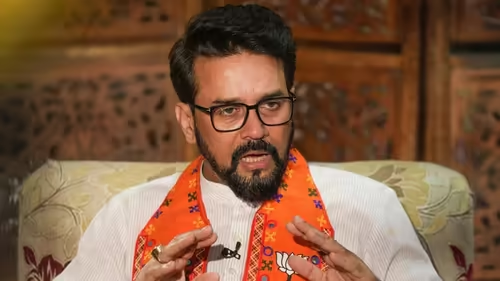
After nearly a decade in the administrative wilderness, Anurag Thakur is officially back in the game. In a significant ruling on February 5, 2026, the Supreme Court of India modified its 2017 order that had barred the former BCCI president from holding any position in cricket administration [[1]]. The decision—hailed by Thakur as a “vindication of truth”—opens the door for one of Indian cricket’s most polarizing figures to return to the corridors of power at the Board of Control for Cricket in India (BCCI).
This isn’t just about one man’s comeback. It’s a pivotal moment that could reshape the future of Indian cricket governance, reignite old rivalries, and test the durability of reforms introduced under the Lodha Committee. So, what led to this reversal? And what does it mean for the BCCI moving forward?
Table of Contents
- The Original Ban: Why Was Anurag Thakur Barred?
- The 2026 Supreme Court Ruling: Key Details
- Anurag Thakur BCCI: A Complicated Legacy
- Potential Impact on BCCI Governance and Reforms
- Reactions from the Cricket Fraternity
- Conclusion: A New Chapter for Indian Cricket Administration?
- Sources
The Original Ban: Why Was Anurag Thakur Barred?
The roots of Thakur’s exclusion trace back to the explosive 2013 IPL spot-fixing scandal. As BCCI secretary at the time, he was accused of failing to act decisively against tainted players and franchises. The crisis prompted the Supreme Court to appoint the Justice R.M. Lodha Committee in 2015 to recommend structural reforms for Indian cricket [[4]].
In 2017, the Court accepted key Lodha recommendations, including a ban on office-bearers who had served more than two consecutive terms or were found non-compliant with new eligibility criteria. Thakur—along with former BCCI chief N. Srinivasan—was deemed ineligible due to alleged contempt of court for not fully implementing earlier directives [[5]]. The ban was intended to be temporary but stretched into nine years.
The 2026 Supreme Court Ruling: Key Details
Thakur filed a review petition in late 2025, arguing that the prolonged ban had served its purpose and that he had since complied with all legal and ethical requirements. The Supreme Court, in its latest order, acknowledged the “lengthy duration” of the restriction and agreed to modify the 2017 directive [[1]].
Critically, the Court did not overturn the original findings but exercised its discretionary power under Article 142 of the Constitution—which allows it to pass orders necessary for “complete justice.” This means Thakur is now free to participate in BCCI affairs, including contesting elections or holding office, provided he meets current eligibility norms.
Anurag Thakur BCCI: A Complicated Legacy
Anurag Thakur’s tenure at the BCCI (2015–2016) was marked by both ambition and controversy:
- Commercial Expansion: He oversaw record-breaking media rights deals and pushed for greater professionalism in domestic cricket.
- IPL Turmoil: His handling of the 2015 IPL suspension of Chennai Super Kings and Rajasthan Royals drew sharp criticism for perceived inconsistency.
- Political Ties: As a sitting BJP MP, his dual role fueled debates about political interference in sports—a core concern the Lodha reforms sought to address [[6]].
Supporters view him as a dynamic leader who modernized the BCCI’s operations. Critics argue his return undermines the very principles of depoliticization and accountability the Supreme Court once championed.
Potential Impact on BCCI Governance and Reforms
Thakur’s reinstatement could have far-reaching consequences:
- Erosion of Lodha Reforms? Some fear this sets a precedent where bans become negotiable after enough time passes, weakening the reform framework.
- Power Shift in BCCI Elections: With his political clout and network, Thakur could mount a serious challenge for top posts in upcoming elections, potentially displacing the current leadership.
- Policy Direction: Known for his pro-commercial stance, his influence might accelerate privatization of domestic tournaments or changes to player contracts.
- Public Trust: The BCCI’s credibility hinges on perceived neutrality. Thakur’s return may reignite public skepticism about the board’s independence.
Reactions from the Cricket Fraternity
News of the verdict sparked mixed responses. Former cricketers like Virender Sehwag welcomed it as “fair,” noting that everyone deserves a second chance [[7]]. Others, including ex-captain Sourav Ganguly (who succeeded Thakur), remained silent, perhaps wary of internal board politics.
Meanwhile, transparency advocates expressed concern. “The spirit of the Lodha reforms was to cleanse cricket administration,” said a representative from the [INTERNAL_LINK:cricket-governance-reforms] initiative. “This ruling risks turning that vision into a revolving door.”
Conclusion: A New Chapter for Indian Cricket Administration?
The Supreme Court’s decision to lift the ban on Anurag Thakur BCCI involvement is more than a personal victory—it’s a litmus test for the future of Indian cricket governance. While the Court emphasized “complete justice,” the cricketing world now watches closely to see whether this marks a return to old practices or a reformed, matured leadership ready to serve the game without baggage. One thing is certain: the battle for the soul of the BCCI just got a lot more interesting.
Sources
- Times of India: Supreme Court paves way for Anurag Thakur to return to cricket administration
- The Hindu: SC modifies 2017 order against Anurag Thakur
- Mint: Anurag Thakur can now return to BCCI after Supreme Court relief
- Supreme Court of India Judgments Database
- BBC: The Lodha Committee reforms explained
- The Wire: How Politics and Cricket Intertwine in the BCCI
- ESPNCricinfo: Anurag Thakur free to return to BCCI after SC order