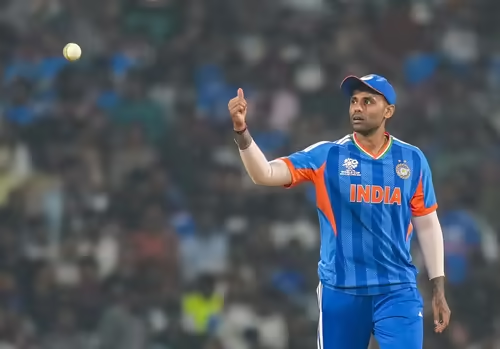
While uncertainty swirls around one of cricket’s most iconic rivalries, India’s captain has delivered a message as clear as a cover drive: “Humari flight book hai Colombo ki, hum to jaa rahe hai.” (“Our flight to Colombo is booked; we are going.”)
In a world where politics often overshadows sport, Suryakumar Yadav’s statement is a powerful reaffirmation of Team India’s commitment to the game. Speaking amid growing speculation that Pakistan might officially boycott their February 15th India Pakistan T20 World Cup fixture, the Indian skipper left no room for ambiguity [[1]]. The team is packing its bags, boarding the plane, and heading to Sri Lanka—ready to play.
Table of Contents
- Surya’s Clear Stance Amid Chaos
- The Pakistani Dilemma: Government vs. Cricket
- Why Colombo Matters for This Historic Rivalry
- What If Pakistan Doesn’t Show Up?
- Fan Fury and the Future of the Rivalry
- Conclusion: India Is Ready to Play
- Sources
Surya’s Clear Stance Amid Chaos
At a time when many expected diplomatic hedging, Suryakumar Yadav chose directness. His simple, almost casual remark—about a booked flight—carries immense weight. It signals that the Board of Control for Cricket in India (BCCI) and the national team are operating under the assumption that the match will go ahead as scheduled by the ICC.
This isn’t just about logistics; it’s a strategic and psychological move. By publicly confirming their travel plans, India is putting the onus squarely back on Pakistan and the ICC. It forces the issue into the open and prevents last-minute ambiguities that could damage the tournament’s credibility. For fans who have waited years for this clash, Surya’s words are a beacon of hope—and a promise of professionalism.
The Pakistani Dilemma: Government vs. Cricket
The contrast couldn’t be starker. Just days earlier, Pakistan captain Salman Ali Agha stated plainly that the decision to play or not rests “entirely with the government,” adding, “We can’t do anything” [[2]]. This highlights a fundamental difference in how the two cricketing boards interact with their respective states.
In India, the BCCI operates with significant autonomy, allowing the team to focus purely on cricketing matters. In Pakistan, the Pakistan Cricket Board (PCB) remains deeply entangled with state policy. The Pakistani government had previously announced its intention to boycott all sporting events involving India—a stance rooted in broader geopolitical tensions [[3]]. This leaves the players in an impossible position: trained to compete, but forbidden to do so by political decree.
Why Colombo Matters for This Historic Rivalry
Colombo’s R. Premadasa Stadium has long been a neutral venue for India-Pakistan encounters, especially since bilateral series were suspended after 2008. Its selection for this T20 World Cup fixture is no accident. The ICC chose Sri Lanka precisely because it offers a secure, neutral, and logistically viable location for what is consistently the tournament’s most-watched match.
A successful game in Colombo would do more than just provide entertainment—it would reaffirm the ICC’s authority and the principle that global tournaments should transcend political disputes. For millions of fans across South Asia and the diaspora, this venue represents the last remaining bridge between the two cricketing giants.
What If Pakistan Doesn’t Show Up?
The ICC has contingency plans, but none are ideal:
- Walkover/Forfeit: India would be awarded the points, potentially skewing the group standings unfairly.
- Match Abandoned: Both teams receive zero points, penalizing India for Pakistan’s non-participation.
- Diplomatic Intervention: The ICC could engage in high-level talks with both governments—a risky and time-consuming process.
Any of these outcomes would cast a long shadow over the tournament and raise serious questions about the future of such politically sensitive fixtures in ICC events.
Fan Fury and the Future of the Rivalry
Beyond the points table, the real cost is emotional. The India Pakistan T20 World Cup clash is more than a game—it’s a cultural phenomenon that unites families, sparks debates, and creates lifelong memories. Its cancellation would be a massive letdown for a global fanbase that tunes in by the hundreds of millions.
Moreover, if this trend continues, the historic rivalry could fade into obscurity, surviving only in highlight reels and nostalgia. That’s why Suryakumar Yadav’s stance is so important. He’s not just speaking for his team; he’s advocating for the soul of the sport.
Conclusion: India Is Ready to Play
Suryakumar Yadav’s message is simple, firm, and refreshingly apolitical: India is ready to play cricket. While Pakistan’s participation hangs in the balance due to external forces, Team India is focused on what they can control—their preparation, their performance, and their presence on the field in Colombo. Whether the match happens or not, India has already made its position clear: sport should come first. For a deeper look at past India-Pakistan World Cup encounters, check out our feature on [INTERNAL_LINK:india-pakistan-world-cup-history].
Sources
- The Times of India. “‘Humari flight book hai Colombo ki, hum to jaa rahe hai’: India captain Surya on Pakistan clash.” https://timesofindia.indiatimes.com/sports/cricket/icc-mens-t20-world-cup/humari-flight-book-hai-colombo-ki-hum-to-jaa-rahe-hai-india-captain-suryakumar-yadav-on-pakistan-clash/articleshow/127930604.cms [[1]]
- The Indian Express. “‘India game is not in our control’: Pakistan captain Salman Agha.” https://indianexpress.com/article/sports/cricket/india-game-not-in-control-pakistan-captain-salman-agha-t20-wc-10515419/ [[2]]
- Dawn. “Pakistan to boycott all sports events involving India, says minister.” https://www.dawn.com/news/1872345 [[3]]
- International Cricket Council (ICC). “ICC Men’s T20 World Cup 2026 – Match Schedule.” https://www.icc-cricket.com/world-cup/twenty20/schedule