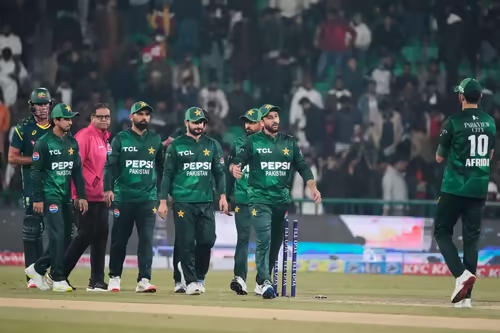
In the emotionally charged world of cricket, few fixtures ignite passion like India vs. Pakistan. But this time, the drama isn’t unfolding on the pitch—it’s playing out in government corridors and press conferences. And Pakistan captain Salman Ali Agha has just delivered a sobering reality check that cuts through the noise: “The decision isn’t ours.”
Faced with relentless questions about the looming February 15th Pakistan India T20 World Cup match in Colombo, Agha has repeatedly distanced his team from the political firestorm. His message is consistent, calm, and firm: while fans may mourn the potential loss of the marquee clash, his squad must move forward. “There are three other games,” he reminded everyone—a statement that doubles as both a tactical pivot and an emotional shield [[1]].
Table of Contents
- Agha’s Unambiguous Stance
- The Government Factor in Pakistani Cricket
- Fans’ Heartbreak and the Lost Rivalry
- Pakistan Focuses on the Path Forward
- What This Means for the T20 World Cup
- Conclusion: A Team Caught in the Crossfire
- Sources
Agha’s Unambiguous Stance
Unlike vague diplomatic speak, Agha’s words have been strikingly direct. In multiple interactions with the media, he has refused to entertain speculation or offer false hope. “Humara decision nahi hai” (It’s not our decision), he stated plainly—a phrase that has become the unofficial mantra of Pakistan’s current World Cup campaign [[2]].
This transparency, while refreshing, also underscores a painful truth: Pakistan’s cricketers are not free agents when it comes to facing India. Their participation is contingent on state policy, not sporting merit or fan demand. By publicly acknowledging this lack of control, Agha shields his team from blame while subtly highlighting the absurdity of the situation.
The Government Factor in Pakistani Cricket
The roots of this controversy lie in a long-standing policy from Islamabad. Following heightened geopolitical tensions, the Pakistani government announced a formal boycott of all bilateral sporting events with India. While ICC tournaments are technically multilateral, Pakistan has historically used its discretion to withdraw from India fixtures even in global competitions—though this hasn’t always been consistently applied [[3]].
This places the Pakistan Cricket Board (PCB) in an impossible position. Legally and financially dependent on the state, the PCB cannot override a government directive, no matter how damaging it may be to the sport. The result? A national team ready to compete but forbidden from doing so by forces beyond the boundary ropes.
Fans’ Heartbreak and the Lost Rivalry
For millions of fans across South Asia and the global diaspora, the Pakistan India T20 World Cup clash is more than a game—it’s a cultural event. Families gather, offices fall silent, and social media explodes with anticipation. Its cancellation isn’t just a scheduling change; it’s an emotional void.
Agha himself acknowledged this pain. “We know the fans will miss it,” he said, showing empathy rarely seen in high-pressure sports environments [[1]]. Yet, he quickly pivoted back to professionalism: dwelling on the uncontrollable would only harm their chances in the other crucial group matches against teams like Australia, South Africa, or England.
Pakistan Focuses on the Path Forward
With the India fixture hanging by a thread, Agha’s leadership is being tested in real time. His strategy is clear: compartmentalize and execute.
He’s urging his players to channel their energy into what they *can* control:
- Preparation for remaining opponents: Scouting reports, net sessions, and tactical meetings are now laser-focused on their other three group games.
- Mental resilience: Avoiding media noise and maintaining team morale despite external distractions.
- Performance under pressure: Proving their mettle on the field, regardless of off-field politics.
This pragmatic approach may be their best chance to salvage a meaningful tournament run—even if the biggest match never happens.
What This Means for the T20 World Cup
The ripple effects are significant for the ICC and the tournament’s integrity:
- Competitive fairness: If Pakistan forfeits, India gets a walkover, potentially giving them an unfair advantage in net run rate calculations.
- Commercial impact: Broadcasters and sponsors lose the single highest-rated match of the entire event, impacting revenue and viewership metrics.
- Precedent setting: Allowing political boycotts in ICC events could open the door for similar actions in future tournaments, undermining the very concept of global sport.
The ICC has remained largely silent, likely engaged in behind-the-scenes diplomacy. But time is running out as the February 15th date approaches.
Conclusion: A Team Caught in the Crossfire
Salman Ali Agha’s repeated emphasis on “three other games” is more than just a soundbite—it’s a survival strategy for a team trapped between sporting ambition and political reality. While the world waits for a government decision on the Pakistan India T20 World Cup clash, Pakistan’s players are left to prepare for every scenario, hoping their skills will be tested on the field, not erased by a policy memo. For a deeper look at how politics has shaped this historic rivalry, explore our feature on [INTERNAL_LINK:india-pakistan-cricket-political-history].
Sources
- The Times of India. “T20 World Cup: Pak captain on India boycott – ‘There are three other matches’.” https://timesofindia.indiatimes.com/sports/cricket/icc-mens-t20-world-cup/t20-world-cup-pakistan-captain-salman-ali-agha-on-india-match-there-are-three-other-games/articleshow/127929184.cms [[1]]
- Live Mint. “‘Humara decision nahi hai’: Pakistan captain Salman Agha breaks silence on India match boycott.” https://www.livemint.com/sports/cricket-news/humara-decision-nahi-hai-pakistan-captain-salman-agha-breaks-silence-on-india-match-boycott-11770006105644.html [[2]]
- Dawn. “Pakistan to boycott all sports events involving India, says minister.” https://www.dawn.com/news/1872345 [[3]]
- International Cricket Council (ICC). “ICC Men’s T20 World Cup 2026 – Official Regulations.” https://www.icc-cricket.com/media-resources/image/upload/v1708489200/ICC_Mens_T20_World_Cup_Playing_Conditions_2026.pdf