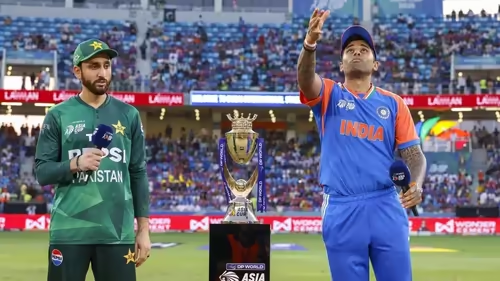
In a dramatic turn of events that could reshape the India-Pakistan T20 World Cup narrative, Sri Lanka Cricket (SLC) has fired off an urgent and deeply personal letter to the Pakistan Cricket Board (PCB). The subject? A desperate plea for Pakistan to reconsider its announced boycott of their highly anticipated group-stage fixture against India, scheduled for February 15 in Colombo [[1]].
This isn’t just about cricket; it’s about survival for a host nation banking on the world’s biggest sporting rivalry to fuel its economy. With hotel bookings already being cancelled and local businesses bracing for a hit, SLC’s appeal carries the weight of a nation’s financial hopes [[5]].
Table of Contents
- SLC’s Emotional and Financial Appeal
- Pakistan’s Official Stance on the India Boycott
- The Devastating Financial Impact on Sri Lanka
- A Debt of Gratitude: Sri Lanka’s Bravery in Pakistan
- What Happens Next for the India-Pakistan T20 World Cup?
- Conclusion: A Test of Cricket Diplomacy
- Sources
SLC’s Emotional and Financial Appeal
At the heart of SLC’s communication is a dual-pronged argument designed to appeal to both Pakistan’s sense of history and its understanding of the game’s economics. SLC President Shammi Silva reportedly penned the letter, invoking a powerful memory from cricket’s darkest days: the 2009 terrorist attack on the Sri Lankan team bus in Lahore [[2]].
Despite that horrific event, which left eight people dead and effectively exiled Pakistan from hosting international cricket for years, Sri Lanka was among the first nations to return and play in the country. They toured in 2015 and again for a historic Test series in 2019, helping Pakistan’s slow return to the international fold [[27]]. SLC’s message is clear: “We stood by you when few others would. Now, we ask for your support in the broader interests of the game.” [[2]]
Pakistan’s Official Stance on the India Boycott
Pakistan’s decision to boycott the match stems from a political stance of solidarity with Bangladesh, which was controversially excluded from the 2026 T20 World Cup. Prime Minister Shehbaz Sharif has publicly confirmed the team’s refusal to play India, framing it as a “very considered decision” made on principle [[15]].
The PCB has conveyed this position to the ICC, creating a major headache for the global governing body. While Pakistan has committed to playing its other matches in the tournament, its absence from the India fixture threatens to derail one of the event’s biggest draws [[11]]. This puts the PCB in a precarious position, caught between political directives at home and the potential for sanctions or fines from the ICC for breaching its participation agreement [[14]].
The Devastating Financial Impact on Sri Lanka
The consequences of this boycott for Sri Lanka are not merely symbolic; they are brutally financial. Colombo, as the designated host city, was expecting a massive influx of fans, media, and corporate sponsors for the India-Pakistan T20 World Cup clash.
Analysts estimate that the cancellation could lead to:
- Massive Hotel Cancellations: High-end hotels in Colombo had already sold out their inventory for the match dates. Widespread cancellations are now expected, dealing a direct blow to the hospitality sector [[22]].
- Loss of Tourism Revenue: Beyond accommodation, local restaurants, transport services, and souvenir vendors were all counting on the spending power of thousands of visiting fans [[18]].
- Damage to Future Bidding: A failed marquee event could harm Sri Lanka’s reputation as a reliable host for future ICC tournaments, impacting long-term economic planning [[5]].
The estimated economic value of a single India-Pakistan match can run into hundreds of millions of dollars, a figure Sri Lanka can ill afford to lose [[25]].
A Debt of Gratitude: Sri Lanka’s Bravery in Pakistan
SLC’s reference to the 2009 attack is not a casual historical footnote; it’s a cornerstone of their argument. After the attack, international teams refused to tour Pakistan for nearly a decade. Sri Lanka’s willingness to be a pioneer in returning was a significant act of faith and friendship that helped rehabilitate Pakistan’s status in world cricket [[30]].
By reminding the PCB of this history, SLC is making a powerful case for reciprocity. They are essentially asking Pakistan to honor that past goodwill by ensuring the Colombo fixture goes ahead, thereby protecting the shared financial ecosystem of the sport that both nations depend on.
What Happens Next for the India-Pakistan T20 World Cup?
The ball is now firmly in the PCB’s court. Will they hold firm on their political stance, risking their relationship with SLC and inviting potential ICC penalties? Or will they heed SLC’s emotional and pragmatic appeal?
The ICC is also under immense pressure. It must find a solution that upholds its regulations while navigating complex geopolitical realities. One potential, though unlikely, scenario could involve relocating the match, but this would be logistically chaotic and still damage Colombo’s economy. For now, all eyes are on the PCB’s response to SLC’s letter—a response that will determine the fate of cricket’s most valuable fixture [[11]].
Conclusion: A Test of Cricket Diplomacy
This situation transcends the boundary ropes. It’s a stark reminder that in modern cricket, sport, politics, and economics are inextricably linked. SLC’s plea to the PCB is a masterclass in cricket diplomacy, blending a call for historical loyalty with a stark warning of present-day financial ruin. The outcome of this standoff will not only decide whether fans get to witness the India-Pakistan T20 World Cup clash in Colombo but will also set a precedent for how the sport handles such crises in the future. The hope remains that the spirit of the game, and a sense of mutual obligation, will prevail.
Sources
- Al Jazeera. (2026, February 5). T20 World Cup: Sri Lanka urge Pakistan to reconsider India boycott. Retrieved from https://www.aljazeera.com/sports/2026/2/5/t20-world-cup-sri-lanka-urge-pakistan-to-reconsider-india-boycott
- The Times of India. (2026, February 5). T20 World Cup: SLC invokes 2009 terror attack memory in letter to PCB. Retrieved from https://timesofindia.indiatimes.com/sports/cricket/icc-mens-t20-world-cup/t20-world-cup-slc-writes-to-pcb-after-pakistans-stand-of-boycotting-india-fixture-in-colombo/articleshow/127945511.cms
- BBC Sport. (2026, February 5). Sri Lanka ask Pakistan to re-think India refusal. Retrieved from https://www.bbc.com/sport/cricket/articles/cj4lr07dnr2o
- T20WC2026.com. (2026). SLC Sends Formal Letter to PCB. Retrieved from https://t20wc2026.com/slc-sends-formal-letter-to-pcb/
- ESPNcricinfo. (2026). Can Pakistan be sanctioned by ICC for boycotting India match?. Retrieved from https://www.espncricinfo.com/story/how-the-icc-pcb-problem-over-india-boycott-could-play-out-at-the-2026-t20-world-cup-1522178
- New Kerala. (2026). Pakistan vs India Match Uncertainty Risks Colombo Tourism. Retrieved from https://www.newkerala.com/news/a/off-field-fallout-pakistans-icc-match-decision-puts-colombo-411.htm
- BBC Sport. (2019, December 9). Sri Lanka arrive in Pakistan for first Test series since 2009. Retrieved from https://www.bbc.com/sport/cricket/50710502