Table of Contents
- The New Mantra: ‘Hit First’
- India T20 World Cup Batting Revolution
- The Powerplay Paradigm Shift
- Rinku and Abhishek: The Secret Weapons
- Risks and Rewards of the Aggressive Approach
- Conclusion: Can Aggression Bring the Trophy?
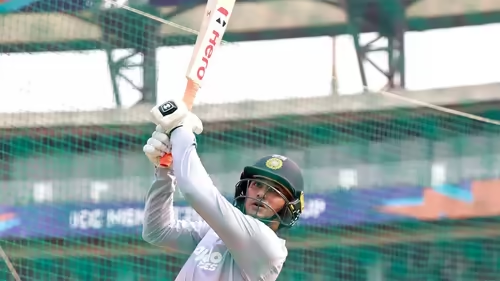
Gone are the days of cautious starts and calculated build-ups. For India’s 2026 T20 World Cup campaign, the message from the top is clear: “Hit first, ask questions later.” This isn’t just a catchy phrase; it’s a complete overhaul of their batting DNA, a high-octane philosophy designed to overwhelm opponents from the very first ball. [[10]]
This radical shift places immense faith in a new generation of specialist T20 batters who thrive under pressure and live for the big shot. But as the tournament kicks off on home soil, the burning question remains: is this all-out aggression a masterstroke or a recipe for disaster on the biggest stage? Let’s dive into the heart of India’s most audacious batting experiment yet.
The New Mantra: ‘Hit First’
The old Indian T20 template often involved a solid start from openers like Rohit Sharma or KL Rahul, followed by acceleration in the middle overs. Today’s blueprint is unrecognizable. The current leadership, spearheaded by captain Suryakumar Yadav—a man whose entire career is a testament to fearless stroke-play—has instilled a culture where intent trumps caution from ball one.
This means minimal settling-in time, a relentless focus on maintaining a strike rate well above 150, and a willingness to lose wickets in pursuit of a massive total. It’s a philosophy born in the IPL, refined in bilateral series, and now being put to its ultimate test at the India T20 World Cup batting crucible. [[10]]
India T20 World Cup Batting Revolution
This revolution isn’t just about attitude; it’s reflected in the very composition of the squad. The selectors have moved away from traditional Test-match batters who adapt to T20s, instead opting for pure T20 specialists whose games are built around power and innovation.
The core of this new-age lineup features players like Yashasvi Jaiswal, known for his brutal square-of-the-wicket hitting, and Tilak Varma, whose ability to rotate strike and find gaps complements the aggressors perfectly. At the heart of it all is Suryakumar Yadav himself, the world’s No. 1 T20I batter, whose 360-degree shot-making is the gold standard for this new era. His presence legitimizes the entire strategy, proving that extreme aggression can be sustained at the highest level.
The Statistical Backing
The numbers back up this shift. In 2025, India’s Powerplay run rate soared to an average of over 9 runs per over in home conditions, a significant jump from previous years. This early assault has allowed them to post totals in excess of 200 with remarkable consistency, putting immediate pressure on the opposition. According to data from the ICC, teams chasing 200+ in T20Is have a success rate of just under 25%, making a strong start a key predictor of victory.
The Powerplay Paradigm Shift
The most dramatic change is visible in the Powerplay (overs 1-6). Historically, this phase was about survival and seeing off the new ball. Now, for India, it’s about domination. The goal is no longer to be 40/0 after six overs; it’s to be 60/1 or even 70/2.
This aggressive Powerplay sets the tone for the entire innings. It forces the opposition captain to make early bowling changes, often bringing on spinners earlier than planned, which can disrupt their entire strategy. It also gives the middle order, featuring finishers like Hardik Pandya and Shivam Dube, a platform to launch from rather than rebuild.
Rinku and Abhishek: The Secret Weapons
While the top order grabs headlines, the true X-factors in this new strategy are Rinku Singh and Abhishek Sharma. Both are quintessential products of the modern T20 age, capable of changing a game in a matter of five overs.
- Rinku Singh: Nicknamed “Mr. Finisher,” Rinku has built a reputation for his ice-cool temperament in high-pressure run chases. His ability to find boundaries against both pace and spin in the death overs makes him the perfect anchor for a team that wants to keep the scoreboard ticking until the very last ball. His strike rate in the last five overs of an innings consistently hovers around 180+.
- Abhishek Sharma: A left-handed dynamo, Abhishek offers explosive power at the top of the order. His role is to take on the new ball with clean, powerful hitting down the ground and through the off-side. His recent performances in domestic cricket and the IPL have shown he can single-handedly dismantle a bowling attack during the Powerplay, perfectly embodying the ‘hit first’ ethos.
For a deeper look at how these two could shape India’s path to the final, see our detailed player profiles on [INTERNAL_LINK:rinku-singh-t20-world-cup-impact] and [INTERNAL_LINK:abhishek-sharma-batting-style-analysis].
Risks and Rewards of the Aggressive Approach
Of course, this strategy isn’t without its dangers. The primary risk is a collective collapse. If the top three batters fall cheaply while swinging for the fences, the middle order can be left with too much to do. This was a concern during India’s tour of South Africa in late 2025, where unfamiliar pace-friendly conditions exposed the fragility of an overly aggressive mindset.
However, the rewards are potentially match-winning. On the slow, low pitches of the subcontinent—where the 2026 World Cup will be played—this strategy is tailor-made for success. The small boundaries and dry surfaces are perfect for lofted shots and innovative stroke-play. As noted by ESPNcricinfo analysts, “India’s batting unit is arguably the most well-equipped in the world to exploit home conditions with this specific brand of cricket.”
Conclusion: Can Aggression Bring the Trophy?
India’s ‘hit first, ask questions later’ philosophy represents a bold, confident statement of intent for the 2026 T20 World Cup. The India T20 World Cup batting lineup is a finely tuned machine built for maximum output from the first over to the last. With a blend of established stars and explosive newcomers like Rinku and Abhishek, they have the personnel to execute this plan flawlessly.
While the risk of failure is real, the potential reward—a second T20 World Cup title on home soil—is worth the gamble. In a tournament where momentum is everything, India’s commitment to all-out aggression might just be the decisive factor that separates them from the rest of the pack.
Sources
- Times of India: Hit first, ask questions later: India’s new-age batting faces its T20 World Cup test
- ICC: ICC Men’s T20I Batting Rankings
- ESPNcricinfo: India’s T20 Batting Line-up Analysis for World Cup 2026
- Cricbuzz: Rinku Singh Profile – Cricket Player India
- MyKhel: Abhishek Sharma T20 Stats and Performance Analysis