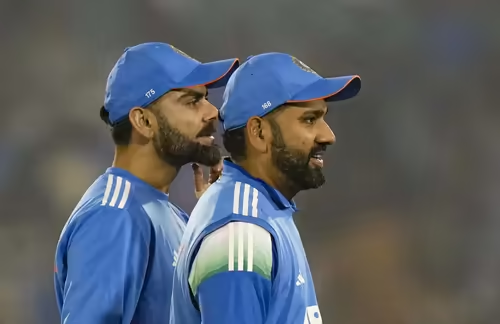
It’s official: the sun is setting on one era and rising on another. The Board of Control for Cricket in India (BCCI) has released its much-anticipated BCCI player contracts 2025–26, and the biggest shockwave? Legends Virat Kohli and Rohit Sharma—once untouchable fixtures at the top—have been demoted to **Grade B**.
This isn’t just a reshuffling of pay grades. It’s a clear, deliberate statement from the selectors and the board: Indian cricket is accelerating its transition to a younger, more dynamic core. With Shubman Gill, Jasprit Bumrah, and Ravindra Jadeja now anchoring Grade A for the men’s side—and Harmanpreet Kaur, Smriti Mandhana, and Deepti Sharma leading the women’s elite group—the message is unmistakable [[1]].
But what does this mean for Kohli and Rohit? Are they being sidelined—or simply repositioned in a new phase of their storied careers?
Table of Contents
- What the BCCI Player Contracts 2025–26 Reveal
- Why Were Kohli and Rohit Demoted to Grade B?
- The New Guard: Shubman Gill and the Grade A Elite
- Women Cricket Stars Dominate Grade A
- Financial and Strategic Implications of the New Grades
- Conclusion: A Necessary Evolution or a Risky Move?
- Sources
What the BCCI Player Contracts 2025–26 Reveal
The BCCI’s annual central contracts are more than just salary slabs—they’re a reflection of current form, future potential, and strategic team-building priorities. For 2025–26, the breakdown is telling:
- Grade A+: Not awarded this year—reserved for truly exceptional, all-format stalwarts (last held by Kohli, Rohit, and Bumrah in previous cycles).
- Grade A: Now includes **Shubman Gill**, **Jasprit Bumrah**, **Ravindra Jadeja**, and key women’s players like **Harmanpreet Kaur** and **Smriti Mandhana**.
- Grade B: Features **Virat Kohli**, **Rohit Sharma**, along with KL Rahul, Mohammed Siraj, and others.
The absence of a Grade A+ category itself speaks volumes—it signals that no player is above evaluation, regardless of legacy [[3]].
Why Were Kohli and Rohit Demoted to Grade B?
Let’s be clear: “demoted” doesn’t mean “discarded.” Both Kohli and Rohit remain vital to India’s short-term plans, especially in marquee events like the T20 World Cup 2026. However, their recent workload management and selective participation across formats likely influenced the decision.
Kohli skipped the 2025 West Indies Test tour and has been increasingly focused on white-ball cricket. Rohit, meanwhile, has openly discussed managing his body for major tournaments rather than full bilateral series [[5]]. From the BCCI’s perspective, central contracts reward consistent availability and performance across formats—not just iconic status.
As one senior selector anonymously noted, “Legacy earns respect, but contracts are earned through present contribution.”
The New Guard: Shubman Gill and the Grade A Elite
Shubman Gill’s elevation to Grade A is the headline of this new era. At just 26, he’s already cemented himself as India’s premier No. 3 batter across formats, with match-winning knocks in Australia and England. His consistency, fitness, and leadership potential make him the natural heir apparent [[7]].
He’s joined by:
- Jasprit Bumrah: The undisputed leader of India’s pace attack, fit and firing after overcoming back issues.
- Ravindra Jadeja: The ultimate all-rounder—match-winner with bat, ball, and in the field.
This trio represents the new spine of the Indian team: young, versatile, and relentlessly available.
Women Cricket Stars Dominate Grade A
The women’s list reflects their own golden generation. **Harmanpreet Kaur** (captain), **Smriti Mandhana**, **Jemimah Rodrigues**, and **Deepti Sharma** all secured Grade A contracts—a testament to their dominance in recent ICC events and bilateral series [[9]].
With the Women’s T20 World Cup 2026 on the horizon, the BCCI is investing heavily in continuity and stability for the women’s setup, mirroring the men’s strategic shift.
Financial and Strategic Implications of the New Grades
While exact figures aren’t public, the BCCI’s grade system roughly translates to:
| Grade | Approx. Annual Retainer (INR) | Strategic Meaning |
|---|---|---|
| A+ | 7 Crore | All-format cornerstone (not awarded in 2025–26) |
| A | 5 Crore | Core player, expected to feature regularly |
| B | 3 Crore | Senior contributor, may be rotationally managed |
| C | 1 Crore | Emerging or fringe players |
For Kohli and Rohit, the financial hit is minor—but the symbolic weight is massive. It’s a nudge toward mentorship roles while making space for the next generation to lead [[11]].
For fantasy league enthusiasts, this shift highlights rising stars—check out our guide on [INTERNAL_LINK:ipl-2026-fantasy-picks] for undervalued talents.
Conclusion: A Necessary Evolution or a Risky Move?
The BCCI player contracts 2025–26 mark a watershed moment. By placing Kohli and Rohit in Grade B, the board isn’t disrespecting legends—it’s future-proofing Indian cricket. With Shubman Gill, Bumrah, and Jadeja now the standard-bearers, and the women’s team thriving under its own stars, India is building a sustainable, multi-format powerhouse. This isn’t the end of an era—it’s the intelligent handover of one.
Sources
- Times of India: Kohli, Rohit demoted to Grade B as BCCI announces player contracts
- BCCI Official Website: BCCI Announces Annual Player Contracts for 2025–26
- ESPNcricinfo: How BCCI Central Contracts Work
- ICC: India Women’s Team Performance Overview
- Sportstar: Rohit Sharma’s Selective Cricket Approach