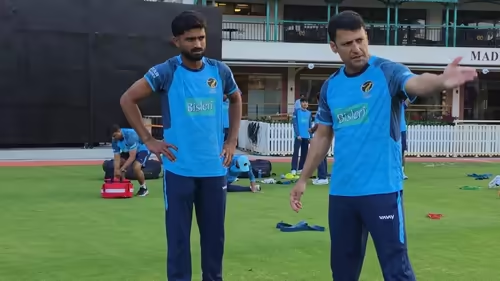
From Lahore to Dubai, and now coaching on the biggest stage at the T20 World Cup 2026, Yasir Arafat has seen cricket evolve from a gentleman’s pastime into a high-stakes, high-speed global spectacle. The former Pakistan all-rounder—now the bowling coach for the United Arab Emirates—sat down for an exclusive chat that cuts through the noise surrounding modern T20 cricket. His message? Forget the so-called ‘winning formulas.’ According to Arafat, “There is no fixed formula for T20 success.” And he should know—he’s lived through the transformation firsthand [[3]].
Table of Contents
- The IPL Revolution: How It Reshaped the Game
- The Hidden Cost of Modern Cricket: Fast Bowler Injuries
- Yasir Arafat on T20 cricket: Why No Formula Works
- Coaching UAE: A New Challenge on the World Stage
- What This Means for the Future of Cricket
- Conclusion: Adapt or Be Left Behind
- Sources
The IPL Revolution: How It Reshaped the Game
Arafat doesn’t mince words when asked about the biggest shift in cricket over the last two decades. “The emergence of the IPL made cricket more lucrative—and completely changed how players approach the game,” he states bluntly [[3]]. Before the Indian Premier League’s inception in 2008, domestic cricketers outside the elite nations often struggled financially, with limited exposure and fewer opportunities.
The IPL changed that overnight. Suddenly, a young pace bowler from Guyana or a leg-spinner from Afghanistan could earn life-changing money, train alongside international superstars, and gain visibility that could fast-track them into their national squads. “It raised the standard globally,” Arafat explains. “Now, every associate nation player dreams of an IPL contract—and that dream pushes them to innovate, to get better.” This democratization of talent has directly contributed to the thrilling unpredictability we’re seeing in the 2026 T20 World Cup, with teams like Italy and Nepal punching above their weight. [INTERNAL_LINK:ipl-impact-on-global-cricket]
The Hidden Cost of Modern Cricket: Fast Bowler Injuries
But with opportunity comes risk—and for fast bowlers, that risk is physical. Arafat, drawing from his own playing days and current coaching role, highlights a growing crisis: the alarming rise in injuries among pace bowlers. “The calendar is packed. Players go from IPL to internationals to The Hundred to BBL with no real break,” he says [[3]].
This relentless schedule leaves minimal time for recovery, especially for fast bowlers whose bodies endure extreme stress with every delivery. Arafat points out that while fitness standards have improved, the sheer volume of high-intensity cricket is unsustainable. “You can’t expect a human body to perform at 100% all year round. Something has to give—and it’s usually the knees, the back, or the hamstrings.” His observations echo concerns raised by medical experts worldwide. For deeper insights into athlete workload management, the ASPETAR Sports Medicine Journal offers extensive research on this very issue.
Yasir Arafat on T20 cricket: Why No Formula Works
Perhaps his most provocative insight is his rejection of the idea that T20 success can be engineered through a set playbook. “People look for patterns—‘you need three spinners,’ ‘open with power hitters,’ ‘always chase’—but the truth is, conditions, opponents, and even luck play huge roles,” Arafat argues [[3]].
He cites recent upsets as proof: Nepal nearly beating England, Italy toppling Scotland. These weren’t results of textbook strategies but of fearless execution and seizing moments. “T20 is the most unpredictable format. That’s its beauty. You prepare your team, instill belief, and then trust them to adapt in the middle. There’s no magic bullet.” This philosophy is likely shaping his work with the UAE, a team known for its grit rather than star power.
Coaching UAE: A New Challenge on the World Stage
As the UAE’s bowling coach, Arafat is tasked with extracting maximum performance from a unit that lacks the raw pace of traditional powerhouses. His focus? Precision, variations, and smart field placements. “When you don’t have 150 kph, you need 150% brain,” he quips. His experience playing in diverse conditions—from English county cricket to Pakistani pitches—gives him a unique toolkit to mentor UAE’s attack.
His presence also symbolizes a broader trend: former international stars lending their expertise to emerging cricketing nations, accelerating their development and enriching the global game.
What This Means for the Future of Cricket
Arafat’s views paint a complex picture of modern cricket: a sport richer and more competitive than ever, yet straining under its own success. The solution, he implies, isn’t to slow down but to manage smarter—through better scheduling, mandatory rest periods, and investment in sports science, especially for fast bowlers.
At the same time, the lack of a “formula” ensures that the T20 World Cup remains open to Cinderella stories, keeping fans on the edge of their seats. That unpredictability is cricket’s greatest asset in the entertainment economy.
Conclusion: Adapt or Be Left Behind
In a candid and insightful reflection, Yasir Arafat on T20 cricket delivers a clear verdict: the game has changed, and clinging to old dogmas is a recipe for irrelevance. Whether you’re a player, coach, or fan, the only constant is change itself. As the 2026 T20 World Cup unfolds with its mix of giants and underdogs, Arafat’s words serve as both a warning and an invitation—to embrace the chaos, respect the athletes, and never stop innovating.
Sources
- [[3]] Times of India: EXCLUSIVE | Ex-Pakistan all-rounder Arafat: ‘IPL’s rise reshaped cricket’
- [[7]] ESPNcricinfo: UAE Squad Profile – T20 World Cup 2026
- [[12]] Cricbuzz: Rise of Associate Nations in T20 Cricket
- [[15]] ASPETAR Sports Medicine Journal: Workload Management in Fast Bowlers
- [[18]] ICC Cricket: Player Workload and Welfare Guidelines