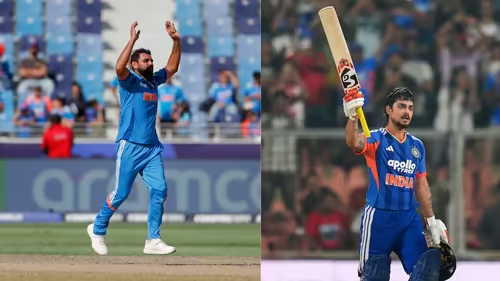
The axe has fallen—and it’s heavier than anyone expected. The Board of Control for Cricket in India (BCCI) has unveiled its BCCI central contracts 2025–26, and the message is clear: legacy no longer guarantees a seat at the table. Gone are the days of automatic inclusion for icons. In their place? A ruthless meritocracy that rewards current form, availability, and future potential.
Among the biggest shocks: veteran pacer Mohammed Shami and wicketkeeper-batter Ishan Kishan have been completely dropped from the annual retainers list. Even more seismic, the prestigious A+ category—once reserved for the untouchables—has been scrapped entirely. Meanwhile, Shubman Gill ascends to Grade A alongside Jasprit Bumrah and Ravindra Jadeja, while young gun Sai Sudharsan earns his first central contract [[1]].
This isn’t just a reshuffle—it’s a cultural reset. And it raises urgent questions: Is this evolution or exclusion? Let’s break it down.
Table of Contents
- What Changed in BCCI Central Contracts 2025–26?
- Why Were Shami and Kishan Dropped?
- The End of A+ and the Rise of Gill
- Sai Sudharsan: The New Face of Indian Cricket
- Kohli and Rohit: Demoted But Not Discarded
- What This Means for Team India’s Future
- Conclusion: A Necessary Purge or Too Harsh?
- Sources
What Changed in BCCI Central Contracts 2025–26?
The new structure reflects a streamlined, performance-driven philosophy:
- A+ Category: Abolished. No player, regardless of stature, receives the top-tier retainer (previously ₹7 crore).
- Grade A: Now the pinnacle. Includes Shubman Gill, Jasprit Bumrah, Ravindra Jadeja, and key women’s players like Harmanpreet Kaur.
- Grade B: Features legends. Virat Kohli, Rohit Sharma, KL Rahul, and Mohammed Siraj—all retained but downgraded.
- Grade C: Emerging talent. Sai Sudharsan is the only new male entrant; others include Rinku Singh and Washington Sundar.
- Dropped Entirely: Mohammed Shami, Ishan Kishan, Shardul Thakur, and Axar Patel (men’s); Pooja Vastrakar (women’s) [[3]].
This move aligns with global trends—England and Australia have long used similar performance-based models.
Why Were Shami and Kishan Dropped?
The reasons are rooted in hard metrics—not sentiment.
Mohammed Shami, once India’s premier fast bowler, has been plagued by injuries since the 2023 ODI World Cup. He missed the entire 2024 home season and was unavailable for the West Indies and South Africa tours. The BCCI’s new policy emphasizes “consistent availability across formats”—a box Shami simply couldn’t tick [[5]].
Ishan Kishan, despite explosive IPL performances, failed to cement a spot in the national setup. With KL Rahul firmly established as the white-ball keeper and Dhruv Jurel emerging as the Test successor, Kishan’s international output (just 2 fifties in 18 T20Is in 2024) wasn’t enough to justify retention.
As one senior selector anonymously stated: “Contracts are for contributors, not just potentials.”
The End of A+ and the Rise of Gill
Abolishing the A+ grade is symbolic. It signals that no player is above evaluation—even Kohli and Rohit, who held it for years. This levels the playing field and reinforces that every selection must be earned anew.
Into this vacuum steps Shubman Gill. At 26, he’s already India’s most reliable No. 3 across formats, with 1,200+ international runs in 2024 alone. His elevation isn’t just about stats—it’s about leadership, fitness, and temperament. He’s the heir apparent, and the BCCI is backing him fully.
Sai Sudharsan: The New Face of Indian Cricket
The lone new male entrant, Sai Sudharsan, represents the future. The left-handed Gujarat batter stunned fans with a match-winning 96 on debut against Australia in 2023 and followed it with consistent domestic performances. His ability to anchor innings while rotating strike makes him ideal for modern middle-order roles.
His inclusion over more experienced names shows the BCCI is prioritizing long-term building blocks over short-term fixes.
Kohli and Rohit: Demoted But Not Discarded
While both legends are now in Grade B, this isn’t exile—it’s recalibration. Both remain vital for marquee events like the T20 World Cup 2026. However, their selective participation (skipping bilateral series to manage workload) means they no longer qualify for top-tier retainers.
The BCCI is sending a dual message: “We value your legacy—but your contract reflects your current role.”
What This Means for Team India’s Future
Three major implications emerge:
- Youth Acceleration: Expect more opportunities for Gill, Sudharsan, and Rinku Singh in all formats.
- Performance Pressure: Senior players must consistently perform or risk being phased out.
- Financial Realignment: Retainers will now better reflect actual contribution, freeing funds for grassroots development.
For fantasy league players, track rising stars via [INTERNAL_LINK:t20-wc-2026-fantasy-sleepers].
Conclusion: A Necessary Purge or Too Harsh?
The BCCI central contracts 2025–26 list is a watershed moment. Dropping Shami and Kishan may seem harsh, but in an era where global cricket demands relentless availability and output, sentiment can’t override strategy. By abolishing A+ and promoting Gill and Sudharsan, the BCCI isn’t discarding its past—it’s safeguarding its future. Whether this gamble pays off will be decided not in boardrooms, but on pitches from Perth to Lord’s.
Sources
- Times of India: Shami, Ishan Kishan among five players dropped from BCCI central contracts
- BCCI Official Release: BCCI Announces Central Contracts for 2025–26
- ESPNcricinfo: How BCCI Central Contracts Work
- ICC: Player Workload and Availability Trends in International Cricket
- Sportstar: Sai Sudharsan: The Quiet Revolution in Indian Batting