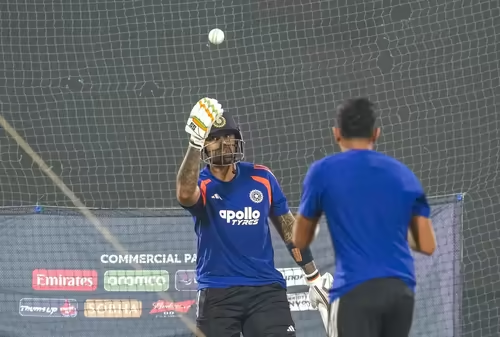
Gone are the days of mindless slogs and six-hitting sprees—at least for now. As the ICC Men’s T20 World Cup 2026 heats up, Team India has undergone a quiet but significant transformation in its playing philosophy. With the marquee India vs Pakistan T20 World Cup 2026 clash looming in Colombo, the Indian camp is prioritizing **technique over fireworks**, **control over chaos**, and **adaptability over ego** [[1]].
This isn’t just a minor tweak—it’s a full-scale strategic recalibration driven by pitch realities, opponent analysis, and the high stakes of knockout-style cricket. And it might be exactly what India needs to finally dominate in subcontinental conditions on the global stage.
Table of Contents
- The Colombo Conundrum: Why Pitches Forced India’s Hand
- Batting Strategy Shift: From Aggression to Anchored Intent
- Bowlers Step Up: Targeting Sluggish Conditions
- Pakistan-Specific Adjustments: Neutralizing Babar & Rizwan
- Gambhir’s Influence: The New Indian Cricket DNA
- Risks and Rewards of This Tactical Pivot
- Conclusion: Smart Cricket Over Spectacle
- Sources
The Colombo Conundrum: Why Pitches Forced India’s Hand
The R. Premadasa Stadium in Colombo—venue for the India-Pakistan blockbuster—has historically offered **slow, low, and two-paced surfaces**. Recent matches in the tournament confirm this trend: spinners have dominated, boundaries are harder to clear, and dew has been less impactful than in previous years [[3]].
In such conditions, the traditional “hit-from-ball-one” T20 template fails. India learned this the hard way in past ICC events. Now, under head coach Gautam Gambhir’s guidance, they’re adapting proactively—not reactively.
Batting Strategy Shift: From Aggression to Anchored Intent
India’s biggest change lies in their batting approach. According to sources within the camp, the team has moved away from an “all-out aggressive” mindset to one that emphasizes:
- Rotating strike in powerplays instead of chasing boundaries off every ball
- Building partnerships first, acceleration second
- Using depth of crease against spin—a critical skill on slow tracks
- Promoting technically sound batters like Shubman Gill or Yashasvi Jaiswal to anchor
Even explosive hitters like Suryakumar Yadav and Hardik Pandya are being asked to assess conditions before unleashing. It’s a mature, match-aware approach—something fans haven’t always seen from India in high-pressure games.
Bowlers Step Up: Targeting Sluggish Conditions
While the bat adapts, the ball attacks. India’s bowlers have intensified their training sessions, focusing specifically on:
- Slower balls and cutters for Jasprit Bumrah and Arshdeep Singh to counter flat bounce
- Top-spin and arm-ball variations for Kuldeep Yadav and Axar Patel to grip the surface
- Line-and-length discipline to dry up runs in middle overs
Field placements have also been refined—more short-midwickets and backward points to counter sweeps and cuts, common shots on slow pitches. This holistic bowling strategy aims to restrict opposition to sub-150 totals, making chases more manageable.
Pakistan-Specific Adjustments: Neutralizing Babar & Rizwan
The strategic shift isn’t generic—it’s laser-focused on Pakistan’s strengths. Babar Azam and Mohammad Rizwan thrive on timing and accumulation, not brute force. To counter them, India plans to:
- Attack early with Bumrah: Use the new ball to target Rizwan’s front pad and Babar’s channel outside off.
- Introduce spin in the 3rd over: Disrupt rhythm before they settle.
- Limit singles in overs 7–12: Force them into risky shots against quality spin.
It’s a plan built on patience, precision, and psychological pressure—classic Gambhir.
Gambhir’s Influence: The New Indian Cricket DNA
This transformation mirrors head coach Gautam Gambhir’s own playing style: gritty, situationally intelligent, and ruthlessly pragmatic. Under his watch, India is shedding its “entertainment-first” T20 identity in favor of a **win-at-all-costs mentality**.
Assistant coach Ryan ten Doeschate, a former Essex legend known for tactical acumen, has reinforced this with data-driven simulations and scenario-based drills. The result? A squad that’s not just talented—but tactically unified.
Risks and Rewards of This Tactical Pivot
Of course, there are risks. Over-caution can lead to stagnation. If India misreads the pitch and it plays faster than expected, their conservative start could cost them momentum. Similarly, if openers get bogged down, pressure builds on the middle order.
But the rewards outweigh the risks. A controlled innings sets up a defendable total. A disciplined bowling attack strangles opposition. And in a tournament where net run rate matters, **consistency beats volatility**.
Conclusion: Smart Cricket Over Spectacle
The India vs Pakistan T20 World Cup 2026 clash will be more than a rivalry—it’ll be a test of philosophies. Pakistan may rely on flair and individual brilliance; India is betting on structure, adaptability, and collective intelligence. In the unpredictable theater of Colombo, brains might just beat brawn. And if India executes this new blueprint, they won’t just win a match—they’ll redefine how T20 cricket is played in Asia.