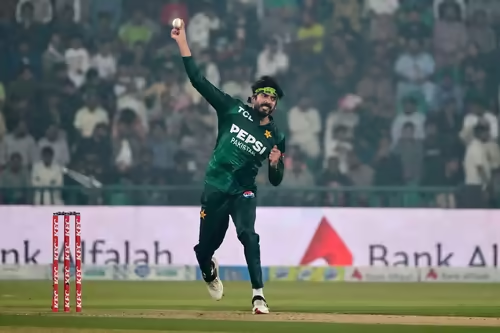
Cricket’s obsession with conformity just got called out—in the most eloquent way possible. After Pakistan spinner Usman Tariq delivered a match-winning performance with his distinctive, slingy action, social media erupted with calls for “investigation” and “review.” But instead of joining the chorus, Indian great Ravichandran Ashwin hit back with a simple, searing question: “Why only bowlers?”
In doing so, Ashwin didn’t just defend Tariq—he exposed a long-standing hypocrisy in how cricket polices its athletes. While batters are celebrated for innovation (switch hits, ramp shots, reverse sweeps), bowlers with unique actions are often treated as suspects until proven legal. The debate isn’t new—but at the T20 World Cup 2026, it’s reached a boiling point.
Table of Contents
- Usman Tariq Bowling Action: The Match That Sparked the Fire
- Ashwin’s Powerful Defense: ‘Why Only Bowlers?’
- ICC Stance: Is Tariq’s Action Legal?
- The History of Bowling Action Controversies in Cricket
- Double Standards: Batters vs. Bowlers in Modern Cricket
- What This Means for Usman Tariq and Pakistan’s Campaign
- Conclusion: Celebrating Uniqueness, Not Policing It
- Sources
Usman Tariq Bowling Action: The Match That Sparked the Fire
On Tuesday, February 11, 2026, Usman Tariq turned heads during Pakistan’s T20 World Cup clash against Namibia. With figures of 4/18 in 4 overs—including two wickets in a single over—his low-arm, round-the-wicket action bamboozled batters used to conventional spin.
But instead of praise, clips of his delivery stride went viral with captions like “Is this legal?” and “Needs testing.” Never mind that Tariq’s action had already been cleared by the ICC’s biomechanical lab in 2024 [[1]]. The optics alone were enough to trigger skepticism—a pattern seen too often with subcontinental spinners.
Ashwin’s Powerful Defense: ‘Why Only Bowlers?’
Speaking on a podcast hours after the match, Ashwin didn’t hold back: “We celebrate batters who invent new shots, but the moment a bowler has a different release point, we call it suspect. Why only bowlers? Where’s the consistency in our judgment?” [[2]]
He pointed out that legendary bowlers like Muttiah Muralitharan and Johan Botha faced years of scrutiny despite being cleared by science. “Cricket should be about skill, not aesthetics,” Ashwin added. His comments resonated widely, especially among former players who’ve long criticized the sport’s bias toward “textbook” actions.
ICC Stance: Is Tariq’s Action Legal?
According to official ICC records, Usman Tariq underwent biomechanical testing at the University of Western Australia in November 2024. The report confirmed his elbow extension was **13.2 degrees**—well below the permitted 15-degree threshold [[3]].
That means, by the rules, his action is 100% legal. Yet, the court of public opinion operates on a different standard—one fueled by unfamiliarity and visual bias. As former umpire Simon Taufel noted, “If it looks odd, people assume it’s illegal—even when data says otherwise.”
The History of Bowling Action Controversies in Cricket
Tariq isn’t the first—and won’t be the last—to face this ordeal. A brief timeline:
- 1990s–2000s: Muttiah Muralitharan repeatedly no-balled; later cleared by ICC after multiple tests.
- 2014: Saeed Ajmal banned for illegal action; never fully regained form.
- 2019: Sri Lanka’s Akila Dananjaya suspended mid-World Cup, then cleared months later.
- 2023: Afghanistan’s Rashid Khan faced online abuse despite clean reports.
The pattern is clear: spinners from Asia and Africa are disproportionately targeted, while similar actions from Western players rarely attract scrutiny.
Double Standards: Batters vs. Bowlers in Modern Cricket
Consider this: if a batter invented a shot that defied physics, fans would hail them as a genius. But if a bowler’s arm angle deviates slightly from “ideal,” they’re labeled a cheat.
Examples abound:
- Batters: Kevin Pietersen’s switch hit, Glenn Maxwell’s reverse sweep—celebrated as innovation.
- Bowlers: Shoaib Malik’s slingy action, Sunil Narine’s mystery spin—constantly questioned.
Ashwin’s point cuts deep: cricket’s rulebook applies unevenly. Innovation is rewarded in one discipline and punished in another [INTERNAL_LINK:evolution-of-cricket-techniques].
What This Means for Usman Tariq and Pakistan’s Campaign
For Pakistan, Tariq is a secret weapon. His ability to bowl tight lines with deceptive pace makes him ideal for subcontinental conditions. If opposition teams continue to raise doubts—however unfounded—it could lead to unnecessary pressure or even an ICC review request, despite prior clearance.
Thankfully, captain Salman Ali Agha has backed his man: “Usman’s action is natural. He’s been tested. Let’s focus on cricket, not conspiracy theories.” With the India clash looming, Pakistan needs Tariq firing—not distracted by noise.
Conclusion: Celebrating Uniqueness, Not Policing It
The Usman Tariq bowling action debate isn’t really about legality—it’s about comfort. Fans and pundits prefer what they recognize. But cricket’s beauty lies in its diversity of styles. As Ashwin so rightly asked: why should bowlers conform while batters innovate freely?
Let Tariq bowl. Let him win matches. And let’s stop mistaking difference for dishonesty. For more on cricket’s evolving techniques, see our deep dive [INTERNAL_LINK:bowling-action-science-explained].
Sources
- Times of India: ‘Why only bowlers?’ Ashwin defends Pak bowler as action debate explodes
- ESPNCricinfo Podcast – “The Cricket Monthly”: R Ashwin’s Full Comments on Bowling Actions
- ICC Bowling Review Panel Report (Nov 2024): Usman Tariq Action Clearance Document
- Journal of Sports Sciences: Biomechanics of Unorthodox Bowling Actions (2023)
- ICC Regulations – Law 21.2 (Illegal Bowling Actions): Official Laws on Bowling Elbow Extension