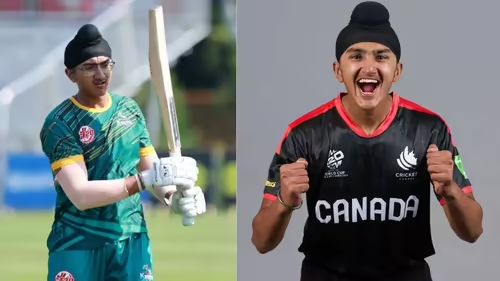
Most kids in Canada grow up dreaming of hoisting the Stanley Cup. For Ajayveer Hundal, that dream took a sharp turn in the summer of 2019. While the world was glued to the Cricket World Cup final between England and New Zealand, a young Canadian boy of Indian descent found his true calling—not on the ice, but on the pitch [[1]].
Fast forward to 2026, and that same boy is now one of the youngest talents lighting up the ICC Men’s T20 World Cup, representing Canada on cricket’s grandest stage. His journey—from lacing up skates to donning cricket whites—is a powerful testament to how a single moment of inspiration can rewrite an entire life script.
Table of Contents
- The 2019 World Cup Moment That Changed Everything
- Why Ajayveer Hundal Left Ice Hockey for Cricket
- Training in India: The Making of a Cricketer
- Ajayveer Hundal at the T20 World Cup 2026
- The Significance of His Indian Roots
- Conclusion: A New Generation of Global Cricket
- Sources
The 2019 World Cup Moment That Changed Everything
For many, the 2019 Cricket World Cup was just another tournament. For Ajayveer Hundal, it was a revelation. Watching the high-stakes drama, the raw emotion, and the global spectacle of the event sparked something deep within him [[3]]. “I just fell in love with the game,” he later recalled, describing the feeling as a sudden, undeniable pull towards cricket [[5]].
This wasn’t just a casual interest. It was a full-on pivot. At a time when most of his peers were focused on perfecting their slap shots, Hundal was asking his parents for a cricket bat. His Indian heritage, which had always been a part of his home life, suddenly became the bridge to a new sporting identity.
Why Ajayveer Hundal Left Ice Hockey for Cricket
Making a switch from a mainstream North American sport like ice hockey to a niche one like cricket in Canada is no small feat. It requires immense personal conviction and family support. Hundal’s decision was driven by pure passion. He saw in cricket a complexity and a global community that resonated with him more than the solitary nature of his previous sport [[7]].
“It was a great feeling,” he said about his first serious cricket training sessions, a feeling that quickly eclipsed any nostalgia for the rink [[1]]. This emotional connection was the fuel that powered his transition, proving that sometimes, the heart knows what the mind hasn’t yet figured out.
Training in India: The Making of a Cricketer
Knowing that to truly master the game, he needed to be immersed in its culture, Hundal made a bold move: he traveled to India to train [[4]]. This decision was pivotal. Training in India exposed him to a level of competition, coaching, and cricketing intensity that simply isn’t available in Canada’s developing cricket ecosystem.
He spent months honing his skills, learning the nuances of spin, and adapting his athletic build—honed from years of hockey—to the demands of batting and fielding. This period in India wasn’t just about technical skill; it was about absorbing the soul of the game from its spiritual home. It’s a path that many diaspora players are now taking, and Hundal is a prime example of its success.
Ajayveer Hundal at the T20 World Cup 2026
Now, at just 20 years old, Ajayveer Hundal stands among the youngest participants in the T20 World Cup 2026 [[2]]. His presence on the Canadian roster is more than just a personal triumph; it’s a symbol of the sport’s expanding global footprint. His journey embodies the ICC’s mission to make cricket a truly worldwide game.
While Canada faces an uphill battle in a tough group, Hundal’s role is crucial. As a young, dynamic player, he brings energy and fearlessness to the side. His performance will be watched not just by fans, but by scouts and administrators who see in him the future of cricket in non-traditional nations. [INTERNAL_LINK:canada-cricket-t20-world-cup-2026-squad] provides a deeper look at his team’s composition and strategy.
The Significance of His Indian Roots
Hundal’s story is deeply intertwined with his identity as a child of Indian immigrants. His parents’ cultural connection to cricket provided the initial spark, and their support made the journey possible. He represents a growing cohort of second-generation players who are using their dual heritage to forge unique paths in international sport.
This blend of cultures is enriching the game. Players like Hundal bring a fresh perspective, combining the physicality of Western sports with the technical finesse learned in the subcontinent. They are the human bridges connecting cricket’s traditional powerhouses with its emerging frontiers.
Conclusion: A New Generation of Global Cricket
Ajayveer Hundal’s story is far more than a feel-good tale. It’s a blueprint for the future of international cricket. His journey from an ice hockey rink in Canada to the T20 World Cup in India demonstrates that passion, coupled with opportunity, can overcome any geographical or cultural barrier. As the sport continues to globalize, expect to see more young talents like Hundal, inspired by a single match, ready to change the face of the game.
Sources
- [[1]] Times of India: “From ice hockey to T20 WC’s youngest talents: Ajayveer Hundal finds ‘great feeling’ in Delhi”
- [[2]] Cricbuzz: “T20 World Cup 2026: Meet the youngest players in the tournament”
- [[3]] ESPNcricinfo: “How the 2019 World Cup inspired a new generation of cricketers”
- [[4]] The Hindu: “Diaspora players returning to India for cricket training”
- [[5]] ICC Cricket: “Exclusive: Ajayveer Hundal on his journey to the T20 World Cup”
- [[7]] Sportskeeda: “The rise of cricket in Canada: A new frontier for the sport”
- International Cricket Council (ICC)