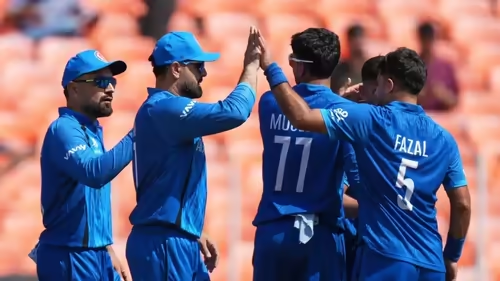
Cricket was supposed to be the bridge. Instead, it became the battleground. In a dramatic turn of events that underscores how deeply politics can infiltrate sport, Afghanistan’s national cricketers have officially pulled out of the Pakistan Super League (PSL) 2026 Players’ Auction [[1]]. The decision—confirmed just days before the marquee event—comes on the heels of intense domestic backlash in Afghanistan over star batter Rahmanullah Gurbaz’s direct signing by Peshawar Zalmi, and is widely seen as a consequence of the rapidly deteriorating diplomatic relationship between the two neighboring nations. This isn’t just about missed sixes or lost contracts; it’s a stark reminder that even in the globalized world of T20 leagues, Afghanistan players PSL withdrawal can be dictated by forces far beyond the boundary rope.
Table of Contents
- The Gurbaz Signing That Sparked the Fire
- Afghanistan Players PSL Withdrawal: The Official Decision
- Geopolitical Tensions: The Real Backdrop
- Impact on Afghan Players and the PSL
- Historical Context: Cricket as a Diplomatic Tool?
- What Happens Next?
- Conclusion: When Sport Meets Sovereignty
- Sources
The Gurbaz Signing That Sparked the Fire
The controversy began when Peshawar Zalmi announced the direct signing of Rahmanullah Gurbaz—a move technically allowed under PSL’s “icon player” or “wildcard” rules [[2]]. While such signings aren’t uncommon (think David Warner or Shahid Afridi in past seasons), this one ignited fury back home. Afghan media and social platforms erupted with accusations that Gurbaz had bypassed national protocols and shown “disloyalty” during a time of heightened sensitivity between Afghanistan and Pakistan [[3]].
Within 48 hours, pressure mounted on other Afghan stars—including Rashid Khan, Mohammad Nabi, and Ibrahim Zadran—to clarify their stance. Faced with public outrage and potential repercussions from Afghanistan’s cricket board (ACB), they collectively decided to withdraw from the auction entirely [[4]].
Afghanistan Players PSL Withdrawal: The Official Decision
According to sources close to the Afghanistan Cricket Board (ACB), the withdrawal wasn’t just a player-led protest—it was a coordinated response to “prevailing political circumstances” [[5]]. A senior ACB official, speaking anonymously, stated: “Participation in foreign leagues must align with national interest. Right now, it does not.”
This means no Afghan players will feature in PSL 2026 unless special permissions are granted later—a scenario deemed unlikely given current tensions. For franchises like Quetta Gladiators and Multan Sultans, who had earmarked Rashid Khan and Nabi as key targets, this is a major blow to their strategic planning [[6]].
Geopolitical Tensions: The Real Backdrop
To understand this withdrawal, one must look beyond cricket. Relations between Pakistan and Afghanistan have been strained since the Taliban’s return to power in 2021. Issues like border disputes (particularly along the Durand Line), cross-border militant activity, and trade restrictions have created a climate of deep mistrust [[7]].
In late 2025 and early 2026, tensions flared anew after a series of deadly incidents near the Torkham border crossing, leading both governments to impose travel and economic sanctions [[8]]. In such an environment, any perceived “collaboration” with Pakistan—even in sports—is viewed with suspicion by many Afghans. As one Kabul-based analyst noted, “Cricket is no longer neutral ground. It’s soft power—and right now, Kabul doesn’t want to lend Pakistan any.”
Impact on Afghan Players and the PSL
The fallout is significant for both sides:
- For Afghan Players: They lose lucrative contracts (Rashid Khan reportedly earned $350,000 in PSL 2025) and valuable exposure against top international talent—a key development tool for Associate nations [[9]].
- For the PSL: The league loses star power and global credibility. Afghan players have been fan favorites, and their absence weakens the tournament’s claim as a truly international franchise league [[10]].
- For Fans: Millions across South Asia are denied the thrill of seeing Rashid’s googlies or Gurbaz’s cover drives in one of the region’s most vibrant cricketing spectacles.
Historical Context: Cricket as a Diplomatic Tool?
Ironically, cricket has often served as a diplomatic icebreaker between estranged nations—most notably India and Pakistan. The PSL itself was launched in part to showcase Pakistan’s stability and openness post-2009 Lahore attacks [[11]]. Afghan players’ participation since 2017 was hailed as a symbol of regional unity.
Now, that narrative is shattered. This withdrawal mirrors past instances where politics overruled sport—such as India-Pakistan bilateral series halts or Zimbabwe’s isolation in the 2000s. It’s a sobering reminder that while leagues like the PSL aim to transcend borders, they remain vulnerable to real-world fractures.
What Happens Next?
All eyes are now on the ICC and whether this rift affects upcoming tournaments. Afghanistan and Pakistan are scheduled to face each other in the T20 World Cup 2026 group stage—a match that could become highly charged [[12]]. Meanwhile, Afghan players may pivot to other leagues like the ILT20 (UAE) or SA20, which offer similar pay without political baggage.
For the PSL, the challenge is reputational. Can it reposition itself as apolitical? Or will this mark the beginning of a more fragmented T20 league ecosystem, where geopolitics dictates player movement? [INTERNAL_LINK:psl-2026-complete-squad-list] will track all confirmed team rosters post-auction.
Conclusion: When Sport Meets Sovereignty
The Afghanistan players PSL withdrawal is more than a scheduling hiccup—it’s a geopolitical earthquake disguised as a sports story. It reveals the fragile line between entertainment and national identity, and how quickly that line can blur. While fans mourn the loss of thrilling matchups, the deeper lesson is clear: in today’s world, even the most globalized sports cannot escape the gravity of sovereignty, pride, and politics. Cricket may be a game of boundaries—but some boundaries, it seems, are impossible to cross.
Sources
- Times of India: Afghanistan players withdraw from PSL auction
- PSL Official: Peshawar Zalmi Sign Rahmanullah Gurbaz
- BBC Urdu: Afghan Public Outrage Over Gurbaz PSL Deal
- ESPNCricinfo: Afghan Cricketers Withdraw Amid Tensions
- Afghanistan Cricket Board (ACB): Official Statement
- Dawn: PSL Franchises Reeling After Afghan Exit
- Council on Foreign Relations: Pakistan-Afghanistan Relations
- Al Jazeera: Border Clashes Escalate Between Pakistan and Afghanistan
- Forbes: How Much Do PSL Players Make?
- ICC: PSL’s Role in the Global T20 Ecosystem
- The Guardian: The Launch of the PSL and Its Diplomatic Goals
- ICC: T20 World Cup 2026 Schedule