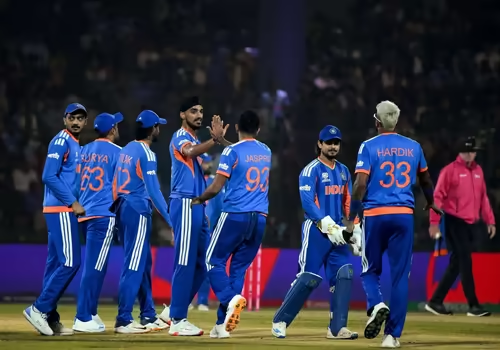
The most anticipated fixture in cricket is just around the corner, and the pressure is already mounting on Team India. With the India vs Pakistan T20 World Cup clash looming large, legendary opener and former captain Sunil Gavaskar has thrown a tactical grenade into the mix. In a bold and controversial suggestion, Gavaskar has hinted that left-arm pacer Arshdeep Singh should be benched in favor of the crafty wristspinner Kuldeep Yadav [[1]]. This isn’t just a casual observation; it’s a strategic masterstroke based on hard evidence from the pitches in Sri Lanka and recent team performances.
Table of Contents
- Gavaskar’s Bold Proposal: Why Kuldeep Over Arshdeep?
- The Sri Lanka Pitch Factor
- Arshdeep’s Recent Struggles
- Kuldeep’s Unique Advantage Against Pakistan
- Gavaskar on Sanju Samson’s Batting Flaw
- What This Means for India’s Game Plan
Gavaskar’s Bold Proposal: Why Kuldeep Over Arshdeep?
Speaking on a recent sports panel, Sunil Gavaskar didn’t mince words. He pointed directly to the incomplete overs bowled by Arshdeep Singh in India’s previous match as a red flag [[1]]. In T20 cricket, where every ball is a potential game-changer, a bowler who can’t consistently deliver his full quota is a liability, especially in a high-pressure game like the India vs Pakistan T20 World Cup encounter.
Gavaskar’s logic is simple and rooted in the current conditions. He argues that the pitches in Sri Lanka, where the match is being played, are offering significant turn and grip for spinners, making them far more potent than pace bowlers who rely on bounce and seam movement. In this context, Kuldeep Yadav’s ability to extract sharp turn and deceive batters in the air becomes a far more valuable asset.
The Sri Lanka Pitch Factor
The venues in Colombo and Kandy have historically been spin-friendly. The surface tends to be slow, with the ball gripping and turning from the word go. This neutralizes the advantage of express pace and instead rewards accuracy, variation, and guile—qualities that Kuldeep Yadav possesses in abundance.
For Pakistan, whose top order includes right-handers like Babar Azam and Mohammad Rizwan, a leg-spinner of Kuldeep’s caliber can be a nightmare. His googly, in particular, has troubled some of the best batters in the world. On a track that aids his natural action, he could be the X-factor India needs to break crucial partnerships early.
Arshdeep’s Recent Struggles
While Arshdeep Singh has been a mainstay in India’s white-ball setup for his ability to swing the new ball, his recent outings have raised questions. Beyond the issue of not completing his overs, his economy rate in the middle overs has been a concern. In subcontinental conditions, where boundaries are shorter on the leg side, his angle can sometimes be predictable for powerful hitters.
This isn’t to say Arshdeep isn’t a quality bowler—he absolutely is. But Gavaskar’s point is about picking the right tool for the specific job at hand. For a one-off, do-or-die match against Pakistan on a turning track, the balance of the side might be better served with an extra spinner.
Kuldeep’s Unique Advantage Against Pakistan
Kuldeep Yadav has a proven record against Pakistan. His variations can disrupt the timing of even the most technically sound batters. Here’s why he could be the perfect weapon:
- Disrupts Right-Handers: His stock delivery turns away from Pakistan’s key right-handed batsmen, creating doubt.
- Googly Threat: The wrong’un, which skids on straight, is a wicket-taking ball that can clean up the stumps.
- Economy in Middle Overs: He can tie down the scoring rate during the crucial 7th to 15th overs, building pressure.
Gavaskar on Sanju Samson’s Batting Flaw
Gavaskar’s analysis wasn’t limited to the bowling department. He also took a close look at wicketkeeper-batter Sanju Samson, identifying a technical issue in his stance. Gavaskar noted that Samson’s backlift is too straight, which can make him vulnerable to deliveries that nip back in or are on a fuller length [[1]]. This is a critical observation, especially against a Pakistani pace attack known for its reverse swing later in the innings. Addressing this minor flaw could be the difference between a quick 20 and a match-winning 70.
What This Means for India’s Game Plan
If India’s think-tank, led by head coach Gautam Gambhir, takes Gavaskar’s advice seriously, we could see a dramatic shift in their playing XI. A combination of Kuldeep Yadav, Axar Patel, and Washington Sundar would give them a formidable three-pronged spin attack, perfectly suited to the conditions. This would allow Jasprit Bumrah and Hardik Pandya to focus on containing the powerplay and death overs with maximum impact.
Such a move would be a huge statement of intent, showing that India is willing to adapt its strategy based on conditions rather than sticking to a rigid formula. It’s a high-risk, high-reward call that could either be hailed as genius or criticized as overthinking. But in a rivalry as intense as India vs Pakistan T20 World Cup, sometimes you need to be bold to be brilliant.
Conclusion
Sunil Gavaskar’s suggestion to replace Arshdeep Singh with Kuldeep Yadav for the marquee India vs Pakistan T20 World Cup match is more than just a personnel change—it’s a fundamental shift in tactical philosophy. By prioritizing pitch conditions and specific matchup advantages, Gavaskar is urging the team to play smart, not just safe. As the cricketing world holds its breath for this epic showdown, one thing is clear: the battle will be won not just on the field, but in the strategic minds of those who dare to think differently.
Sources
- Times of India: Bowling shake-up vs Pak? Gavaskar hints at big India change for WC showdown [[1]]
- ICC Pitch Report: ICC Official Pitch & Weather Report for Colombo
- ESPNcricinfo Stats: T20 World Cup 2026 Player Statistics
- [INTERNAL_LINK:india-t20-world-cup-2026-squad] India’s Full Squad for T20 World Cup 2026
- [INTERNAL_LINK:india-pakistan-rivalry-history] The History of the India-Pakistan Cricket Rivalry