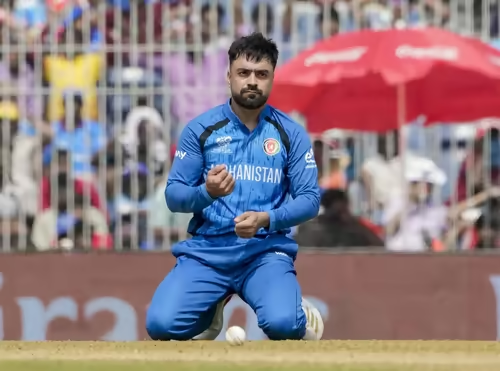
The tears may have dried, but the sting remains.
For Afghanistan, the Afghanistan T20 World Cup 2026 campaign has been a rollercoaster of near-misses and heartbreaking finishes—most notably their gut-wrenching double Super Over loss to South Africa. Now, captain Rashid Khan is speaking out, not with excuses, but with a clear-eyed diagnosis: “We need more exposure.” [[1]]
In a heartfelt interview following their latest setback, Khan didn’t dwell on bad luck or umpiring decisions. Instead, he pointed to a systemic issue that has long plagued Associate and emerging nations: the lack of consistent, high-pressure cricket against the world’s best. And his message is urgent—if Afghanistan is to truly compete on the global stage, they must be given the chance to play more often.
Table of Contents
- The Heartbreak: Double Super Over Loss to South Africa
- Rashid’s Honest Reflection: Pain as Fuel
- The Exposure Gap: Why Afghanistan Struggles in High-Stakes Moments
- What Needs to Change: A Call for Structural Reform
- Super 8 Hopes Still Alive? Afghanistan’s Path Forward
- Conclusion: Talent Isn’t Enough—Opportunity Is Key
- Sources
The Heartbreak: Double Super Over Loss to South Africa
It was a match for the ages—and for Afghanistan, a nightmare replayed twice. After a tense 20-over battle ended in a tie, the first Super Over also concluded level. In the second Super Over, South Africa held their nerve, while Afghanistan faltered under immense pressure [[2]].
Coming just days after a narrow loss to New Zealand, the double Super Over defeat left the team emotionally and physically drained. For a squad built on resilience and street-smart cricket, these back-to-back losses in winnable games were especially cruel.
Rashid’s Honest Reflection: Pain as Fuel
Yet, in true Rashid Khan fashion, despair gave way to determination. “Yes, it hurts,” he admitted. “But this pain will make us stronger. We’ve shown we can compete—but we need more chances to prove it consistently.” [[1]]
His tone wasn’t bitter; it was pragmatic. He praised his team’s fighting spirit but acknowledged a hard truth: talent alone isn’t enough when you’re starved of high-level competition. “When you play India, Australia, or England only once every two years, it’s hard to adapt quickly in World Cups,” he explained.
The Exposure Gap: Why Afghanistan Struggles in High-Stakes Moments
This is the crux of Afghanistan’s challenge. While Full Member nations play bilateral series, tri-series, and multi-team tournaments year-round, Afghanistan’s calendar is sparse. Their domestic structure is improving, but it can’t replicate the pressure of international T20s against elite pace attacks or world-class spinners.
Consider this: in the past 12 months, Afghanistan has played just **5 T20Is against top-5 ranked teams**. Compare that to India or England, who’ve played 15+ each. This disparity shows in clutch moments—like failing to execute in a second Super Over, where experience trumps raw skill.
What Needs to Change: A Call for Structural Reform
Rashid’s plea isn’t just about friendlies—it’s about equity in the global game. He’s calling on the ICC and major boards to:
- Schedule more bilateral T20I series between Full Members and emerging teams like Afghanistan, Ireland, and Netherlands.
- Expand multi-nation tournaments (like the Nidahas Trophy) to include Associate nations regularly.
- Guarantee minimum fixture quotas in FTP (Future Tours Programme) for non-Test-playing nations.
[INTERNAL_LINK:icc-reforms-for-associate-nations] As Rashid put it: “We don’t need sympathy. We need opportunity.” Without it, teams like Afghanistan will keep coming close—but never quite breaking through.
Super 8 Hopes Still Alive? Afghanistan’s Path Forward
Despite the setbacks, Afghanistan isn’t out of the tournament yet. With one group game remaining, they still have a mathematical chance to qualify for the Super 8—if they win convincingly and other results go their way [[3]].
But beyond this World Cup, Khan’s message is about the future. “This generation has put Afghanistan on the map,” he said. “Now, let the next one build a legacy.” That legacy, he insists, depends on access—not just effort.
Conclusion: Talent Isn’t Enough—Opportunity Is Key
Rashid Khan’s words after the Afghanistan T20 World Cup 2026 heartbreak are more than a captain’s lament—they’re a wake-up call for global cricket. Afghanistan has the passion, the talent, and the grit. What they lack is the platform. If the sport truly wants to grow beyond its traditional borders, then giving teams like Afghanistan regular exposure isn’t charity—it’s necessity. And as Rashid’s career has shown, when given a chance, they don’t just participate—they inspire.
Sources
- Times of India: T20 World Cup: Rashid Khan wants more exposure for Afghanistan [[1]]
- ESPN Cricinfo: Afghanistan vs South Africa: Double Super Over Drama in Colombo [[2]]
- ICC Official Website: ICC Men’s T20 World Cup 2026 Standings & Fixtures [[3]]