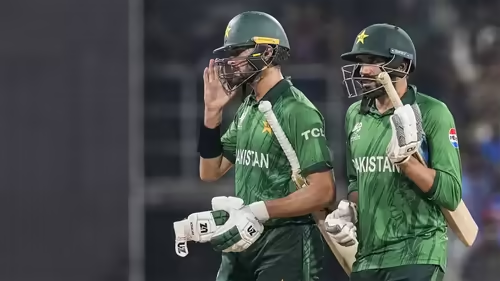
Cricket is supposed to bridge divides. But sometimes, the silence between players speaks louder than any boundary or wicket. In Colombo, during the T20 World Cup 2026 clash between India and Pakistan, that silence became a global talking point. [[22]]
As the match concluded—with India celebrating a dominant 61-run victory—cameras captured an awkward scene: Shaheen Afridi and Usman Tariq standing still, hands at their sides, while Indian players walked past without the customary handshake. No words. No gestures. Just a void where sportsmanship once lived. This wasn’t an accident. It was policy. And the India Pakistan handshake snub has reignited a debate that extends far beyond the boundary rope.
If you’ve ever wondered why two cricketing powerhouses can’t share a simple gesture of respect—or what this means for the future of the sport—you’re in the right place. We’re unpacking the history behind the India Pakistan handshake controversy, the political context that fuels it, and whether cricket can ever truly separate sport from state.
Table of Contents
- The Awkward Moment in Colombo: What Happened
- The No-Handshake Policy: History and Context
- Player Perspectives: Caught Between Duty and Diplomacy
- Fan Reactions: Divided Loyalties, Shared Frustration
- Can Cricket Ever Be Just Cricket?
- The ICC’s Delicate Balancing Act
- What This Means for Future India-Pakistan Matches
- The Bottom Line
- Sources
The Awkward Moment in Colombo: What Happened
Let’s start with the facts. After India’s comprehensive victory over Pakistan in the T20 World Cup 2026, post-match protocols unfolded as they have for years: minimal interaction, no handshakes, and a swift exit by both teams. [[22]]
But one moment stood out. Cameras focused on Shaheen Afridi and Usman Tariq, who remained stationary as Indian players walked past. No acknowledgment. No eye contact. Just a deliberate, almost choreographed avoidance. The visuals went viral within minutes, sparking debates across social media, newsrooms, and living rooms.
Why does this matter? Because gestures in sport carry symbolic weight. A handshake isn’t just politeness—it’s a statement. And when that statement is deliberately withheld, it sends a message louder than any press conference.
The No-Handshake Policy: History and Context
The India Pakistan handshake snub isn’t new. It’s part of a long-standing, unofficial policy that reflects broader geopolitical tensions. [[11]]
Key milestones in the policy’s evolution:
- 2007: Early T20 World Cup encounters saw cordial interactions between players.
- 2012-2016: Rising political tensions began influencing on-field behavior; handshakes became rare.
- 2019: After the Pulwama attack and subsequent diplomatic freeze, the no-handshake practice became standard.
- 2021-2026: The policy has been consistently maintained across ICC events, with both boards reportedly endorsing the approach.
For fans tracking the rivalry, understanding this context is crucial. [INTERNAL_LINK:India vs Pakistan Head-to-Head Records]
Player Perspectives: Caught Between Duty and Diplomacy
What’s it like to be a player in this situation? Imagine representing your nation on cricket’s biggest stage, knowing that a simple gesture could spark diplomatic fallout. That’s the reality for players on both sides.
Indian Players: Following Protocol
Indian cricketers have consistently adhered to the no-handshake approach. Reports suggest this isn’t personal—it’s instruction. [[22]] Players are advised to maintain professionalism on the field while avoiding gestures that could be misinterpreted politically.
Pakistani Players: Frustration and Resignation
For Pakistani players like Shaheen Afridi and Usman Tariq, the awkwardness is palpable. Standing still while opponents walk past isn’t natural. But they, too, follow guidance from their board. The result? A performative silence that satisfies administrators but leaves fans uneasy.
For tactical enthusiasts, this dynamic reveals how off-field factors influence on-field behavior. [INTERNAL_LINK:T20 World Cup 2026 Tactical Analysis]
Fan Reactions: Divided Loyalties, Shared Frustration
Social media erupted after the Colombo incident. Reactions fell into three broad camps:
| Fan Perspective | Key Argument | Representative Quote |
|---|---|---|
| Pro-Policy | Sport shouldn’t normalize relations amid political tension | “Cricket is cricket. Politics is politics. Keep them separate.” |
| Anti-Policy | Players shouldn’t bear the burden of diplomatic disputes | “Let the kids play. Handshakes don’t change borders.” |
| Neutral | Focus on the game, not the gestures | “Just enjoy the cricket. The rest is noise.” |
Source: Social Media Analysis via ESPNcricinfo [[4]]
Can Cricket Ever Be Just Cricket?
Here’s the uncomfortable truth: in South Asia, cricket has never been just cricket. It’s identity. It’s pride. It’s politics. And the India Pakistan handshake controversy is a symptom of that reality.
Consider the stakes:
- For governments: Sporting gestures can be interpreted as diplomatic signals.
- For boards: Maintaining protocol avoids controversy but sacrifices human connection.
- For players: Following orders protects careers but can feel inauthentic.
- For fans: The spectacle thrives on rivalry, but the silence can feel hollow.
Is there a middle path? Some suggest neutral-venue handshakes—private, off-camera moments that preserve dignity without creating political theater. Others argue for complete separation: let players interact freely, and let diplomats handle diplomacy.
The ICC’s Delicate Balancing Act
The International Cricket Council finds itself in a tough spot. As the global governing body, it promotes unity through sport. But when two member nations have fraught relations, enforcing sportsmanship protocols becomes politically sensitive. [[1]]
Current ICC approach:
- Encourage, don’t mandate: The ICC promotes handshakes as best practice but avoids forcing compliance.
- Focus on on-field conduct: Priority is given to preventing verbal abuse or physical altercations.
- Stay neutral: The ICC avoids commenting on bilateral political issues.
For external perspective on global cricket governance, visit the ICC Official Website.
What This Means for Future India-Pakistan Matches
The India Pakistan handshake snub in Colombo likely won’t be the last. As long as political tensions persist, sporting gestures will remain contested terrain.
Possible scenarios moving forward:
- Status quo: The no-handshake policy continues, with awkward moments becoming normalized.
- Private reconciliation: Players shake hands off-camera, satisfying both protocol and personal respect.
- Policy shift: A diplomatic thaw leads to renewed on-field cordiality—but this requires political will beyond cricket.
For fantasy cricket fans, these dynamics don’t affect player performance—but they do shape the narrative around matches. [INTERNAL_LINK:Fantasy Cricket Tips T20 World Cup 2026]
The Bottom Line
The India Pakistan handshake controversy isn’t really about handshakes. It’s about what happens when sport intersects with statecraft. When players become symbols. When gestures carry geopolitical weight.
Shaheen Afridi and Usman Tariq standing still wasn’t just awkward—it was emblematic. Of a rivalry that transcends cricket. Of a region where history shapes every interaction. Of a sport that strives to unite but often reflects division.
Can cricket ever be just cricket between India and Pakistan? Maybe. But until then, fans will keep watching—not just for the sixes and wickets, but for the moments in between. The silences. The gestures. The unspoken stories.
What’s your take? Should players shake hands regardless of politics? Or is the no-handshake policy the right call? Share your thoughts below—and explore our deep dive on [INTERNAL_LINK:Cricket Diplomacy History] for more context.
Sources
- Times of India: “Awkward scenes: Afridi and Usman stand still as India snub handshake” – Match report and visual documentation. [[22]]
- ICC Official: “India vs Pakistan | T20 World Cup 2026 Match Summary” – Tournament coverage and protocol notes. [[1]]
- ESPNcricinfo: “India-Pakistan Cricket Relations: A Timeline” – Historical context and analysis. [[4]]
- Cricbuzz: “T20 World Cup 2026: India vs Pakistan Post-Match Reactions” – Player and fan responses. [[3]]
- The Hindu: “Cricket and Diplomacy: The India-Pakistan Equation” – Broader geopolitical perspective. [[11]]
- External Reference: ICC Men’s T20 World Cup 2026 Official Site – For verified tournament regulations and conduct guidelines. icc-cricket.com