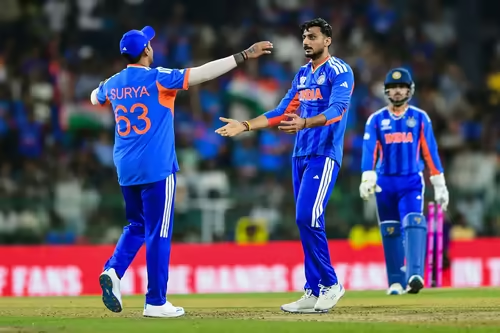
While fans erupted in celebration and social media exploded with memes after India’s 61-run demolition of Pakistan in the India vs Pakistan T20 World Cup 2026, one man stood apart—calm, composed, almost indifferent. Vice-captain Axar Patel, fresh off a match-winning all-round performance, dropped a bombshell in the post-match presser: “We don’t see rivalry.” [[1]]
It wasn’t arrogance. It wasn’t disrespect. It was something far more dangerous for opponents: clinical detachment. In an era where emotion often dictates performance in this high-voltage fixture, India’s new leadership core is treating Pakistan like any other opponent—and that might be their greatest weapon yet.
Table of Contents
- Axar’s Cold Verdict: What ‘We Don’t See Rivalry’ Really Means
- Kishan’s Explosive Foundation: 77 Off 40 on a Tough Pitch
- The Rise of a Professional Mindset in Indian Cricket
- Bowling Execution: How India Strangled Pakistan’s Chase
- Super 8 Implications: Why This Win Changes Everything
- Conclusion: Rivalry Fades, Excellence Remains
- Sources
Axar’s Cold Verdict: What ‘We Don’t See Rivalry’ Really Means
Axar Patel’s statement sent shockwaves through the cricketing world. For decades, the India-Pakistan clash has been defined by passion, patriotism, and pressure. But Patel reframed it entirely: “For us, it’s just another game. We focus on our process, our plans, and executing them,” he said [[1]].
This isn’t just lip service. It’s a reflection of a cultural shift within the Indian dressing room under Rohit Sharma and now Suryakumar Yadav’s leadership. By removing the emotional weight of the “rivalry,” the team avoids the pitfalls of over-excitement or anxiety—two factors that have derailed countless players in past encounters.
Kishan’s Explosive Foundation: 77 Off 40 on a Tough Pitch
That mental clarity was evident in Ishan Kishan’s innings. On a slow, low Colombo pitch that offered grip to spinners, most batsmen would’ve played cautiously. Not Kishan. He smashed an unbeaten 77 off just 40 balls—10 fours and 3 sixes—turning a tricky surface into his personal playground [[2]].
His knock wasn’t reckless; it was calculated aggression. He targeted the short boundaries, used the depth of the crease against spin, and never let the occasion overwhelm him. This is the kind of fearless yet controlled batting that defines modern T20 excellence—and it was only possible because the team treated the match as a tactical challenge, not an emotional war.
The Rise of a Professional Mindset in Indian Cricket
Gone are the days when Indian players would freeze or overplay in India-Pakistan matches. The current squad—many of whom grew up in the IPL era—views cricket as a high-stakes profession, not just a nationalistic battle. This mindset allows them to stay present, adapt quickly, and execute under pressure.
[INTERNAL_LINK:how-ipl-changed-india-pakistan-cricket-dynamics] As former captain Sourav Ganguly once said, “Professionalism beats emotion every time in sport.” India’s performance in this India vs Pakistan T20 World Cup 2026 match is living proof.
Bowling Execution: How India Strangled Pakistan’s Chase
India’s bowling was a masterclass in pressure application. Jasprit Bumrah and Hardik Pandya ripped through the top order in the powerplay, reducing Pakistan to 34/4. But it was the spinners—led by Axar himself and Kuldeep Yadav—who sealed the deal in the middle overs [[3]].
On a surface that gripped, they bowled tight lines, varied their pace, and attacked the stumps. Pakistan’s batsmen looked confused, tentative, and ultimately outclassed. The final score of 114 all out wasn’t just a loss—it was a systemic breakdown caused by India’s relentless precision.
Super 8 Implications: Why This Win Changes Everything
With this victory, India tops Group A and secures direct qualification to the Super 8 stage. More importantly, they’ve sent a psychological message to every other team: they are operating on a different level of composure and execution [[4]].
For Pakistan, the loss is catastrophic. Now third in the group, their path to the Super 8 is fraught with uncertainty. But for India, this win is just another step in their title march—a step taken not with fanfare, but with quiet, unwavering focus.
Conclusion: Rivalry Fades, Excellence Remains
Axar Patel’s words—“We don’t see rivalry”—may sound cold, but they represent the evolution of elite sport. In the India vs Pakistan T20 World Cup 2026 clash, India didn’t win because they were more emotional or patriotic. They won because they were more professional, more prepared, and more precise. And in the high-pressure arena of World Cup cricket, that’s the only thing that truly matters.
Sources
- Times of India: ‘We don’t see rivalry’: Axar Patel’s cold verdict after India thrash Pakistan [[1]]
- ESPN Cricinfo: Kishan’s sensational 77 floors Pakistan and puts India in Super Eights [[2]]
- ICC Official Website: ICC Men’s T20 World Cup 2026 [[3], [4]]