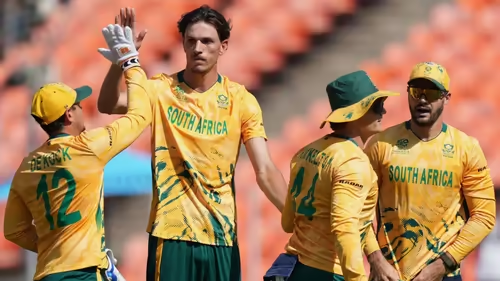
Let’s be honest: in T20 cricket, nothing is ever guaranteed. Yet here we are, watching the South Africa T20 World Cup campaign unfold with a mix of confidence and caution. The Proteas have already booked their ticket to the Super Eight stage, but coach Albie Morkel isn’t popping the champagne just yet. Why? Because the rise of associate nations has turned this tournament into a thrilling, unpredictable rollercoaster.
In their final Group D clash against the UAE at Delhi’s Arun Jaitley Stadium, South Africa faces a deceptively tricky fixture. On paper, it’s a mismatch. On the pitch? Anything can happen. Morkel’s public stance—being ‘unsurprised’ by strong associate displays—reveals a squad that’s respecting every opponent while leaning hard on its core strength: experience. But is that enough in modern T20 cricket?
Table of Contents
- Why South Africa T20 World Cup Experience Matters
- The Associate Nations Factor: No More Easy Wins
- Albie Morkel’s Strategic Approach
- Breaking Down the Super Eight Challenge
- Key Players to Watch
- Can Experience Overcome T20 Unpredictability?
- What’s Next for the Proteas?
Why South Africa T20 World Cup Experience Matters
When Morkel talks about ‘experience’, he’s not just referencing caps or age. He’s highlighting a curated group of players who’ve navigated high-pressure ICC events, IPL auctions, and death-over chaos across global leagues. For the South Africa T20 World Cup push, this translates to:
- Calm decision-making in tight chases
- Adaptability to varying pitch conditions
- Mental resilience after setbacks
These intangibles matter immensely in knockout-phase cricket. But experience alone won’t win trophies. Execution does.
The Associate Nations Factor: No More Easy Wins
Gone are the days when top-tier teams could coast through group stages. Teams like the UAE, Nepal, and Namibia have invested in infrastructure, coaching, and exposure. Their players now feature in franchise leagues worldwide. This evolution means:
- Enhanced skill sets: Better batting depth, smarter bowling variations
- Tactical awareness: Data-driven game plans targeting weaknesses
- Fearless mentality: Nothing to lose, everything to gain
Morkel’s acknowledgment of this shift isn’t just diplomatic—it’s strategic. Underestimating any opponent in today’s T20 World Cup associate nations landscape is a recipe for disaster.
Albie Morkel’s Strategic Approach
As coach, Morkel walks a fine line. He must balance rest for key players with maintaining match rhythm. His comments suggest a focus on:
- Role clarity: Ensuring every player knows their specific contribution
- Scenario planning: Preparing for multiple game situations
- Mental conditioning: Keeping the squad sharp despite early qualification
This methodical approach [INTERNAL_LINK:cricket-coaching-strategies] reflects modern T20 management—where psychology is as crucial as physics.
Breaking Down the Super Eight Challenge
Securing a Super Eight spot is just the beginning. The next phase pits South Africa against other group winners and runners-up, where margins shrink and pressure amplifies. Key considerations include:
- Net Run Rate (NRR): Could be decisive in tight standings
- Player fitness: Managing workloads across a congested schedule
- Opposition analysis: Deep dives into emerging threats
The Proteas’ Proteas Super Eight charge hinges on converting group-stage momentum into knockout consistency.
Key Players to Watch
While the squad boasts depth, certain individuals will likely dictate South Africa’s trajectory:
- Quinton de Kock: Explosive starts that set the tone
- Aiden Markram: Tactical batting and part-time spin
- Kagiso Rabada: Powerplay wickets and death-over precision
- Tabraiz Shamsi: Middle-overs control against aggressive batting
Their ability to deliver in clutch moments will separate contenders from champions.
Can Experience Overcome T20 Unpredictability?
Here’s the million-dollar question. T20 cricket thrives on chaos. A single over can flip a match. So, how does experience help?
Pros of Experience:
- Better handling of pressure situations
- Improved decision-making under fatigue
- Stronger team cohesion in crises
Potential Pitfalls:
- Complacency against ‘weaker’ opponents
- Over-reliance on past success patterns
- Slower adaptation to unconventional tactics
The South Africa T20 World Cup campaign will test whether their veteran core can evolve with the game’s rapid changes.
What’s Next for the Proteas?
After the UAE fixture, attention shifts to Super Eight preparations. Key focus areas:
- Finalizing the XI: Balancing aggression with stability
- Powerplay optimization: Maximizing the first six overs
- Death-bowling drills: Protecting totals in high-scoring games
Fans can track live updates via official channels like the ICC’s official website for real-time scores and squad news.
Concluding Summary
South Africa’s South Africa T20 World Cup journey embodies a classic tension: experience versus evolution. While their veteran squad offers stability, the tournament’s unpredictable nature demands constant adaptation. Albie Morkel’s measured approach acknowledges both the threat of associate nations and the value of composure. If the Proteas can blend their hard-earned wisdom with fresh tactical flexibility, they’re well-positioned for a deep Super Eight run. But in T20 cricket, respect every ball, every opponent, every moment. That’s the real lesson from this World Cup.
Sources
- Original reporting: Times of India – South Africa T20 World Cup coverage
- ICC tournament regulations: ICC Men’s T20 World Cup Official Page
- Player statistics and team analysis: ESPNcricinfo Database