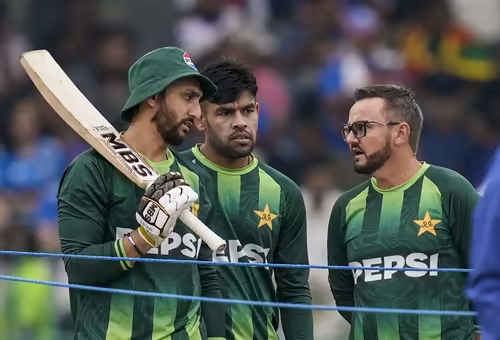
Pakistan had everything going their way. Home conditions in Sri Lanka. Favorable tosses. Surfaces they knew inside out. Yet they still crashed out before the semifinals. How does a team with all the advantages fail so spectacularly?
Key Takeaways
- Babar Azam’s strike rate of 112.34 at No. 4 was far too slow for modern T20 cricket
- Fakhar Zaman smashed 84 off 42 balls when finally promoted to opener – but only in the last match
- Pakistan’s death bowling collapsed under pressure, with Shaheen Afridi conceding 4, 6, 6, 6 in crucial moments
- Tactical blunders against India and poor middle-order consistency sealed their fate
- Team management took 4 matches to make obvious batting order changes
The Babar Azam Mistake
Here’s the brutal truth: Babar Azam was completely miscast at No. 4.
His strike rate of 112.34 simply doesn’t cut it in modern T20 cricket. Not at that position. Not in a World Cup.
But Pakistan’s team management – captain Salman Ali Agha and coach Mike Hesson – persisted with him for four straight matches. Even when the warning signs were flashing red.
[IMAGE PLACEHOLDER: Babar Azam batting graph showing strike rate comparison | Alt Text: Babar Azam strike rate T20 World Cup 2026]
The result? A slow 24-ball 25 against England that killed Pakistan’s momentum. Harry Brook’s century sealed their fate, but Babar’s inability to accelerate was the real culprit.
Here is the deal: World Cups demand quick decisions. Pakistan took four games to realize what should have been obvious from game one.
Why This Mattered
When you bat a player out of position, you create a domino effect:
- Middle-order collapses become frequent
- Run rate pressure builds in crucial phases
- Other batters can’t play their natural game
Captain Agha defended the decision, saying Babar’s role was “stability.” But in T20 cricket, stability without scoring rate is just slow suicide.
Tactical Blunders That Cost Them
But there’s a catch: It wasn’t just the batting order.
Pakistan’s tactical decisions in high-pressure moments were nothing short of baffling.
The India match disaster: They elected to field first on a spin-friendly pitch. Then introduced mystery spinner Usman Tariq too late to make any impact.
These aren’t rookie mistakes. This is a team that should know better.
[IMAGE PLACEHOLDER: Pakistan team huddle during T20 World Cup match | Alt Text: Pakistan cricket team tactical discussion T20 World Cup]
Captain Agha admitted it himself: “Whenever there is pressure, our decision-making is not as good as it should be.”
The Pattern You Need to See
This isn’t new for Pakistan in ICC tournaments. They’ve developed a toxic pattern:
- Start with questionable tactics
- Stick with failing strategies too long
- Make changes only when elimination is imminent
- Blame pressure and nerves
Sound familiar? That’s because you’ve seen this movie before.
Death Bowling Disaster
Now let’s talk about the elephant in the room: Shaheen Afridi’s death bowling.
Pakistan’s premier fast bowler became their biggest liability in crucial moments. Time and again, he bowled the wrong length when his team needed him most.
The numbers don’t lie:
- Against Sri Lanka: Conceded 4, 6, 6, 6 in the final over
- Nearly lost a match they completely dominated
- Consistently failed to execute yorkers under pressure
[IMAGE PLACEHOLDER: Shaheen Afridi bowling action analysis | Alt Text: Shaheen Afridi death bowling T20 World Cup 2026]
The England Collapse
Remember that England match? Pakistan posted 164-9 – not a great total, but defendable.
Then their death bowling imploded. Harry Brook smashed a century. Game over.
Here’s what hurts: Pakistan had the conditions, the toss, and the home advantage. They still couldn’t defend a mediocre total.
Fakhar Zaman: Too Little, Too Late
Here’s the most frustrating part of Pakistan’s campaign.
Fakhar Zaman finally opened against Sri Lanka in their last match. His response? A blistering 84 off just 42 balls.
That’s a strike rate of 200. In a World Cup match. As an opener.
So why didn’t they do this earlier?
Captain Agha’s explanation: “Fakhar didn’t come to the tournament with good form.”
The Form Trap
But here’s what you need to understand about T20 cricket:
Sometimes the best way to get form is to give players the role that suits them.
- Fakhar is naturally an aggressive opener
- He was batting out of position in the middle order
- It took 4 matches for management to figure this out
By the time they got it right, Pakistan’s tournament was already over.
[IMAGE PLACEHOLDER: Fakhar Zaman aggressive batting shot | Alt Text: Fakhar Zaman 84 runs T20 World Cup 2026]
Pakistan T20 World Cup Exit Checklist
Want to understand exactly what went wrong? Here’s your complete breakdown:
Batting Failures
- Babar Azam at No. 4: Strike rate of 112.34 – far too slow
- Middle-order collapses: Repeated failures in high-pressure games
- Over-reliance on Sahibzada Farhan: No backup plan when he failed
- Slow starts: Powerplay utilization was poor
Tactical Errors
- India match: Elected to field on spin-friendly pitch
- Bowling changes: Introduced Usman Tariq too late
- Playing XI selection: Took 4 matches to optimize the lineup
- Role confusion: Batters playing out of position
Bowling Breakdowns
- Death bowling: Shaheen’s poor execution in final overs
- England match: Failed to defend 165
- Pressure situations: Wrong lengths at crucial times
- Lack of variation: Predictable bowling plans
The bottom line: Pakistan didn’t fail in one area. They failed in almost every department that matters.
What’s Next for Pakistan?
So what should Pakistan do now?
First, they need honest self-reflection. Not the usual “we’ll do better next time” platitudes.
Second, they must stop persisting with failing strategies. Four matches is too long to figure out that Babar doesn’t belong at No. 4.
Third, trust your instinctive players. Fakhar Zaman proved he’s an opener. Let him open from game one next time.
The Pressure Problem
Captain Agha identified the real issue: “Whenever there is pressure, our decision-making is not as good as it should be.”
This is a mental toughness problem, not a skill problem.
Pakistan has talented players. But talent means nothing if you can’t execute under pressure in ICC tournaments.
[IMAGE PLACEHOLDER: Pakistan cricket team disappointed after loss | Alt Text: Pakistan cricket team T20 World Cup 2026 exit]
The Path Forward
Here’s what Pakistan must fix before the next ICC event:
- Define clear roles: No more batting players out of position
- Quick decision-making: Don’t wait 4 matches to make obvious changes
- Death bowling practice: Specific training for high-pressure situations
- Mental conditioning: Work on handling ICC tournament pressure
- Data-driven selection: Use strike rates and recent form, not reputation
Remember: Pakistan had home conditions, favorable tosses, and surfaces they knew. They still crashed out.
That’s not bad luck. That’s bad cricket.
Frequently Asked Questions
Why did Pakistan exit the T20 World Cup 2026 early?
Pakistan’s early exit resulted from multiple failures: Babar Azam’s poor strike rate (112.34) at No. 4, tactical blunders against India, death bowling collapses led by Shaheen Afridi, and slow decision-making by team management. They took four matches to optimize their playing XI, by which time it was too late.
What was Babar Azam’s strike rate in T20 World Cup 2026?
Babar Azam had a strike rate of just 112.34 in the 2026 T20 World Cup while batting at No. 4. This was far too slow for modern T20 cricket and contributed significantly to Pakistan’s middle-order struggles and eventual tournament exit.
Should Fakhar Zaman have opened earlier for Pakistan?
Absolutely. Fakhar Zaman scored 84 off 42 balls (strike rate 200) when finally promoted to opener against Sri Lanka. Pakistan’s management took four matches to make this obvious change, and by the time they did, their tournament was already over.
What do you think was Pakistan’s biggest mistake – the Babar Azam selection, tactical errors, or death bowling failures? Drop your take in the comments below.