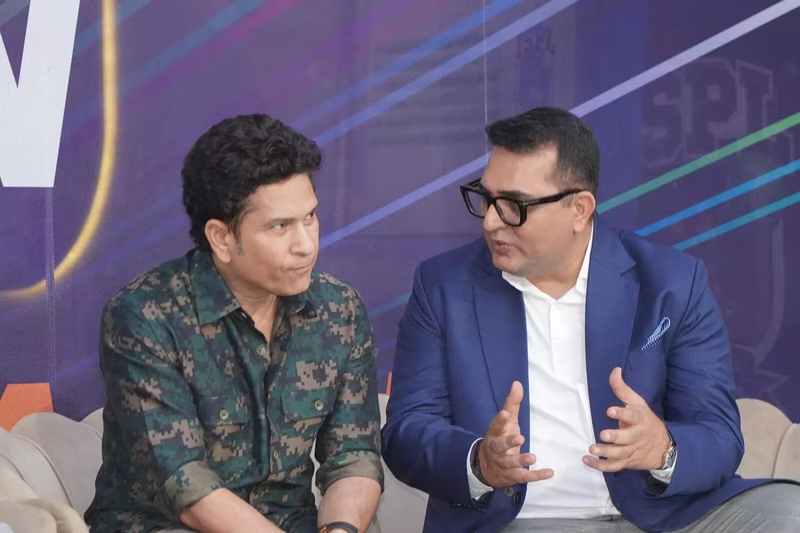
The Indian Street Premier League (ISPL) is taking a bold step beyond entertainment—it’s building a legacy. In a recent interview, ISPL Commissioner Suraj Samat revealed that the league’s third season will prioritize structure, sustainability, and most importantly, inclusivity. At the heart of this vision lies the newly launched National Framework, a revolutionary system designed to unearth and elevate raw cricketing talent from every corner of India .
“Inclusivity is at the core of what we’re building,” Samat emphasized, underscoring a mission that goes far beyond flashy sixes and celebrity appearances. Backed by a Core Committee led by none other than Sachin Tendulkar, the ISPL is now creating a credible, transparent pathway for street cricketers to transition from local gullies to national recognition.
What Is the ISPL National Framework?
Unlike traditional talent hunts that rely on one-off trials or subjective scouting, the ISPL National Framework introduces a data-driven, points-based performance tracking system. Every player participating in ISPL-affiliated local tournaments across states will earn points based on consistent performance—runs scored, wickets taken, fielding efforts, and even leadership qualities.
These points accumulate over time, feeding into a centralized digital leaderboard. Top performers aren’t just noticed—they’re invited to regional camps, then national showcases, and potentially, ISPL franchise contracts. It’s a meritocratic ladder, built to ensure that talent from Tier-2 and Tier-3 cities gets the same shot as those from cricketing hubs like Mumbai or Delhi.
Why Structure Over Expansion?
While many leagues chase rapid growth, ISPL is choosing depth over breadth. “We could have added more teams or cities this season,” Samat explained, “but without a strong foundation, expansion is meaningless.” Instead, the focus is on refining the talent pipeline, standardizing tournament formats, and ensuring fair play across all levels.
This strategic patience reflects a long-term vision: to make ISPL not just a league, but a national cricketing ecosystem.
Sachin Tendulkar’s Role: More Than a Figurehead
With Sachin Tendulkar chairing the Core Committee, the initiative gains instant credibility. The ‘God of Cricket’ has long advocated for grassroots development, and his involvement here is hands-on. The committee—comprising former players, coaches, and sports scientists—helps design the evaluation metrics, review player progress, and mentor emerging stars.
“Sachin sir doesn’t just lend his name,” Samat shared. “He asks detailed questions about player welfare, injury prevention, and even education support. He wants these kids to have a future, whether they become pros or not.”
How the Points System Works: A Snapshot
| Performance Area | Points Awarded | Example |
|---|---|---|
| Batting | 1 point per run + 10 for 50+ + 20 for 100 | 75 runs = 75 + 10 = 85 points |
| Bowling | 20 points per wicket + 10 for 3+ wickets | 4 wickets = 80 + 10 = 90 points |
| Fielding | 15 points per catch/run-out | 2 catches = 30 points |
| Sportsmanship | Up to 20 points (coach/umpire rated) | Full marks for discipline & attitude |
This transparent scoring removes bias and rewards all-round contribution—not just big scores or flashy spells.
The Bigger Impact: Democratizing Indian Cricket
For decades, Indian cricket’s talent pool has been skewed toward urban academies and private schools. The ISPL National Framework aims to flip that script. A boy from a village in Odisha or a girl from a slum in Chennai now has a measurable route to be seen, evaluated, and supported.
And with plans to integrate women’s street cricket in future phases, the league’s commitment to inclusivity is set to grow even deeper.