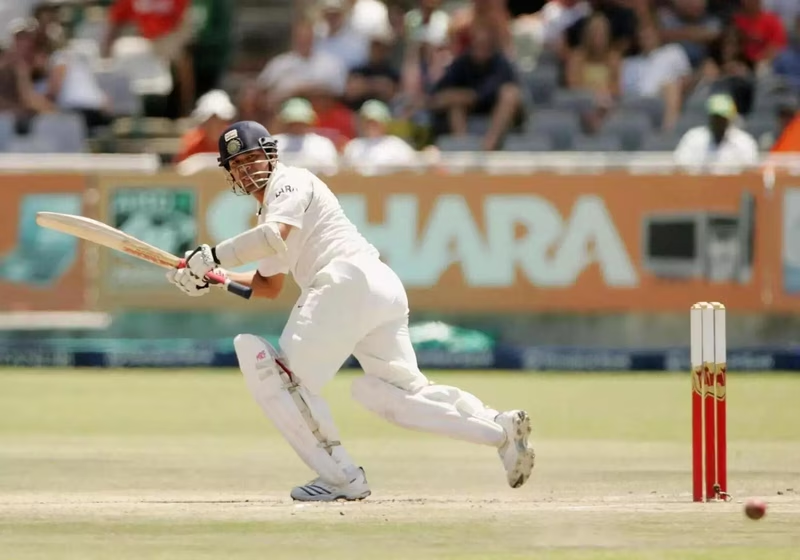
Sachin & Azhar’s 222-Run Stand: A Masterpiece in a Lost Cause
As India and South Africa gear up for their latest Test battle, it’s impossible not to cast our minds back to one of the most heroic—and heartbreaking—chapters in their rivalry. The year was 1997, the venue was Newlands in Cape Town, and the stage was set for a display of pure, unyielding grit from two of India’s greatest batsmen.
The Sachin Azhar partnership that unfolded was pure magic: 222 runs of elegant strokeplay, textbook defence, and unshakeable resolve. Sachin Tendulkar scored a majestic 169, while captain Mohammad Azharuddin blasted a sublime 117. Yet, in a cruel twist of fate, their heroics were not enough to prevent an Indian defeat. This is the story of a partnership so brilliant it’s remembered decades later, even in loss.
Table of Contents
- The Cape Town Context: A Mountain to Climb
- The Sachin Azhar Partnership: A Symphony in Crisis
- Why the Partnership Wasn’t Enough
- The Enduring Legacy of the 222-Run Stand
- Conclusion: Defining Grit Beyond Victory
- Sources
The Cape Town Context: A Mountain to Climb
The second Test of the 1996-97 series was already slipping away from India before their first innings truly began. South Africa, powered by a colossal 314 from Gary Kirsten and a solid 100 from Daryll Cullinan, posted a mammoth 523 for 7 declared .
In response, India’s top order collapsed dramatically. Openers Navjot Singh Sidhu and VVS Laxman were back in the hut with just 26 runs on the board. At 26/2, and then 43/3 after Nayan Mongia’s dismissal, the prospect of avoiding an innings defeat was bleak . The stage was set not for a comeback, but for damage control.
The Sachin Azhar partnership: A Symphony in Crisis
Enter Sachin Tendulkar and captain Mohammad Azharuddin. What followed was a masterclass in batting under extreme pressure. In an era before flat pitches and heavy bats, on a true Newlands surface that offered something for everyone, they took on a formidable South African attack featuring Allan Donald, Shaun Pollock, and Brian McMillan .
Their partnership was a perfect blend of styles. Tendulkar, at his compact, imperious best, played with a straight bat and impeccable timing. Azharuddin, the master of the wrist, unfurled his trademark flicks and late cuts with effortless grace. They didn’t just bat; they counter-attacked, refusing to be passive victims.
For over a session and a half, they owned the crease. They added 222 crucial runs, the backbone of India’s entire innings of 278 all out . Tendulkar’s 169 was a statement of intent, while Azharuddin’s 117 was a captain’s knock of immense responsibility.
Why the Partnership Wasn’t Enough
Despite the brilliance of the Sachin Azhar partnership, the sheer size of South Africa’s first-innings total proved insurmountable. India was left with a staggering deficit of 245 runs .
In the second innings, India showed more fight, with Laxman scoring a fine 51 and Azharuddin adding another 40, but they were eventually bowled out for 260. South Africa needed just 16 runs to win, which they knocked off without losing a wicket .
The simple truth is that while their partnership was heroic, it was a response to a crisis, not a platform for victory. It’s a stark reminder that even the greatest individual and collective efforts can be undone by a team’s failure in other departments. The bowling attack, which couldn’t contain the South African batsmen, was the ultimate difference.
The Enduring Legacy of the 222-Run Stand
So why is this partnership remembered so fondly, even though it ended in defeat? Because it embodied the very spirit of Test cricket: fighting against the odds, showcasing skill under duress, and refusing to surrender.
It stands as a benchmark for partnerships built in adversity. Cricket historians often cite it as one of the finest rescue acts in Indian Test history. It’s a go-to example when discussing famous “losing causes” where the performance transcended the result.
For a deeper look at the evolution of India’s Test batting, you can explore the ICC’s historical data on [INTERNAL_LINK:india-test-batting-evolution].
The International Cricket Council (ICC) itself has often highlighted such moments of individual brilliance in its retrospectives on the game’s rich history, showcasing how they contribute to the sport’s enduring legacy (ICC Greatest Partnerships).
Conclusion: Defining Grit Beyond Victory
The 1997 Cape Town Test is a poignant lesson: in sport, victory isn’t the only measure of greatness. The Sachin Azhar partnership is immortal not because it won a game, but because it revealed the heart of two champions. It was a defiant act of beauty in the face of a looming defeat, a testament to their skill, courage, and unwavering commitment to their team.
As the current Indian side prepares to face South Africa once again, they would do well to remember the spirit of that 222-run stand—not just to win, but to fight with honour, no matter the scoreboard.