Table of Contents
- How the Crisis Unfolded: Key Moments
- The Blast That Shook a Tour
- Player Panic and Internal Tensions
- Army Chief’s Rare Personal Intervention
- PCB’s Emergency Security Review
- Why Canceling Was Not an Option
- What This Means for Pakistan’s Cricket Future
- Conclusion: A Fragile Victory for Cricket Diplomacy
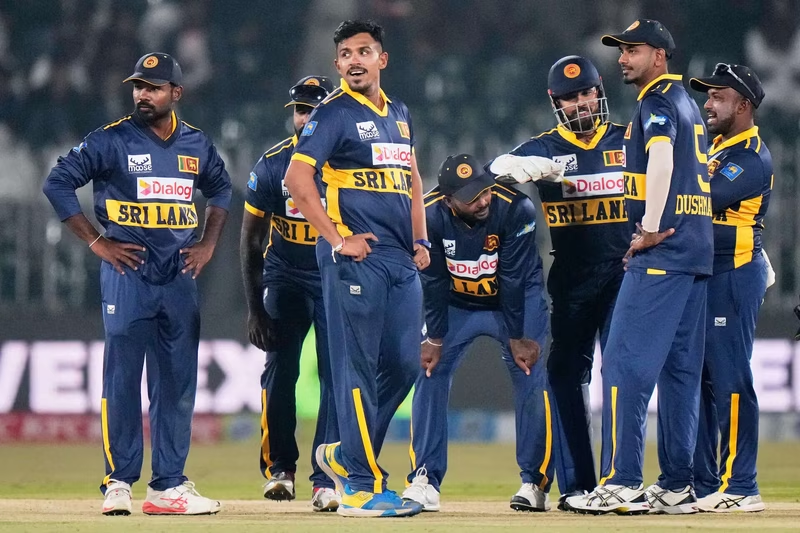
The Sri Lanka tour Pakistan in November 2025 will be remembered not just for runs and wickets—but for a high-stakes drama that tested the resolve of players, boards, and even national institutions. When a suicide bombing near Pakistan’s ISI headquarters in Islamabad claimed lives and rattled nerves, the visiting Sri Lankan contingent was thrown into turmoil. Some players reportedly wanted to board the next flight home. But within 48 hours, the tour was back on track—thanks to unprecedented intervention from Pakistan’s military leadership and rapid crisis management by the PCB.
How the Crisis Unfolded: Key Moments
Here’s a chronological breakdown of the crisis:
- November 10, 2025 (Evening): A suicide bomber detonates explosives near the ISI headquarters in central Islamabad, killing at least 5 and injuring over 20.
- November 11 (Morning): Sri Lankan players express concern; team management holds emergency meeting. Reports surface of players seeking evacuation.
- November 11 (Afternoon): Pakistan Army Chief Gen. Asim Munir personally calls Sri Lankan officials to assure security.
- November 12 (Morning): PCB Chairman Mohsin Naqvi visits Rawalpindi stadium and team hotel, reviews enhanced protocols.
- November 12 (Evening): Sri Lanka Cricket confirms the tour will continue, with all matches now centralized in Rawalpindi.
- November 13: Teams resume practice under tight military surveillance.
The Blast That Shook a Tour
The November 10 explosion struck just 6 kilometers from the Serena Hotel—where international teams often stay during Islamabad fixtures. Though the Sri Lankans were lodged in Rawalpindi (about 15 km away), the psychological impact was immediate. For a team whose bus was attacked in Lahore in 2009, the echoes were chilling.
“This wasn’t just a security issue—it was a trauma trigger,” said a former Sri Lankan player, speaking anonymously . The 2009 attack left six police officers and two civilians dead and ended Pakistan’s era of hosting international cricket for over a decade.
Player Panic and Internal Tensions
According to insider reports, several senior Sri Lankan players were adamant about leaving. “They felt blindsided,” a team source told TOI. “They’d been told Pakistan was ‘100% safe’—and then this happened.”
However, Sri Lanka Cricket (SLC), under pressure from the ICC and wary of financial penalties for cancellation, urged calm. The board also consulted with the Sri Lankan Foreign Ministry before making a final call .
Sri Lanka tour Pakistan Saved by Army Chief’s Assurance
The turning point came when Pakistan’s powerful Chief of Army Staff, General Asim Munir, took the extraordinary step of calling Sri Lankan government and cricket officials directly. “He didn’t delegate. He made the call himself,” confirmed Interior Minister Mohsin Naqvi .
Gen. Munir assured them that the Sri Lankan team would receive “Level-Z security”—the highest designation in Pakistan’s protocol, typically reserved for heads of state. This included round-the-clock army commandos, drone surveillance, and dedicated emergency evacuation routes.
Such direct military involvement in a cricketing matter is rare, underscoring how seriously Pakistan views the revival of home internationals.
PCB’s Emergency Security Review
PCB Chairman Mohsin Naqvi, who also serves as Interior Minister, personally visited the Rawalpindi Cricket Stadium and the team hotel. He ordered:
- Deployment of 300+ elite security personnel
- Installation of RF jammers to block remote detonation signals
- Restricted access zones with biometric checkpoints
- Daily security briefings involving ISPR, police, and PCB liaisons
All matches were consolidated in Rawalpindi to minimize travel risk—a pragmatic shift that reduced exposure while maintaining the series schedule.
Why Canceling Was Not an Option
For Pakistan, the stakes extended far beyond cricket. A cancellation would have reinforced global perceptions of instability, jeopardizing future tours by England, Australia, or even the ICC Champions Trophy 2025, which Pakistan hopes to co-host [[INTERNAL_LINK:pakistan-icc-hosting-bid]].
For Sri Lanka, pulling out risked ICC sanctions and strained bilateral ties. Both boards needed this series to succeed—not just for sport, but for diplomacy.
What This Means for Pakistan’s Cricket Future
The fact that the Sri Lanka tour Pakistan continued despite a major security incident sends a strong signal: Pakistan is willing to deploy its highest state resources to protect cricket. But experts caution that this isn’t a long-term solution.
“Relying on the army chief to personally reassure every visiting team isn’t scalable,” noted Dr. Farhan Hanif Siddiqi, a geopolitical analyst. “Sustainable hosting requires systemic, civilian-led security frameworks that build organic trust.”
Still, if the rest of the series proceeds smoothly, it could mark a turning point in Pakistan’s return to the international fold.
Conclusion: A Fragile Victory for Cricket Diplomacy
The crisis surrounding the Sri Lanka tour Pakistan was resolved not by protocol alone, but by human intervention at the highest levels of power. While the immediate threat has passed, the episode highlights both the progress Pakistan has made and the vulnerabilities that remain. For now, cricket—and courage—prevail.