Table of Contents
- Gambhir’s Hard Truth: “More Than Skill, You Need…”
- India vs South Africa Test: The Collapse Recap
- The Pressure Cookbook: Why Young Batters Froze
- Gambhir’s Coaching Philosophy Under Fire
- Comparing Generations: Then vs. Now
- Building Resilience: What India Must Do Next
- Looking Ahead to Guwahati
- Conclusion
- Sources
Gambhir’s Hard Truth: “More Than Skill, You Need…”
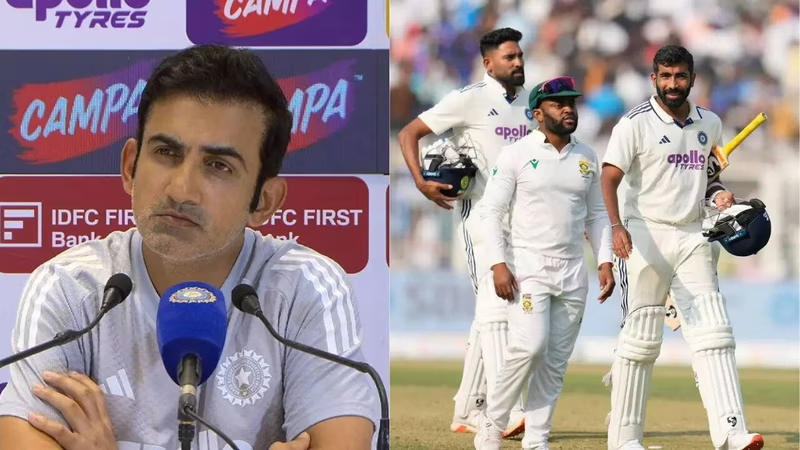
In the wake of India’s shocking 30-run loss to South Africa in the first Test at Eden Gardens, head coach Gautam Gambhir didn’t blame the pitch, the conditions, or even the bowling. Instead, he delivered a stark assessment that cut to the core of the problem: “More than skill, you need temperament,” he said bluntly .
For a nation that prides itself on producing technically gifted batters, Gambhir’s words were a wake-up call. India’s batting lineup—featuring young stars like Yashasvi Jaiswal, Shreyas Iyer, and KL Rahul—possesses undeniable talent. But in the high-stakes, pressure-cooker environment of a tense fourth-innings chase on a crumbling pitch, that talent evaporated.
This wasn’t a failure of technique. It was a failure of nerve.
India vs South Africa Test: The Collapse Recap
The India vs South Africa Test ended in historic fashion. Chasing a modest 124, India were bowled out for just 93—marking South Africa’s first win on Indian soil in 15 years . Simon Harmer’s 8-wicket haul dominated headlines, but the real story was India’s mental disintegration.
Stand-in captain Rishabh Pant admitted post-match: “We had the skills, but the pressure got to us” . That sentiment echoed Gambhir’s diagnosis. The batters didn’t play rash shots out of aggression; they played tentative, uncertain strokes out of fear—fear of failure, fear of the turning ball, fear of the moment.
The Pressure Cookbook: Why Young Batters Froze
Modern cricket’s structure may be partly to blame. Today’s young Indian players rise through the ranks via T20 leagues, where the emphasis is on quick scoring, not survival. Test cricket, especially on Day 4 in India, demands the opposite: patience, judgment, and emotional control.
Consider these pressure indicators from the innings:
- Average time at crease per batter: under 20 minutes
- Only 3 boundaries
- 7 of 10 dismissals came to spinners bowling in “rough” outside off-stump—a well-known trap
These stats reveal batters who weren’t thinking; they were reacting. And in Test cricket, reaction loses to calculation every time.
Gambhir’s Coaching Philosophy Under Fire
Since taking over as head coach, Gambhir has championed a “no-excuses” culture. A former opener known for his grit and fearless attitude—famously battling Mitchell Johnson with a broken finger in 2008—he expects the same steeliness from his players .
His post-match comments reflect that ethos: “You can’t win Test matches with talent alone. You need to want it more than the opposition. You need to suffer” .
While some critics argue his approach is too harsh for a rebuilding side, others see it as necessary medicine. In an era where T20 stardom comes fast, Gambhir is trying to re-inject the old-school values of Test cricket: discipline, resilience, and mental fortitude.
Comparing Generations: Then vs. Now
Look back at India’s golden Test era (2015–2021): Kohli, Pujara, Rahane, and Ashwin built their reputations on grit, not flair. They averaged 45+ in home Tests and routinely batted for 100+ balls even in low-pressure chases .
Today’s lineup is different:
- Yashasvi Jaiswal: Explosive but inconsistent under pressure
- Shreyas Iyer: Brilliant on good days, fragile on tough ones
- KL Rahul: Still searching for Test rhythm after years in T20 formats
It’s not that this generation lacks ability—it’s that they haven’t been tested enough in adversity. And as Gambhir implies, you can’t simulate that pressure in nets or academies.
Building Resilience: What India Must Do Next
Gambhir and the support staff now face a critical challenge: how to build mental toughness quickly. Experts suggest:
- Scenario-based net sessions: Simulate high-pressure chases with consequences (e.g., “You’re 50/4 chasing 120—survive 15 overs”)
- Mental conditioning coaches: Bring in sports psychologists to work on focus and emotional regulation [INTERNAL_LINK:india-vs-south-africa-test-gambhir-defends-pitch]
- Leadership reinforcement: Empower Pant to project calmness, even when things go wrong
As Gambhir put it: “Temperament isn’t inherited. It’s built.”
Looking Ahead to Guwahati
The second Test in Guwahati begins on Saturday . With Shubman Gill potentially returning from injury, India may regain some top-order stability. But the real test won’t be the pitch—it will be whether the batters can internalize Gambhir’s message.
If they fail again, it won’t be a matter of skill. It will be proof that the team’s biggest gap is between the ears—not the bat and ball.
Conclusion
Gautam Gambhir’s assessment after the India vs South Africa Test loss cuts through the noise: talent is table stakes in international cricket. What separates winners from also-rans is sheer mental resilience. India’s young batters now face a defining moment—not just to win a match, but to prove they have the temperament to wear the Test cap with pride.