Table of Contents
- From Eden Gardens Backlash to Guwahati Revival
- Why the Guwahati Pitch Is Raising Eyebrows
- The Science Behind Barsapara Stadium’s Red Soil
- Ashish Bhowmick: The Man Behind India’s Pitch Strategy
- What “Turn and Bounce at Pace” Really Means for Batters
- How This Pitch Could Benefit India’s Spinners
- South Africa’s Challenge on a Different Kind of Subcontinental Track
- Conclusion
- Sources
From Eden Gardens Backlash to Guwahati Revival
The recent **Eden Gardens Test** between India and South Africa drew sharp criticism—not just for India’s batting collapse, but for a pitch that offered inconsistent bounce and unpredictable turn, raising questions about player safety and match fairness .
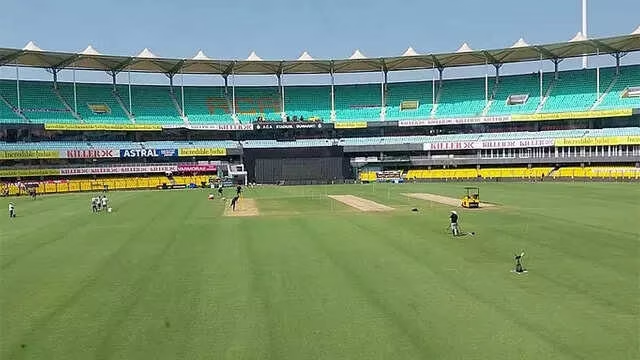
Now, all eyes turn to Guwahati, where the Barsapara Stadium is preparing a surface designed to learn from those concerns. Early reports suggest the **Guwahati pitch** will deliver something far more balanced yet equally challenging: consistent turn, sharp bounce, and genuine carry—without the erratic behavior that marred Kolkata.
Why the Guwahati Pitch Is Raising Eyebrows
Unlike traditional clay-heavy pitches in northern India, the **Guwahati pitch** is built on locally sourced red soil—a composition known for its firmness and ability to retain structure over five days. According to the BCCI’s pitch monitoring unit, this soil type offers “superb bounce and carry,” making it ideal for a contest that rewards both seamers early on and spinners as the match progresses .
Indian team management has reportedly advocated for conditions that amplify their spin strength against South Africa’s relatively inexperienced batting lineup on turning tracks. The goal? A surface that’s tough but fair—where skill, not luck, decides the outcome.
The Science Behind Barsapara Stadium’s Red Soil
Red soil, rich in iron oxide and low in organic matter, dries hard and cracks in a predictable pattern. This creates natural footholds for spinners and allows the ball to grip without excessive deviation. Crucially, it also maintains integrity under heavy roller use and varying humidity—key factors in Assam’s tropical climate.
Compared to the loamy, moisture-retentive soil of Kolkata, Guwahati’s base is less prone to sudden variable bounce. As noted by pitch experts at the International Cricket Council (ICC), “Consistent sub-surface density is critical for player safety and match quality” .
Ashish Bhowmick: The Man Behind India’s Pitch Strategy
Overseeing the preparation is BCCI’s head curator, **Ashish Bhowmick**—a respected figure known for crafting pitches that align with team strategy without crossing into controversy. Bhowmick, who has worked on venues from Mohali to Chennai, brings a data-driven approach to pitch design.
His team has reportedly been working on the Barsapara strip for over two weeks, using precise moisture control, rolling schedules, and grass coverage to fine-tune behavior. “We want a surface that lasts five days, offers something for everyone, and produces a result,” Bhowmick hinted in internal briefings cited by The Times of India .
What “Turn and Bounce at Pace” Really Means for Batters
This phrase is more than marketing—it describes a uniquely challenging condition:
- Turn: The ball deviates off the straight path after pitching, testing footwork and shot selection.
- Bounce: The ball rises sharply after hitting the pitch, often reaching chest or head height.
- At pace: Unlike slow, dusty tracks, the ball retains speed off the surface, giving batters less reaction time.
For South African batters like Keegan Petersen or Tony de Zorzi—more accustomed to flatter pitches back home—this could be a steep learning curve.
How This Pitch Could Benefit India’s Spinners
India’s spin trio—Ravichandran Ashwin, Kuldeep Yadav, and Ravindra Jadeja—thrive on surfaces offering grip and bounce. On the **Guwahati pitch**, they could extract sharp turn without needing excessive rough patches.
Notably, Kuldeep’s wrist-spin could become even more dangerous if the ball bounces at pace, taking batsmen by surprise. Meanwhile, Jadeja’s ability to bowl flat and fast into the pitch aligns perfectly with these conditions.
This setup gives India a strategic edge while avoiding the “dust bowl” label that has drawn ICC scrutiny in the past.
South Africa’s Challenge on a Different Kind of Subcontinental Track
While Simon Harmer and Keshav Maharaj gave South Africa a historic win in Kolkata, replicating that success in Guwahati will require adaptation. The pitch here won’t crumble on Day 3; instead, it will offer consistent challenge throughout.
Their batters must focus on:
- Staying deep in the crease to counter bounce.
- Using soft hands to handle sharp turn.
- Building partnerships through patience—something Temba Bavuma exemplified in Kolkata.
For fans following the series, our [INTERNAL_LINK:india-vs-sa-guwahati-test-preview] offers live updates and expert analysis.
Conclusion
The **Guwahati pitch** represents a course correction after Eden Gardens’ controversy. With red soil offering consistent turn and bounce at pace, and Ashish Bhowmick’s expert curation, Barsapara Stadium is poised to host a fair, competitive, and result-oriented Test. For India, it’s a chance to redeem their home pride; for South Africa, a test of adaptability. One thing’s certain: cricket fans are in for a gripping contest.