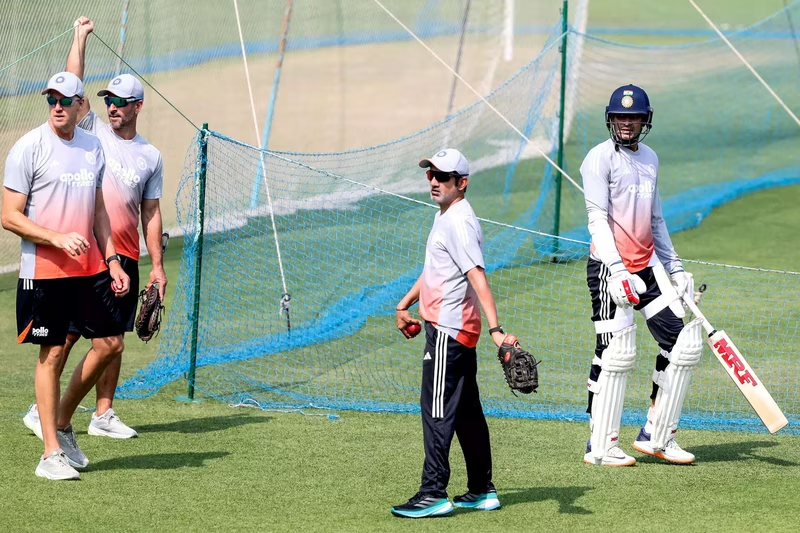
Gautam Gambhir’s Test Coaching Record: A Red-Ball Reality Check
Gautam Gambhir’s arrival as India’s head coach was met with optimism. After all, here was a former opener with a gritty temperament, a proven winner in high-pressure limited-overs cricket, and a voice long respected in Indian dressing rooms. Yet, as India stumbles through a difficult overseas Test series against South Africa, a stark contrast has emerged: while his white-ball leadership shows promise, his **Gautam Gambhir Test coach** stint is facing intense scrutiny—and for good reason .
From questionable pitch preparations at home to constant team shuffling and a baffling lack of batting resilience, the red-ball project under Gambhir appears to be losing steam just when stability and strategy were most needed.
Table of Contents
- The White-Ball Shine vs. Red-Ball Struggles
- Underprepared Pitches: A Self-Inflicted Wound?
- The Chopping and Changing Crisis
- Impact on Batters: Confidence and Technique
- Comparing Gambhir to Predecessor Coaches
- What Needs to Change Ahead of 2027 WTC?
- Conclusion: Can Gambhir Turn the Tide?
- Sources
The White-Ball Shine vs. Red-Ball Struggles
There’s no denying Gambhir’s impact in limited-overs formats. Under his watch, India clinched the T20 World Cup 2024 and showed tactical sharpness in ODIs . His aggressive mindset, emphasis on top-order dominance, and field placements have paid dividends.
But Test cricket is a different beast. It demands patience, structural consistency, and long-term planning—qualities that seem absent in India’s recent red-ball outings. Since taking over, India’s Test win-loss record has slipped, especially away from home, raising questions about whether Gambhir’s coaching philosophy truly translates to the longest format.
Underprepared Pitches: A Self-Inflicted Wound?
One of the most glaring issues during Gambhir’s tenure has been India’s persistent use of underprepared, rank-turning pitches in home Tests. While spin-friendly tracks are part of India’s traditional advantage, recent surfaces have bordered on unplayable—offering excessive turn from Day 1, crumbling prematurely, and often resulting in sub-200 match totals.
This approach backfires in two key ways:
- Hurts batter development: Young Indian batters get no chance to build long innings or learn to handle seam and bounce—skills crucial for overseas success.
- Creates false confidence: Bowlers rack up wickets on helpful surfaces but struggle when conditions flatten out or offer pace and carry abroad.
As former captain Sunil Gavaskar remarked in a recent column, “If you keep winning on dust bowls, you never learn to adapt. And adaptability is the soul of Test cricket.”
The Chopping and Changing Crisis
Another red flag is the constant chopping and changing of the playing XI. In the past year alone, India has experimented with at least seven different middle-order combinations in Tests. Openers rotate, keepers switch, all-rounders in and out—without a clear strategic rationale.
This lack of continuity breeds uncertainty. Players can’t settle into roles, form is sacrificed for “potential,” and team chemistry suffers. Compare this to New Zealand or Australia, where core units remain stable for years, allowing players to grow into their positions.
Impact on Batters: Confidence and Technique
The fallout is visible in the batting unit’s fragility—especially overseas. In Centurion, India collapsed twice against disciplined South African seam and spin, exposing technical flaws in playing length and leaving the ball.
Without consistent selection or stable conditions to hone their game, batters like Shubman Gill, Yashasvi Jaiswal, and even senior players appear tentative. The **Gautam Gambhir Test coach** era was meant to rebuild batting resilience; instead, it’s looking increasingly shaky.
Comparing Gambhir to Predecessor Coaches
Rahul Dravid’s tenure (2021–2024) had its ups and downs, but it was defined by a clear vision: develop young talent while maintaining competitive Test standards. Under Dravid, India reached two World Test Championship finals and won series in England and Australia.
Gambhir, by contrast, seems torn between white-ball urgency and red-ball patience. His aggressive instincts—so effective in T20s—may be misfiring in Tests, where incremental progress trumps instant results.
For deeper insights into coaching philosophies in Test cricket, the ICC’s official analysis hub offers expert breakdowns of global team strategies.
What Needs to Change Ahead of 2027 World Test Championship?
With the next World Test Championship cycle underway, India can’t afford to drift. Three urgent fixes are needed:
- Balanced home pitches: Prepare tracks that offer something for everyone—pace, bounce, and turn over five days.
- Stable core XI: Give players 3–4 Tests to prove themselves before making changes.
- Overseas-specific prep: Simulate South African or English conditions in domestic cricket and practice matches.
Conclusion: Can Gambhir Turn the Tide?
Gautam Gambhir is a smart, passionate leader—but being a great white-ball coach doesn’t automatically make you a great **Gautam Gambhir Test coach**. The red-ball format demands humility, long-view thinking, and a willingness to prioritize process over flash.
If India’s recent Test performances are any indication, a course correction is not just advisable—it’s essential. The talent is there. The leadership must now provide the right environment for it to flourish.
For more on India’s Test future, see our [INTERNAL_LINK:india-test-team-rebuild-strategy].
Sources
- Times of India: “Decoding Gautam Gambhir’s Test report card.” https://timesofindia.indiatimes.com/…/125402735.cms
- ICC Cricket: “Coaching Strategies in Modern Test Cricket.” https://www.icc-cricket.com/news
- ESPNCricinfo Archives: India’s Home Test Pitch Reports (2023–2025).