R Ashwin Slams Rare ‘Hit Ball Twice’ Ranji Dismissal
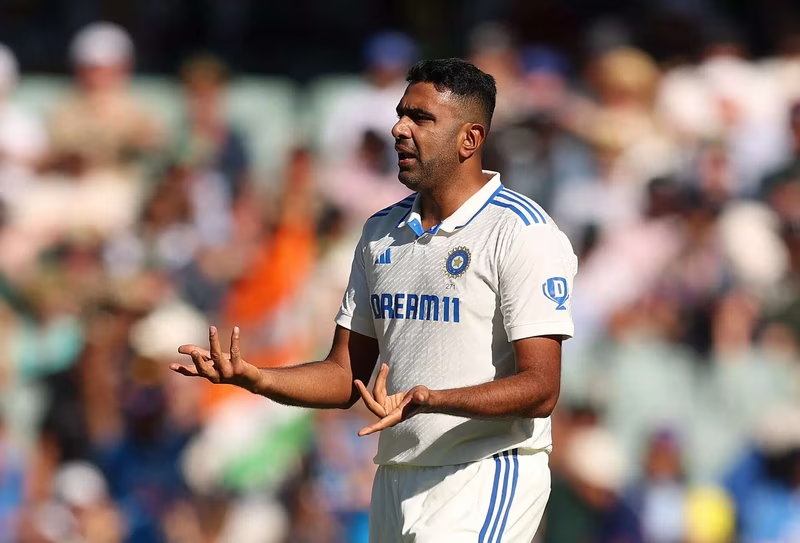
In a moment that felt more like a backyard gully match than India’s premier domestic tournament, a Manipur batter was given out under the obscure ‘hit ball twice’ law during a Ranji Trophy fixture. The dismissal—so rare it hadn’t occurred in the competition since 2005—prompted an immediate and sharp reaction from India’s spin legend, R Ashwin. On X (formerly Twitter), he quipped, “It’s out only in gully cricket,” igniting a fresh debate about the application of archaic rules in modern contexts .
The incident centered on Lamabam Ajay Singh, who instinctively used his bat to stop the ball from crashing into his stumps after playing a shot. While his intent was purely defensive, the on-field umpires deemed it a violation of MCC Law 34—and ruled him out. But was it the right call? And why did it draw Ashwin’s ire?
Table of Contents
- What Happened in the Ranji Match?
- Breaking Down the ‘Hit Ball Twice’ Dismissal
- Ashwin’s “Gully Cricket” Comment: What He Really Meant
- Historical Context: How Rare Is This Mode of Dismissal?
- MCC Law 34 Explained: When Is It Legitimate?
- Should the Law Be Updated for the Modern Game?
- Fan and Expert Reactions: Split Opinions
- Conclusion
- Sources
Understanding the Hit Ball Twice Dismissal
The ‘hit ball twice’ dismissal falls under Law 34 of the MCC’s Laws of Cricket. It states a batter is out if they “willfully strike the ball a second time with their bat or person,” unless it’s to protect their stumps or return the ball to a fielder .
In Lamabam Ajay Singh’s case, he played a shot, saw the ball ricochet dangerously toward his stumps, and tapped it away with his bat—clearly to avoid being bowled. The umpires, however, interpreted this as a “willful” second strike not made in the “act of playing the ball,” leading to his dismissal.
What Happened in the Ranji Match?
During Manipur’s clash against a stronger opponent, Lamabam Ajay Singh was on strike when he played a defensive push. The ball bounced off his bat, rolled back toward the stumps, and he instinctively blocked it with a second tap. The fielding side appealed, and after deliberation, the umpire raised his finger.
While technically within the letter of the law, many—including Ashwin—argued it violated the spirit of the game, which values fair intent over robotic rule enforcement.
Ashwin’s “Gully Cricket” Comment: What He Really Meant
Ashwin’s viral post wasn’t just sarcasm—it was a critique of inconsistent officiating. In informal gully cricket, such dismissals are often used humorously or arbitrarily. But in a structured, televised domestic tournament like the Ranji Trophy, applying such a rare law without clear malicious intent can appear pedantic.
His comment resonated because it highlighted a disconnect: elite cricket should prioritize fairness and intent, not penalize split-second reflexes meant to avoid dismissal.
Historical Context: How Rare Is This Mode of Dismissal?
The ‘hit ball twice’ dismissal is among cricket’s rarest. Consider this:
- The last such dismissal in the Ranji Trophy before this was in **2005**—nearly **20 years ago** .
- In international cricket, only **two** batters have ever been out this way: Russell Endean (SA, 1957) and Mohinder Amarnath (IND, 1986) .
- In the entire history of first-class cricket, fewer than 30 such dismissals are recorded.
Its rarity makes its sudden appearance in 2025 feel jarring—and possibly unnecessary.
MCC Law 34 Explained: When Is It Legitimate?
According to the official MCC Laws:
“A batter is out Hit the Ball Twice if they strike the ball a second time with their bat or person, except for the sole purpose of guarding their wicket or returning the ball to a fielder with their consent.”
Key phrase: **“sole purpose of guarding their wicket.”**
Critics argue that Lamabam’s action fits this exception perfectly—he wasn’t trying to score or manipulate the ball; he was saving his wicket. So why was he given out? It may come down to umpire interpretation, but that’s precisely the issue Ashwin is highlighting.
Should the Law Be Updated for the Modern Game?
Many experts believe Law 34 needs clarification or modernization:
- Remove ambiguity around “willful” vs. “reflexive” actions.
- Explicitly protect batters who tap the ball away from stumps in a single continuous motion.
- Reserve this dismissal only for clear cases of repeated striking to gain runs (e.g., deliberately hitting it twice to run extra).
As cricket evolves, so should its laws—especially those that penalize instinct over intent.
Fan and Expert Reactions: Split Opinions
Reactions online were polarized:
- Supporters of the decision cited “law is law” and warned that relaxing rules could open floodgates for exploitation.
- Critics**, including former players, sided with Ashwin, calling it a “harsh” and “unnecessary” call that kills the flow of the game.
One fan summed it up: “If you’re out for saving your stumps, the law is broken—not the player.”
Conclusion
The hit ball twice dismissal of Lamabam Ajay Singh may be technically correct, but it’s ethically and emotionally unsatisfying. R Ashwin’s “gully cricket” remark wasn’t just a throwaway line—it was a call for cricket to remember its soul. In a sport that celebrates resilience, instinct, and split-second decisions, penalizing a batter for trying not to get bowled feels like a step backward. Perhaps it’s time for the MCC and BCCI to revisit Law 34—not to abolish it, but to ensure it serves justice, not just procedure.