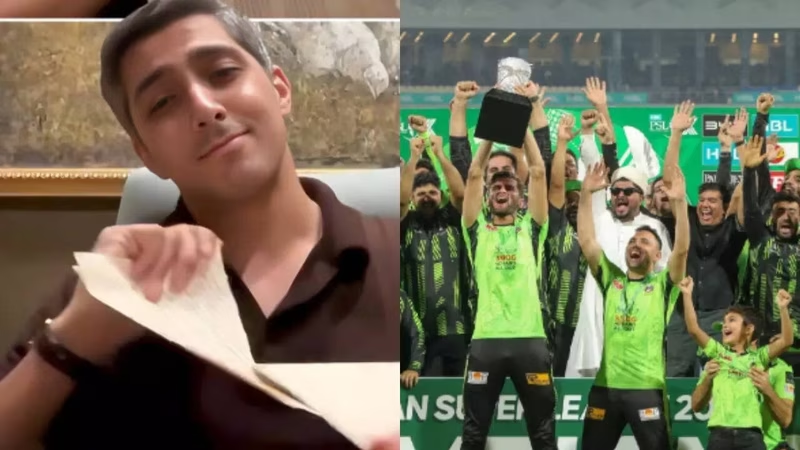
PSL Crisis: Multan Sultans Owner Threatens Legal Action
The Pakistan Super League (PSL) is facing one of its most serious internal crises yet. Ali Khan Tareen, the high-profile owner of Multan Sultans, has publicly accused the league’s management of “ghosting” his franchise during critical negotiations over valuation and renewal. In a dramatic turn, Tareen—who once famously tore up a show-cause notice from the PCB in 2022—now warns of impending legal action if the silence continues .
This isn’t just a boardroom spat. It’s a potential fracture in the foundation of Pakistan’s flagship T20 tournament, raising urgent questions about transparency, governance, and the future of franchise involvement in the PSL.
Table of Contents
- The Allegations: Ghosting and Exclusion
- Who Is Ali Khan Tareen? A Disruptive Force in PSL
- PSL Crisis Multan Sultans: What’s at Stake?
- History of Tensions Between Tareen and PCB
- The Franchise Valuation Dispute Explained
- Impact on PSL 2026 and Beyond
- Expert Perspectives on PSL Governance
- Conclusion
- Sources
The Allegations: Ghosting and Exclusion
In a strongly worded public statement, Ali Khan Tareen revealed that despite “multiple formal and legal communications,” the PSL management has failed to respond to Multan Sultans’ inquiries regarding the league’s upcoming renewal cycle and franchise valuation process .
“We are being treated as if we don’t exist,” Tareen said, claiming that other franchises have been engaged in discussions while Multan—the 2021 PSL champions—has been left out. This lack of communication, he argues, violates the spirit of partnership and could invalidate any future agreements.
PSL Crisis Multan Sultans: Legal and Financial Fallout
Tareen’s threat isn’t idle. The stakes are high:
- Contract Validity: If franchise owners weren’t consulted on revised terms, existing contracts could be legally challenged.
- Investor Confidence: Other owners may question PCB’s reliability, potentially affecting future bidding and sponsorship.
- League Credibility: The PSL’s reputation as a professionally run T20 league is on the line—especially as it competes with the IPL, SA20, and ILT20 for player talent and broadcast revenue.
Multan Sultans, valued at over $35 million, is one of the PSL’s most successful and visible franchises. Disenfranchising its ownership sends a dangerous signal to domestic and international investors .
Who Is Ali Khan Tareen? A Disruptive Force in PSL
Ali Khan Tareen isn’t your typical franchise owner. Son of influential politician Jahangir Tareen, he acquired the Multan Sultans in 2020 and quickly made headlines for his unorthodox style—including tearing up a PCB notice live on camera during a previous dispute .
Under his ownership, the team won its first PSL title in 2021 and consistently ranks among the league’s top performers in fan engagement and marketing. His willingness to challenge authority has earned him both admirers and critics—but never indifference.
History of Tensions Between Tareen and PCB
This isn’t the first clash:
- 2022: Tareen tore up a PCB show-cause notice over alleged contract violations.
- 2023: He publicly criticized PSL revenue-sharing models.
- 2024: Demanded greater transparency in player auction rules.
Each episode reflects a broader tension: private franchise owners vs. a state-controlled cricket board. The current standoff is the boiling point of that ongoing friction.
The Franchise Valuation Dispute Explained
As the PSL approaches its 10th season, the PCB is reportedly restructuring franchise agreements. Key issues include:
- Revised franchise fees (rumored to increase by 25–40%).
- New revenue-sharing percentages for broadcast and sponsorship.
- Longer contract durations (10+ years) to secure investor commitment.
Tareen insists that no official documentation or negotiation invitations have been sent to Multan Sultans—despite their repeated requests for inclusion .
Impact on PSL 2026 and Beyond
If unresolved, this dispute could delay the PSL 2026 season or even lead to Multan Sultans withdrawing—a scenario that would damage the league’s competitive balance and marketability.
[INTERNAL_LINK:psl-franchise-ownership-model-analysis] explores how other T20 leagues manage owner-board relations more collaboratively.
Expert Perspectives on PSL Governance
Former PCB official Najam Sethi once called the PSL “Pakistan’s biggest soft power export.” But governance experts warn that centralized control without owner consultation is unsustainable.
“Franchise leagues thrive on partnership, not paternalism,” said Dr. Ayesha Malik, sports economist at LUMS. “Ignoring a champion team’s ownership sets a terrible precedent.”
Conclusion
The PSL crisis Multan Sultans now represents more than a personal feud—it’s a test of the league’s maturity. Can the PCB evolve from a top-down administrator to a collaborative league partner? Ali Khan Tareen’s legal threat is a wake-up call. If the PSL wants to join the elite ranks of global T20 leagues, it must treat its franchise owners not as tenants, but as stakeholders. The clock is ticking—and the world is watching.