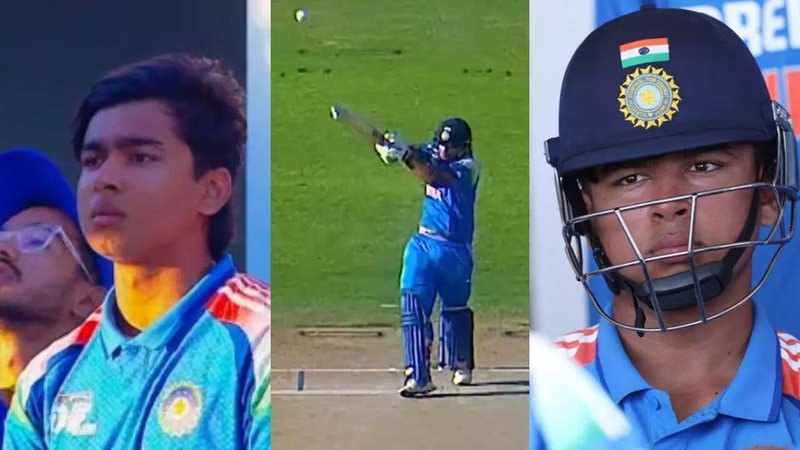
The cricketing world was left stunned—not by a six or a stunning catch—but by a glaring absence. In the high-stakes Super Over of the Asia Cup Rising Stars match between India A and Bangladesh A, teenage batting prodigy Vaibhav Suryavanshi watched from the dugout while his team crumbled to a score of zero .
It wasn’t just a loss. It was a catastrophic strategic blunder that ended India’s campaign and ignited a firestorm of debate: Why on earth wasn’t Vaibhav Suryavanshi sent out to bat? The 13-year-old had been India’s most consistent batter in the tournament, yet he was inexplicably benched at the moment that mattered most.
Table of Contents
- The Match That Ended in Zero
- Vaibhav Suryavanshi: The Teen Sensation
- The Controversial Super Over Decision
- What the Rules Say About Player Eligibility
- Expert Reactions and Fan Backlash
- Lessons for Indian Cricket
- Conclusion: A Missed Opportunity
- Sources
The Match That Ended in Zero
India A and Bangladesh A were locked in a tense finale in the Asia Cup Rising Stars—a tournament designed to showcase the next generation of Asian cricket talent. Bangladesh, chasing 132, looked set for victory at 121/5 with 10 balls left. But a dramatic late collapse, including three wickets in the final over, tied the match and forced a Super Over .
Hope surged for India. But that hope vanished in under 60 seconds. Sent in to bat first in the Super Over, India’s batters—Arshin Kulkarni and Uday Saharan—failed to score a single run. Both fell to Bangladesh’s Mustafa Sakib, and India was bowled out for 0 .
Just like that, the campaign was over. And the burning question remained: where was Vaibhav Suryavanshi?
Vaibhav Suryavanshi: The Teen Sensation
At just 13 years old, Vaibhav Suryavanshi has already become a household name in Indian cricket circles. Signed by the Rajasthan Royals for the IPL 2025 season, he’s known for his calm temperament, elegant strokeplay, and ability to anchor innings under pressure .
In the lead-up to this match, he’d been India A’s most reliable batter:
- Scored a fluent 40 against Afghanistan A.
- Top-scored in the practice games with consistent 30+ knocks.
- Demonstrated excellent game awareness and shot selection—rare for his age.
Given his form and composure, many expected him to be the go-to man in a high-pressure Super Over—especially against spin, which Bangladesh deployed effectively.
The Controversial Super Over Decision
The decision to send in Kulkarni and Saharan instead of Suryavanshi baffled fans and experts alike. Neither batter had shown strong form in the death overs, and both are more comfortable in the middle order.
Multiple theories have emerged:
- Fielding restrictions: Some speculate the team wanted better fielders, but Suryavanshi is no liability in the field.
- Match-up concerns: Perhaps the captain feared his inexperience against Sakib’s variations—but Suryavanshi has faced high-quality spin in domestic cricket.
- Lack of clear communication: Reports suggest confusion in the dugout about who was “ready,” but that points to poor preparation, not strategy.
Whatever the reason, the outcome was indefensible. As former India selector Saba Karim noted, “When you have your best batter available, you send him in. Period.”
What the Rules Say About Player Eligibility
According to ICC playing conditions for such tournaments, any player who has batted, bowled, or fielded in the main match is eligible for the Super Over . Vaibhav Suryavanshi batted at No. 4 in the main innings, scoring 18 runs before being dismissed. He was 100% eligible—and arguably the best-placed to handle the pressure.
There was no injury, no tactical substitution rule violation. This was purely a captaincy and coaching error.
Expert Reactions and Fan Backlash
Cricket analysts were scathing in their assessment:
- Aakash Chopra called it “a massive oversight that cost India the match.”
- Irfan Pathan tweeted: “You don’t hide your best player in a Super Over. That’s not strategy—that’s panic.”
- On social media, #BringVaibhav trended across India, with fans demanding accountability.
The incident has also raised broader questions about how young talent is managed in high-pressure environments.
Lessons for Indian Cricket
This isn’t just about one match. It’s about a mindset. Indian cricket has long struggled with balancing protection and exposure for its young stars. While shielding Vaibhav might seem like care, it deprives him—and the team—of crucial experience.
As [INTERNAL_LINK:youth-cricket-development] experts argue, the path to greatness is paved with high-stakes moments, not benchwarmers.
Conclusion: A Missed Opportunity
The decision to bench Vaibhav Suryavanshi in the Super Over wasn’t just a tactical error—it was a missed opportunity to trust a future star. In a tournament built to nurture rising talent, India A’s leadership failed to give their most promising batter the stage he deserved.
Hopefully, this painful lesson will lead to smarter, bolder decisions in the future. Because if India wants its next generation to thrive, it must stop sitting them on the sidelines when the game is on the line.