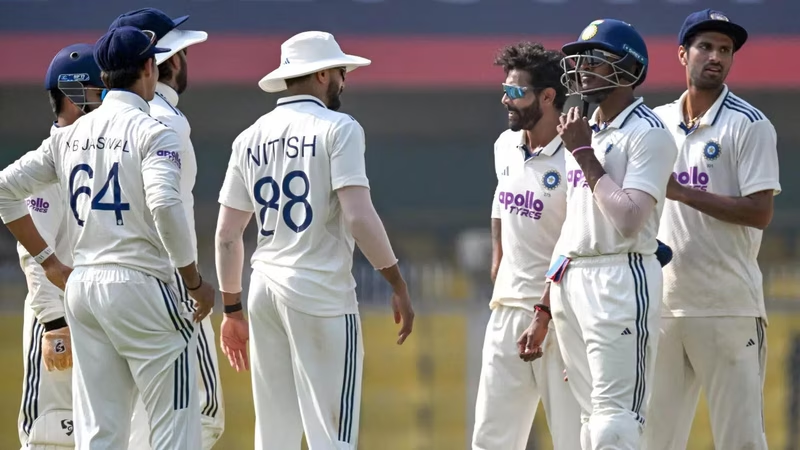
Remember when the thought of an Indian Test team losing a series at home felt like a distant, almost impossible, nightmare? Those days are gone. India has now suffered a humiliating whitewash on home soil, and the problem runs far deeper than just a few bad shots or a misfiring bowler. The core issue is structural: India’s home Test collapse is a direct symptom of a collapsed feeder line and a dried-up player pool .
Table of Contents
- The Shocking Reality of India’s Home Test Collapse
- From Fortress to Failure: The End of an Era
- The Golden Era of Player Development Under Dravid
- The Broken Pipeline: Why the Feeder Line Collapsed
- Questionable Selections: A Symptom of Desperation
- Is There a Way Back for Indian Cricket?
- Conclusion
- Sources
The Shocking Reality of India’s Home Test Collapse
The recent meek defeats on familiar pitches are not an anomaly; they are the new normal. India has lost five of its last seven home Tests , a statistic that would have been unthinkable just a few years ago. This isn’t just a team in a slump; it’s a system in crisis. The once-vaunted conveyor belt of talent from the domestic circuit to the international stage has ground to a halt, leaving selectors with few viable options beyond the established, and aging, stars.
From Fortress to Failure: The End of an Era
For over a decade, India was synonymous with home dominance. The spinners ruled, the batsmen were secure, and visiting teams dreaded the tour. That era was built on a foundation of deep bench strength. The end of that era has been marked by a philosophical confusion in team selection and a mishandling of the transition from one generation to the next . The team’s inability to chase modest totals or hold a batting surface in Guwahati is a stark indicator of a side lacking in both skill and mental fortitude .
The Golden Era of Player Development Under Dravid
The contrast couldn’t be sharper when we look back at the highly successful player development process under Rahul Dravid. When Dravid took charge of the India A and U-19 teams in 2015, he instilled a culture of discipline, hard work, and a focus on the longer format . This system was a factory for future stars. Players like Shubman Gill, Rishabh Pant, and Washington Sundar were all blooded and groomed in this rigorous environment, emerging as Test-ready cricketers . Dravid’s biggest achievement was arguably creating a deep and competitive talent pool that gave the senior team a clear succession plan .
The Broken Pipeline: Why the Feeder Line Collapsed
So, what went wrong? The robust development system appears to have been inadvertently dismantled. An over-reliance on IPL performances for selection has led to a generation of batsmen who are ill-equipped for the unique demands of Test cricket . The focus has shifted from building patient, technically sound players to explosive, high-risk entertainers. While the BCCI has recently announced a return to the zonal format for the Duleep Trophy and emphasized mandatory domestic cricket, these feel like reactive measures to a problem that has been festering for years [[25], [29]].
Questionable Selections: A Symptom of Desperation
The most glaring evidence of a dried-up player pool is the selection of players like Nitish Kumar Reddy. His inclusion, despite minimal first-class experience and inconsistent performances, has drawn widespread criticism from former players and experts alike [[19], [20]]. Veteran off-spinner R. Ashwin publicly questioned his selection, pointing out his minimal bowling contribution in a Test match—a role he was ostensibly picked to fulfill . Such decisions are not just about one player; they are a clear signal that the selectors are scraping the bottom of the barrel, unable to find a genuine middle-order batter ready for the highest level.
Is There a Way Back for Indian Cricket?
The path to recovery is long but not impossible. It requires a fundamental shift in philosophy:
- Re-prioritize First-Class Cricket: The Ranji Trophy and other domestic tournaments must be given the status and schedule they deserve, free from the shadow of the IPL.
- Reinstate the ‘A’ Team as a Crucible: The India ‘A’ team tours must become the primary testing ground for future Test players, focusing on red-ball skills and mental resilience.
- Trust the Process, Not Just the Hype: Selectors must look beyond social media buzz and IPL strike rates, focusing on a player’s temperament and technique in multi-day cricket.
There are signs of a course correction, with the BCCI issuing a 10-point policy mandating domestic cricket for national selection, which is a step in the right direction . However, rebuilding a culture takes time and unwavering commitment.
Conclusion
India’s home Test collapse is not a temporary blip; it is the painful result of a strategic failure in player development. The dismantling of a once-successful feeder system has left the national team vulnerable and exposed. To reclaim its home dominance, Indian cricket must look inward, recommit to its domestic roots, and rebuild the pipeline that once made its Test team a global powerhouse. The legacy of the Dravid era provides a clear blueprint—it’s time to follow it again.