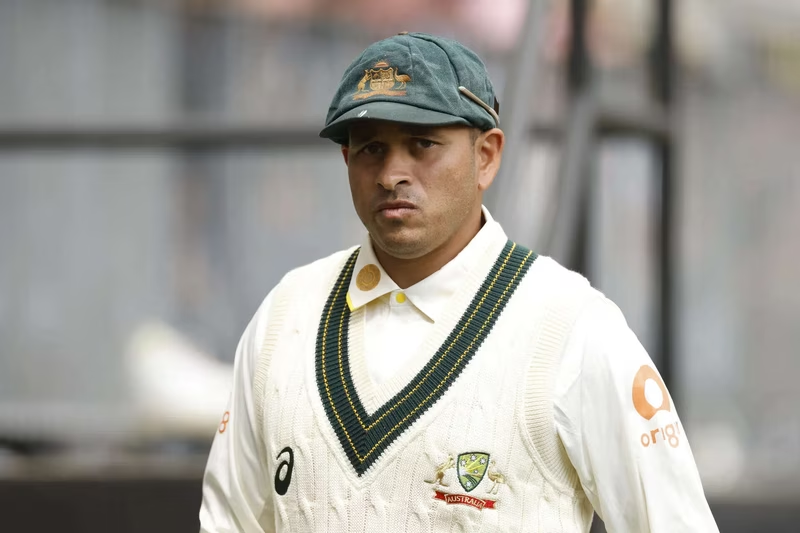
A major selection headache has descended upon the Australian cricket camp just days before the pivotal day-night Test at the Gabba. Veteran opener Usman Khawaja has been officially ruled out due to a persistent back injury, throwing the team’s top-order stability into chaos and opening a Pandora’s box of strategic dilemmas for selectors [[1], [4], [6]].
With Cricket Australia confirming that Khawaja will not be replaced in the 14-man squad, the responsibility to fill his huge shoes falls on the shoulders of two relatively unproven candidates: the explosive Josh Inglis or the in-form all-rounder Beau Webster [[12], [14]]. The decision is far from simple, and its ripple effects could alter the course of the entire Ashes series.
Table of Contents
- The Khawaja Injury and Its Impact
- Australia’s Opening Batsmen Dilemma
- The Case for Josh Inglis
- The Case for Beau Webster
- Strategic Implications for the Gabba Test
- Conclusion: A Crossroads for Australian Cricket
- Sources
The Khawaja Injury and Its Impact
The news of Khawaja’s absence is a significant body blow to Australia’s Ashes campaign. The 38-year-old left-hander has been a pillar of the team’s batting lineup, renowned for his gritty resilience and ability to see off the new ball, a crucial skill at the notoriously bouncy Gabba. His departure isn’t just a loss of runs; it’s a loss of experience and a calming presence at the top of the order .
The fact that selectors have opted against naming a direct replacement from outside the squad suggests they have firm faith in the players already on-site. However, it also highlights the precarious nature of their batting depth. This move puts immense pressure on the chosen successor to deliver an immediate impact on one of cricket’s biggest stages .
Australia’s Opening Batsmen Dilemma
With Usman Khawaja sidelined, Australia’s quest for a stable opening combination faces its toughest test. The two main contenders from the existing squad present contrasting profiles, each with significant pros and cons.
The Case for Josh Inglis
Josh Inglis, the dynamic wicketkeeper-batsman, has been knocking on the Test door for some time. While he has a Test century to his name (a brilliant 102) , his experience at the top of the order in the longest format is virtually non-existent. Inglis is known for his aggressive, 360-degree stroke play, a style that has made him a star in white-ball cricket [[18], [20]].
Proponents of Inglis argue that his fearless approach could unsettle the English bowlers early on. His recent form, including a century against the England Lions , demonstrates his readiness for the challenge. However, the major question mark is whether his aggressive instincts can be tempered for the patient, attritional battle that Test match opening often demands, especially against a seasoned attack like England’s.
The Case for Beau Webster
The other option is the remarkable story of Beau Webster. The 41-year-old all-rounder made his long-awaited Test debut earlier this year and has already shown he can handle the pressure, contributing crucial runs and wickets [[29], [36]]. A powerful right-hander, Webster has batted in virtually every position in the top eight for Tasmania, showcasing his incredible versatility .
Choosing Webster would be a bold, perhaps even romantic, move. His experience and composure could provide a steadying influence alongside David Warner or Travis Head. However, playing him as an opener would likely mean sacrificing a frontline bowler from the attack, a significant tactical shift for a team that often relies on its pace battery. His primary value has been as a bowling all-rounder, and his selection at the top could disrupt that balance .
Strategic Implications for the Gabba Test
The selectors’ choice will have a profound impact on Australia’s entire game plan:
- Go with Inglis: This signals an intent to play an attacking brand of cricket from ball one. It keeps the bowling attack intact but risks early wickets if Inglis can’t curb his natural aggression on a fresh pitch.
- Go with Webster: This prioritizes experience and batting stability but forces a re-jig of the bowling lineup. It’s a more conservative choice that banks on weathering the early storm before letting the middle order, featuring the likes of Smith and Green, take over.
Another, perhaps less likely, scenario involves promoting an established middle-order batsman like Travis Head back to the top. Head has opened before and scored a century in Perth, but moving him would then create a vacancy in his usual position, causing a chain reaction through the lineup .
Conclusion: A Crossroads for Australian Cricket
The absence of Usman Khawaja has thrust Australian selectors into a high-stakes game of chess. The decision between Josh Inglis’s explosive potential and Beau Webster’s seasoned grit is not just about who will face the first ball at the Gabba; it’s a statement about the team’s philosophy and their vision for navigating a critical juncture in the Ashes. One thing is certain: whoever gets the nod will be stepping into the spotlight on a stage that can either launch a career or expose its limitations. The puzzle is deep, but the solution will define Australia’s path forward in this historic series.
Sources
- Associated Press. “Australia batter Khawaja is out of the 2nd Ashes test.” [INTERNAL_LINK:ashes-news]
- Cricket Australia. “Australia look for new opener as Usman Khawaja ruled out.” [INTERNAL_LINK:australia-cricket-news]
- ESPNcricinfo. “Josh Inglis – Career Stats, Records & Profile.” https://www.espncricinfo.com/
- ESPNcricinfo. “Beau Webster stars on debut in fifth Test between Australia and India.” https://www.espncricinfo.com/