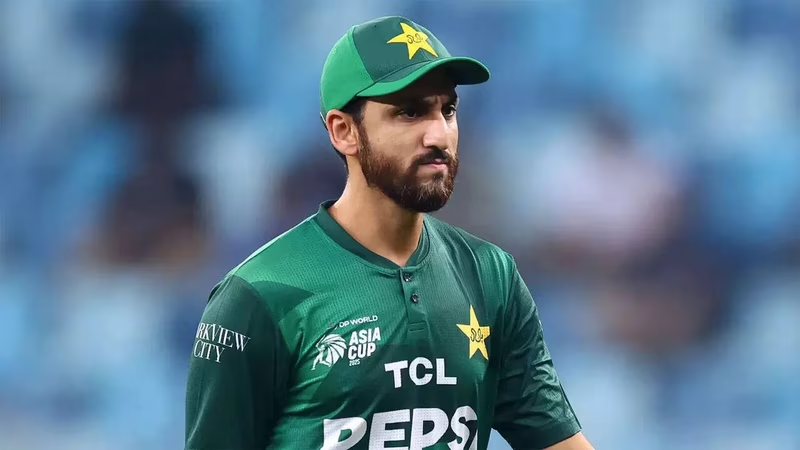
Why Pakistan’s T20 Captain Was Snubbed by Franchise Leagues
In a twist that has left the cricketing world talking, Salman Ali Agha, the official captain of Pakistan’s T20I side, is the only one of the PCB’s top-tier, centrally contracted players who will not be plying his trade in the lucrative overseas T20 leagues this winter. While his teammates like Babar Azam, Mohammad Rizwan, and Shaheen Afridi have secured spots in the BBL, ILT20, and BPL , Agha remains at home—not because the PCB denied him clearance, but because no franchise was willing to pick him up .
This stark reality raises serious questions about his standing in the global T20 market and, more pressingly, about his role in Pakistan’s own short-format future. With major tournaments on the horizon, his lack of match practice could be a significant problem.
Table of Contents
- The PCB’s Greenlight for Stars
- Salman Ali Agha’s Franchise Flop
- Form vs. Captaincy: The Contradiction
- The Cost of Staying Home
- What’s Next for Pakistan’s Captain?
The PCB’s Greenlight for Stars
The Pakistan Cricket Board (PCB) has taken a remarkably open stance this winter, granting No-Objection Certificates (NOCs) to a host of its marquee players. This move is a strategic shift aimed at keeping its top talent sharp and competitive on the global stage .
Names like Babar Azam, Fakhar Zaman, and Naseem Shah have all received the green light to join various leagues, including the high-profile ILT20 in the UAE and the Big Bash League (BBL) in Australia . This policy, which reverses a previous suspension on NOCs from October 2025 , signals the PCB’s intent to be a player-friendly board and prepare its squad for the rigors of international cricket.
Salman Ali Agha’s Franchise Flop
Yet, in the midst of this player exodus, one name is conspicuously absent: Salman Ali Agha. Despite being nominated for the BBL draft , he went unpicked in the primary squad selections. His name was also on the list for the Bangladesh Premier League (BPL) 2026 auction, but he failed to attract a single bid, making him the only current national captain from a top cricketing nation to be unsold .
This isn’t a case of the PCB holding him back. In fact, had a franchise shown interest, he would have been granted an NOC just like his peers. The harsh truth is that his value in the T20 marketplace has plummeted. Franchise owners, who are looking for explosive match-winners, have seemingly overlooked Agha in favor of more dynamic options.
Form vs. Captaincy: The Contradiction
The central dilemma for Salman Ali Agha is the growing gap between his official title and his on-field output. While he led Pakistan to a T20I series win against the West Indies in the U.S. in August 2025 , his personal batting returns have been underwhelming.
His recent performances tell a stark story:
- In a T20I series, he scored just 3, 9, and 12 runs across three matches .
- His T20I career strike rate sits at 115.85, which is considered below par for a modern top-order batsman in the power-hitting era .
- While he has had a few notable innings, like his 56 against Bangladesh in May 2025 , his consistency has been a major issue.
Franchises are investing millions and need players who can deliver instant impact. Agha’s perceived role as a stabilizing, rather than explosive, batsman may not fit the aggressive brand of cricket these leagues demand. This raises a critical question for the PCB: is he the right man to lead the T20I side into the future?
The Cost of Staying Home
The consequences of this snub are far-reaching. While other Pakistani stars will be gaining invaluable high-pressure experience in competitive leagues, Salman Ali Agha will be left without any top-level cricket for months. The winter leagues are a crucial proving ground, and this lack of match practice could severely hamper his preparation for upcoming ICC events and bilateral series.
This situation is particularly ironic. The very job of a national captain is to be a team’s best player and lead from the front. If he’s not deemed good enough for a franchise league, can he truly be the leading light for his country? This paradox puts the PCB in a difficult position, balancing leadership stability with the need for peak on-field performance.
What’s Next for Pakistan’s Captain?
As the BBL, ILT20, and BPL get underway in December 2025 , all eyes in Pakistan will be on their overseas stars. Back home, however, Salman Ali Agha faces a period of intense introspection and hard work. He must use this time to rebuild his game, refine his power-hitting, and silence his critics.
His future as Pakistan’s T20I captain is now under a microscope. The PCB may have to consider whether a change in leadership is needed to better reflect the team’s playing philosophy and ambitions on the world stage. For now, Agha’s winter of discontent serves as a powerful reminder that in the cutthroat world of T20 cricket, even a captain’s armband offers no immunity from the market’s judgment.
Summary
Salman Ali Agha’s exclusion from the 2025-26 winter T20 leagues is not a PCB decision but a market verdict. His lack of franchise interest, driven by inconsistent form and a perceived lack of explosive power, leaves him isolated from his peers and without crucial match practice. This situation casts a long shadow over his future as Pakistan’s T20I captain and presents a significant challenge he must overcome to retain his place at the top.
Sources
- PCB grants NOCs to players for foreign leagues: , , ,
- Salman Ali Agha unsold in BPL and not picked for BBL: , , ,
- Salman Ali Agha’s performance stats and captaincy record: , , ,
- Winter T20 league schedule: