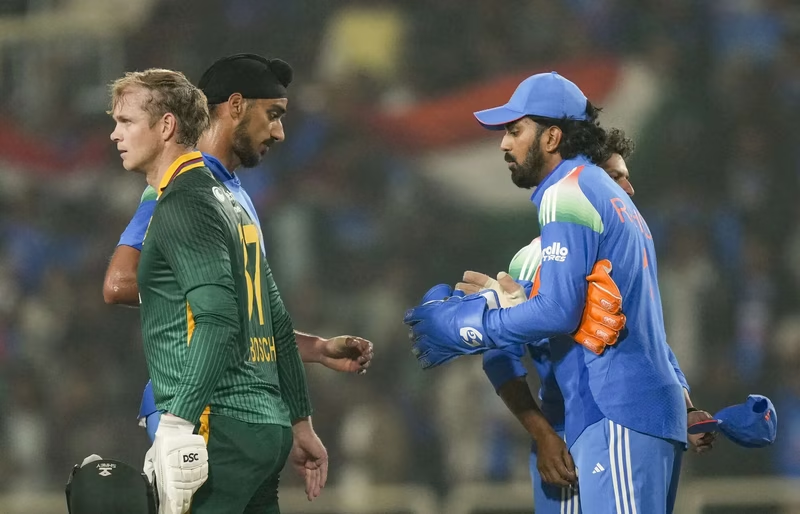
In a match that defied all logic, India posted a colossal 358/5 against South Africa in the 2nd ODI at Raipur, only to watch the Proteas pull off a stunning four-wicket victory. The home crowd was left stunned, and at the heart of the confusion was captain KL Rahul, who later delivered a brutally honest post-match assessment. His words, “I’m kicking myself,” have since become the defining quote of a game where traditional cricketing wisdom was turned on its head.
Rahul didn’t just lament the loss; he pinpointed two very specific, environmental factors that he believes were the decisive culprits. For any fan trying to understand this India ODI defeat, his explanation is crucial. Let’s break down what really happened on that dew-laden Raipur pitch.
Table of Contents
- What Happened in the Match?
- KL Rahul’s Real Reasons for India’s ODI Defeat
- South Africa’s Record-Breaking Response
- Expert Analysis: Did India Over-Rely on Batting?
- What This Means for the Rest of the Series
- Conclusion
- Sources
What Happened in the Match?
The script seemed written for an Indian victory. On a flat Raipur track, the Men in Blue delivered a batting masterclass. Virat Kohli and Ruturaj Gaikwad both slammed centuries, powering India to a target that, on paper, looked unassailable at 358/5. The belief was that the bowlers, even without their absolute best, would get the job done on a slow pitch.
However, cricket is played on the field, not on paper. South Africa’s openers started steadily, and despite a few wickets, they never lost their nerve. Heinrich Klaasen’s explosive 74 and David Miller’s calm 71* guided them home with five balls to spare, scripting their highest-ever successful chase against India .
KL Rahul’s Real Reasons for India’s ODI Defeat
In the post-match press conference, a visibly frustrated Rahul didn’t shy away from calling out the critical elements that derailed his team’s plans. His analysis was clear and focused on two non-negotiables of the game: the toss and the weather.
“The toss and the heavy dew played a major role. It was extremely difficult to grip the ball in the second innings. We needed to be a lot sharper in the first 10 and last 10 overs,” Rahul stated .
Rahul’s point about the heavy dew is a well-known phenomenon in Indian conditions during the evening. The moisture on the outfield and the ball makes it incredibly challenging for spinners to turn the ball and for fast bowlers to execute yorkers or slower deliveries. The ball becomes wet and slippery, often leading to full tosses and misfields.
By losing the toss, India was forced to bat first, a decision that seemed perfect until the evening dew set in. Had they bowled first in drier conditions, they could have exploited the new ball on a surface that offered some assistance early on. This single coin flip, according to Rahul, was a “huge part” of the outcome .
South Africa’s Record-Breaking Response
While Rahul focused on the external factors, South African skipper Temba Bavuma was full of praise for his team’s internal resolve. He highlighted two key elements in their victory.
- Tactical Acumen: Bavuma’s decision to promote David Miller up the order proved to be a masterstroke, counteracting India’s spin threat in the middle overs.
- Internal Competition: The intense fight for places within the squad has created a “never-say-die” attitude, with every player determined to prove their worth .
South Africa’s total of 362/6 wasn’t just a win; it was a statement of their new-found depth and resilience in overseas conditions.
Expert Analysis: Did India Over-Rely on Batting?
Rahul’s explanation, while valid, raises a bigger strategic question: Is it a sustainable plan to rely so heavily on the bat? For a team with world-class batters, the instinct is to pile on the runs. However, this match exposed a potential flaw in the team’s bowling strategy, especially in high-pressure chases under dewy conditions.
The Indian pace attack, missing its usual bite, struggled to execute basic plans. The spinners, who are usually India’s strength at home, were rendered almost ineffective. A more balanced approach, perhaps with an extra seamer or a different plan for the death overs, might have been necessary. This is a critical area for Rahul and the coaching staff to address before the next match. For more on team balance strategies, see our guide on effective ODI team composition.
What This Means for the Rest of the Series
Despite the shock defeat, India went on to win the series, proving their overall superiority. However, this loss in Raipur is a significant data point. It’s a stark reminder that in modern ODI cricket, a big total is never enough.
For Rahul, the learnings are clear. Future captains will need to factor in the dew factor more aggressively in their game planning, possibly even requesting more day games in the schedule. It’s also a lesson in bowling depth, as teams can no longer afford to have just one-dimensional bowlers. This is a trend we’re seeing across all top-tier cricket nations, as highlighted by the International Cricket Council’s recent match analysis reports.
Conclusion
The India ODI defeat in Raipur was a perfect storm of a record-breaking chase by a determined South African side and a perfect set of conditions—dew and a lost toss—that worked against the hosts. While KL Rahul’s frustration is understandable, the real value lies in the lessons learned. For fans, it was a thrilling, heart-stopping game. For the team, it’s a blueprint of what to avoid and what to prepare for in the future. One thing is certain: in cricket, there are no guarantees, no matter how big the total.
Sources
- Times of India. (2025). ‘I’m kicking myself’: KL Rahul reveals ‘real’ reasons behind India’s shock defeat. https://timesofindia.indiatimes.com/…
- Web Search Results on KL Rahul’s comments regarding the toss and dew [[1], [2], [4], [5]].