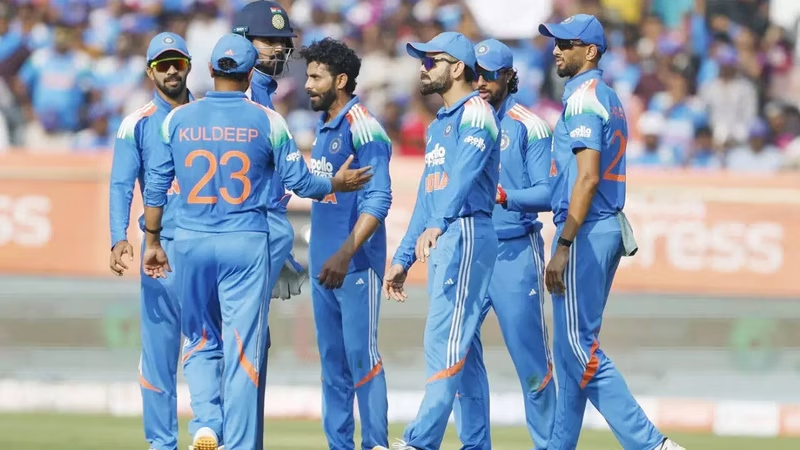
India may have clinched a hard-fought 2-1 ODI series victory over South Africa in December 2025, but their celebration was slightly dampened by an India over-rate penalty that caught fans by surprise. Led by KL Rahul, the Indian team was fined 10% of their match fee during the second ODI in Raipur for failing to maintain the required bowling pace .
But what exactly triggered this sanction? And why should fans and fantasy cricket managers care about something as technical as over-rates? Let’s dive deep into the details, the ICC regulations, and what this means for India’s future under Rahul’s leadership.
Table of Contents
- What Happened in the SA ODI?
- ICC Article 2.22 Explained: The Rule Behind the Fine
- Why Does Over-Rate Matter in ODIs?
- KL Rahul’s Captaincy Under Scrutiny
- Historical Context: Has India Been Fined Before?
- What Does This Mean for Future Series?
- Conclusion
- Sources
What Happened in the SA ODI?
During the second ODI of the India vs South Africa series in Raipur, the Indian bowling side failed to complete their 50 overs within the stipulated time. As a result, match referee imposed a 10% match fee fine on all 11 players . This isn’t just a slap on the wrist—it’s a formal breach of the ICC’s Code of Conduct, and it carries both financial and reputational consequences.
While the exact number of overs short wasn’t disclosed in official reports, a 10% penalty typically suggests the team was two overs behind schedule, since the ICC levies a 5% match fee deduction per over short under Article 2.22 .
India over-rate penalty and ICC Article 2.22 Explained
The governing rule behind this sanction is Article 2.22 of the ICC Code of Conduct for Players and Player Support Personnel. Here’s what it states in plain terms:
“Players are fined five per cent of their match fee for every over their team fails to bowl within the stipulated time, up to a maximum of 50%” .
This means:
- 1 over short = 5% match fee penalty
- 2 overs short = 10% match fee penalty (as in India’s case)
- 10 overs short = 50% (maximum cap)
While no World Test Championship points are at stake in ODIs (unlike in Test matches), the financial sting—and potential impact on future captaincy evaluations—remains real.
Why Does Over-Rate Matter in ODIs?
Slow over-rates frustrate fans, broadcasters, and organizers alike. In an era where cricket is competing for attention with other fast-paced sports and entertainment, time efficiency is critical. A delayed match can disrupt TV schedules, affect stadium logistics, and even lead to shortened games if weather intervenes.
The ICC has been steadily tightening enforcement to protect the sport’s commercial and viewer experience. Teams like England have also faced similar sanctions recently, proving that no nation is exempt .
KL Rahul’s Captaincy Under Scrutiny
This fine comes during KL Rahul’s second series as full-time ODI captain, following a promising start where he scored 60 and 66* in the first two matches . While his batting and leadership were praised, this over-rate breach adds a layer of complexity to his captaincy review.
As captain, Rahul bears ultimate responsibility for on-field time management—over changes, DRS reviews, and field adjustments all contribute to delays. The ICC holds the captain accountable for ensuring his team adheres to pace requirements, even if the delay stems from uncontrollable factors like injuries or DRS checks.
Historical Context: Has India Been Fined Before?
Yes—India has a recurring history with slow over-rate penalties. Under previous captains like Virat Kohli and Rohit Sharma, India has been fined multiple times across formats. However, with the ICC now emphasizing zero tolerance, even minor breaches are being penalized more consistently.
This trend reflects a broader shift in cricket governance: efficiency is now part of performance.
What Does This Mean for Future Series?
For upcoming tournaments—especially ICC events like the Champions Trophy or the 2027 ODI World Cup—teams will need to prioritize time management as seriously as batting or bowling strategy.
For fans following [INTERNAL_LINK:fantasy-cricket-tips] or [INTERNAL_LINK:india-odi-squad-analysis], this penalty is a reminder that captaincy isn’t just about runs and wickets—it’s also about discipline and adherence to protocol.
Conclusion
The India over-rate penalty in the South Africa ODI may seem like a minor footnote in an otherwise successful series. But it’s a clear signal from the ICC: pace matters. For KL Rahul and Team India, balancing aggressive cricket with procedural discipline will be key to long-term success—on the field and in the record books.
Sources
- Times of India: Why was KL Rahul-led India penalised in the South Africa ODI? [[1], [2], [6]]
- ICC Code of Conduct Summary: ICC Official Document
- Cricket.com: India vs South Africa ODI Series Recap [[5], [8]]
- ESPNcricinfo: England fined for slow over-rate