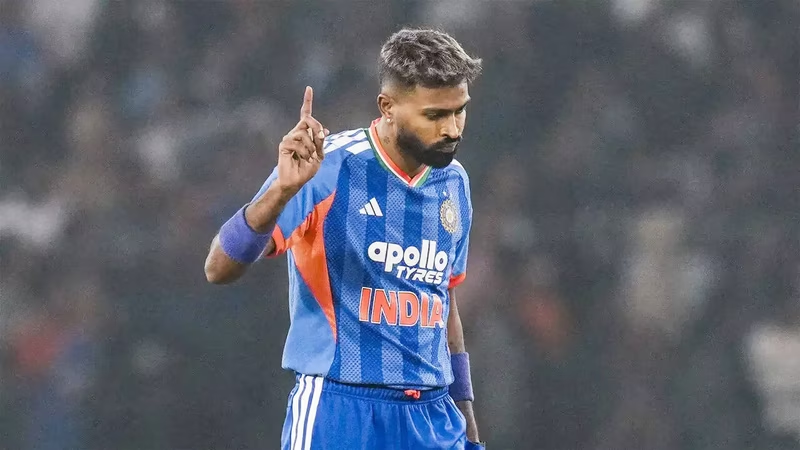
India’s emphatic 101-run demolition of South Africa in the 1st T20I in Cuttack wasn’t just about Hardik Pandya’s explosive 59 off 28 balls. It also raised a burning tactical question on every fan’s lips: Why wasn’t Hardik Pandya used in the Powerplay? The answer, it turns out, is a masterclass in modern T20 captaincy and resource management, as explained by skipper Suryakumar Yadav himself.
Table of Contents
- The Powerplay Puzzle: A Deliberate Tactic
- Suryakumar Yadav’s Tactical Vision for India
- Hardik Pandya: The Precious Asset in his Comeback
- Why Not the Powerplay? A Deeper Dive
- Fan Reactions and Expert Analysis
- Conclusion: A New Era of Calculated Cricket
- Sources
The Powerplay Puzzle: A Deliberate Tactic
In the high-octane world of T20 cricket, the Powerplay (the first six overs) is typically reserved for a team’s best death or new-ball bowlers. So, when India’s Hardik Pandya bowling strategy excluded him from this crucial phase, eyebrows were raised. Pandya, known for his clever variations and ability to contain runs, seemed a natural fit.
However, the decision was far from an oversight. It was a calculated, captain-driven plan. Post-match, Suryakumar Yadav didn’t just explain it; he framed it as a cornerstone of India’s evolving T20 philosophy centered around balance, fearlessness, and intelligent player deployment .
Suryakumar Yadav’s Tactical Vision for India
Surya’s leadership has been defined by a “fearless” brand of cricket. After a shaky start at 48/3, his team roared back to post a competitive 175, a testament to their newfound batting depth . But his captaincy extends far beyond just encouraging big hits.
His press conference revealed a multi-layered approach to building a T20 World Cup-winning side. He’s not just managing a match; he’s managing a 15-player squad over an entire series and a high-stakes tournament cycle. His comments about welcoming the “good headache” of having both Pandya and Shubman Gill back speak volumes about his focus on long-term team balance .
This vision of “balance” is crucial. It’s the very reason Pandya’s return was so highly anticipated, as he offers the rare dual threat with bat and ball . Surya’s strategy is to maximize this balance, not just use it in a vacuum during a single game.
Hardik Pandya: The Precious Asset in his Comeback
We can’t discuss this strategy without acknowledging the context of Pandya’s return. He was only recently cleared for competitive cricket after a significant left quadriceps injury sustained during the 2025 Asia Cup . His domestic comeback for Baroda in early December was a critical step before this international return .
For Suryakumar Yadav, Pandya isn’t just another bowler; he’s a precious asset whose workload must be managed meticulously, especially in a long series leading up to a major tournament. Throwing him into the high-pressure, high-impact Powerplay on his first game back could have been a risk. Instead, using him for his first over in the middle phase, where he claimed the wicket of Tristan Stubbs, was a perfect, controlled reintroduction .
The focus isn’t just on what Pandya can do today, but on ensuring he’s firing for the all-important T20 World Cup.
Why Not the Powerplay? A Deeper Dive
So, what are the specific tactical reasons behind holding back Pandya? It’s a cocktail of smart T20 thinking:
- Workload Management for a Returning Star: As mentioned, his recent injury history makes him a player to be handled with care. The Powerplay is physically demanding, requiring a bowler to be at their absolute sharpest from ball one.
- Exploiting the Middle Overs: The middle overs (7-15) are often where a game can be won or lost. This is where Pandya’s slower balls, yorkers, and clever changes of pace are most effective at breaking partnerships. Surya likely wanted his ace up his sleeve for this critical phase, not to be used up in the first six.
- Having Trusted Powerplay Specialists: India has a wealth of talent. Arshdeep Singh and a fit Mohammed Siraj are proven, reliable options with the new ball who can execute the Powerplay plan without needing to be saved for later.
- The “Fearless” Depth Strategy: Surya’s confidence in his batting lineup—evident from the recovery from 48/3—means he doesn’t necessarily need his all-rounder to bowl first. He can afford to use him in a more strategic, match-defining role later on .
Fan Reactions and Expert Analysis
The decision has sparked a lively debate online. While some fans questioned the move, many analysts have praised Surya’s foresight. By not being predictable and using his resources in a way that serves both the immediate match and the long-term series goals, he’s demonstrating a maturity that India’s T20 leadership has sometimes lacked.
This approach aligns with modern coaching philosophies that view players as holistic assets, not just as a collection of stats to be deployed in a set order. You can learn more about these evolving coaching strategies from authoritative sources like the International Cricket Council (ICC).
For fans of team dynamics, this is a fascinating case study in [INTERNAL_LINK:team-strategy-in-modern-t20-cricket]. And for those tracking player careers, it’s a key moment in [INTERNAL_LINK:hardik-pandya-comeback-journey].
Conclusion: A New Era of Calculated Cricket
Suryakumar Yadav’s explanation for the Hardik Pandya bowling strategy is more than just a post-match justification. It’s a window into a new, more cerebral era of Indian T20 cricket. It’s a strategy built on managing a returning star, leveraging deep squad talent, and making bold, unconventional calls for long-term gain.
The 101-run victory wasn’t just a win on the scoreboard; it was a validation of this new tactical blueprint. As the series against South Africa progresses, we can expect more such nuanced decisions that prioritize team balance and future readiness over short-term, predictable tactics.
Sources
- Times of India: Why Hardik Pandya didn’t bowl in the Powerplay: Suryakumar Yadav explains
- ESPNcricinfo: Match report and quotes from the India vs South Africa 1st T20I (Dec 9, 2025)
- Web search results on Hardik Pandya’s injury and comeback [[15], [16], [17]]
- Web search results on Suryakumar Yadav’s press conference and team strategy [[9], [18], [26]]