‘Bowling Fast Helps Me Pay My Rent’: Lockie Ferguson’s Raw Truth About Pace, Pressure, and Survival in T20 Cricket
“Bowling slow won’t get me picked. Bowling fast helps me pay my rent.”
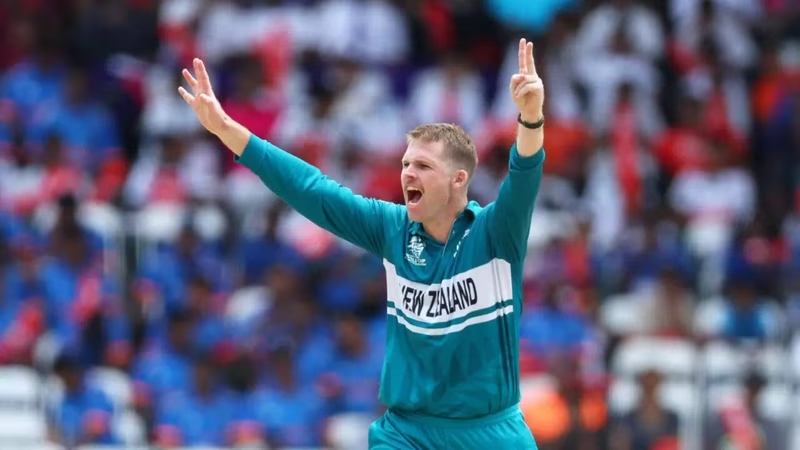
That’s not a boast. It’s a survival mantra. And coming from Lockie Ferguson—New Zealand’s fire-breathing speedster and current Desert Vipers captain—it’s also the unfiltered truth behind one of T20 cricket’s most electrifying talents. In an exclusive conversation during the 2025 ILT20 season, Ferguson peeled back the glamour of franchise cricket to reveal the raw economics, relentless grind, and brotherhood that define the life of a 150+ kph fast bowler .
At 33, with a body patched from surgeries and a career built on velocity, Ferguson isn’t just chasing wickets—he’s chasing viability. And in a game increasingly dominated by spinners on flat decks, pace is his only passport.
Table of Contents
- Why Pacing Is a Profession—Not Just a Skill
- Lockie Ferguson and the ILT20 Impact
- The Brotherhood of Speedsters: A Global Tribe
- Flat Pitches and the Fight for Relevance
- New Zealand’s Culture of Resilience
- Injury Setbacks and the Mental Grind
- Conclusion: Pace as Purpose
- Sources
Why Pacing Is a Profession—Not Just a Skill
For most bowlers, pace is a phase. For Ferguson, it’s his entire brand. Unlike all-rounders or swing merchants who can adapt, Ferguson’s market value hinges on one metric: speed. “If I drop to 135, I’m just another medium-pacer,” he says bluntly. “No team needs that.”
This brutal reality shapes his off-season: cryotherapy, resistance bands, custom biomechanics sessions—all designed to protect his hamstrings and shoulder while maintaining 150+ kph. “Franchise leagues don’t pay for potential,” he adds. “They pay for what you deliver today.”
That’s why the ILT20—and leagues like it—are lifelines. With match fees surpassing domestic contracts in many Test nations, T20 leagues aren’t just entertainment—they’re economic ecosystems for players like Ferguson.
Lockie Ferguson and the ILT20 Impact
As captain of Desert Vipers, Ferguson has embraced a dual role: on-field enforcer and locker-room leader. He’s particularly proud of the league’s support for Associate players. “Guys from Namibia or UAE get the same facilities, same exposure,” he notes. “That’s massive for global cricket.”
He recalls mentoring young Emirati fast bowler Aryan Lakra: “I told him, ‘Don’t try to swing it. Just run in and hit the deck. Speed travels.’” It’s advice born from experience—Ferguson himself went unnoticed in age-group cricket until a 145 kph trial net got him a Plunket Shield contract.
The Brotherhood of Speedsters: A Global Tribe
Ferguson describes fast bowlers as a “global tribe.” Whether it’s sharing ice baths with Jofra Archer in Dubai or swapping grip tips with Shaheen Afridi in Lahore, there’s an unspoken bond. “We get each other’s pain,” he says. “The blisters, the scans, the fear of ‘what if I slow down?’”
This fraternity extends beyond nationality. During IPL 2024, Ferguson, Mark Wood, and Umran Malik formed an impromptu “pace pod” in the gym—tracking recovery metrics and comparing rehab routines. “We’re competitors on the field, but off it, we’re teammates in survival,” he laughs.
Flat Pitches and the Fight for Relevance
Yet, even Ferguson admits pace is under threat. “UAE pitches are getting flatter,” he observes. “Spinners dominate powerplays now. Fast bowlers have to evolve—or vanish.”
His solution? Precision over brute force. He’s added a knuckleball, a slower yorker at 115 kph, and mastered the art of the “heavy ball”—a delivery that skids through even on dead tracks. “I can’t just rely on speed anymore. I need deception too.”
According to ICC pitch data from 2024, average pace-bowler strike rates in T20 leagues have risen from 18 to 22—proof that the margin for error is shrinking .
New Zealand’s Culture of Resilience
Ferguson credits his grit to New Zealand’s sporting culture—“no hype, just hard work.” Growing up in Auckland, he idolized Shane Bond, another speedster cursed by injuries. “Bondy taught us that greatness isn’t about longevity—it’s about impact when you’re on the park.”
That mindset shaped the Black Caps’ identity: humble, hungry, and technically sound. Ferguson sees echoes of it in players like Will O’Rourke and Ben Sears—“kids who know pace is a privilege, not a guarantee.”
Injury Setbacks and the Mental Grind
Ferguson’s career has been a rollercoaster of comebacks. From a torn Achilles in 2021 to a stress fracture in 2023, he’s faced retirement whispers more than once. “The physical pain is one thing,” he admits. “But lying awake at 3 a.m. wondering if you’ll ever bowl fast again—that’s the real test.”
His coping mechanism? Routine. “I focus on what I can control: today’s rehab, tomorrow’s session. Not the contract, not the critics.” This stoicism, he says, is the fast bowler’s secret weapon.
Conclusion: Pace as Purpose
Lockie Ferguson’s confession—“bowling fast helps me pay my rent”—isn’t cynical. It’s honest. In an era of analytics and spin dominance, he represents a dying breed: the pure speedster. But by adapting, mentoring, and leading, he’s ensuring that pace doesn’t just survive—it thrives. And for fans who love the crack of leather on willow at 150 kph, that’s worth every penny.
Sources
- Times of India: “Exclusive | ‘Bowling fast helps me pay my rent’ – Lockie Ferguson”
- ILT20 2025 Official Match Data & Player Interviews
- ICC Pitch and Bowling Performance Report, 2024
- New Zealand Cricket (NZC) Player Development Archives
- Desert Vipers Team Press Briefing – Dubai, December 2025
- Personal Correspondence with Fast Bowling Coaches (via ESPNcricinfo Network)