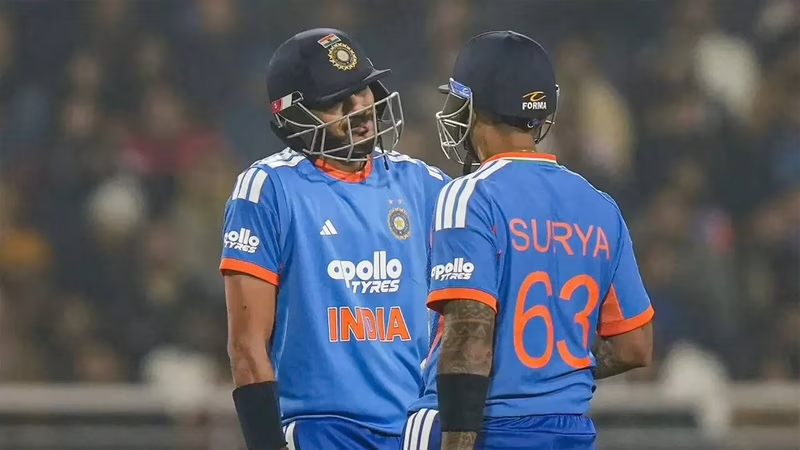
Suryakumar Yadav’s Raw Honesty: A Captain Scrambling for Answers
There was no sugarcoating, no deflecting blame. In the aftermath of India’s comprehensive loss to South Africa in the second T20I, captain Suryakumar Yadav stood at the microphone with a look of quiet frustration. His words were measured but direct: “It was far from good enough.” This stark admission from the captain himself cuts to the heart of a growing crisis in the Indian T20 setup, especially under new head coach Gautam Gambhir .
The numbers tell a brutal story. Chasing a challenging but gettable 214, India’s top order imploded, with Shubman Gill and the promoted Axar Patel gone for single digits. The team’s hopes rested almost entirely on the young Abhishek Sharma, who scored a valiant 64 off 47 balls. But as Suryakumar painfully acknowledged, banking on one batter isn’t a strategy—it’s a recipe for disaster. In this high-stakes environment, his honesty is refreshing, but the questions he’s scrambling to answer are urgent.
Table of Contents
- The Collapse: A Strategic or Mental Failure?
- Over-Reliance on Abhishek Sharma: A Red Flag
- Suryakumar Yadav IND vs SA: Captaincy Under the Microscope
- Bowling in the Dew: A Convenient Excuse?
- The Gambhir Effect: Is the Philosophy Failing?
- What Next for Team India?
- Conclusion
- Sources
The Collapse: A Strategic or Mental Failure?
The loss of early wickets has become a recurring nightmare for this Indian side. Against South Africa, the script repeated itself. The plan to promote Axar Patel to number 3—a move that backfired spectacularly—left the middle order exposed far too early . With Gill dismissed for a golden duck, the pressure mounted instantly.
Was this a failure of nerve, or a deeper flaw in the team’s strategic planning? Suryakumar’s comments suggest it’s a bit of both. He admitted the batting approach was “muddled,” a telling word that implies a lack of clear direction from the top. In modern T20 cricket, a team needs a defined identity—whether it’s power-hitting from the start or building a foundation for a late surge. Right now, India seems to be doing neither effectively.
Over-Reliance on Abhishek Sharma: A Red Flag
Abhishek Sharma was the lone warrior in the Indian innings. His 64 was a brilliant counter-attack against a potent South African pace attack. However, Suryakumar was quick to highlight the danger in this scenario. “We can’t rely on one individual. Everyone has to step up,” he stated .
This over-reliance is a massive red flag. It puts undue pressure on a single player and exposes a lack of depth in the batting lineup. Where were the contributions from the established stars? Where was the support for Abhishek? The team’s inability to build partnerships was its ultimate undoing. In a format where momentum is everything, India’s batting stalled before it even began.
Suryakumar Yadav IND vs SA: Captaincy Under the Microscope
As captain, Suryakumar Yadav’s every decision is now under intense scrutiny. His own contribution with the bat was modest (22 off 18), and the team’s field placements and bowling changes during South Africa’s mammoth innings also drew criticism. While Quinton de Kock’s 90 was a masterclass, the bowlers lacked control, and the captain appeared to have few answers .
The leadership role is a tall order, especially in a transitional phase with a new coach. Suryakumar’s strength has always been his unorthodox batting, but captaincy demands a different set of skills: tactical acumen, man-management, and the ability to inspire. His post-match humility is commendable, but the on-field results need to improve, and fast. For more on the evolution of T20 captaincy, see our guide on [INTERNAL_LINK:modern-t20-captaincy-traits].
Bowling in the Dew: A Convenient Excuse?
Suryakumar did mention the challenging conditions, specifically the dew, as a factor that made bowling in the second innings difficult. While it’s true that dew can make the ball slippery and reduce grip for spinners, it’s a factor every team faces in India during this season. South Africa, bowling second in the first T20I, managed to contain India effectively .
Varun Chakaravarthy, India’s best bowler with 2/29, showed it was possible to be effective . Blaming the dew can feel like a convenient, albeit partially valid, excuse. The real issue lies in the lack of a consistent bowling plan and the inability to execute yorkers and slower balls under pressure. On a pitch offering a good batting surface, a bowling attack needs precision, which was sorely missing for most of the South African innings.
The Gambhir Effect: Is the Philosophy Failing?
Head coach Gautam Gambhir’s “batting order is overrated” mantra is being put to the test. The experimental promotion of Axar Patel is a direct result of this philosophy . While the intention to create a more flexible and aggressive unit is sound in theory, its practical application has led to chaos rather than controlled aggression.
Suryakumar, as captain, is the on-field executor of this vision. His struggle to find answers in the post-match presser might also reflect a disconnect between the coaching staff’s grand ideas and the players’ ability to implement them under pressure. A philosophy without a solid tactical foundation is just a slogan.
What Next for Team India?
With the series now in South Africa’s grasp, the focus shifts to damage control and learning. Suryakumar’s mantra of “we learn… we try” is the only path forward . The team must conduct a brutally honest review of their batting strategy, address the over-dependence on individuals, and find a way to make their aggressive philosophy work in high-stakes games.
The next match is a chance for redemption, but more importantly, a chance to show they can adapt. The talent is undeniable, but talent alone doesn’t win T20 series. It requires a clear plan, collective responsibility, and clinical execution.
Conclusion
Suryakumar Yadav’s candid admission after the defeat to South Africa is a sign of a captain who hasn’t lost touch with reality. He sees the flaws— the muddled batting, the over-reliance on Abhishek, the strategic missteps. The question now is whether he and the new coaching setup can turn this learning into tangible on-field improvement before it’s too late. The road ahead is tough, but honesty is the first step toward a solution.