Table of Contents
- The Burnout and the Break
- Quinton de Kock Career Revival Begins
- Why a Step Back Was Necessary
- Playing All Formats as a Sustainability Strategy
- Impact on South Africa’s T20I Campaign
- What This Means for the 2026 T20 World Cup
- Conclusion: A Veteran Recharged
- Sources
There’s a moment in every elite athlete’s career when the fire dims—not from lack of talent, but from sheer exhaustion. For Quinton de Kock, that moment came last year. The gloves felt heavy. The will to grind through another series waned. “I was losing my drive,” he admitted recently.
But instead of fading quietly, de Kock chose a bold path: he stepped away. And now, fresh off a strategic break from international cricket, the South African wicketkeeper-batter is back—with sharper reflexes, clearer focus, and a startling declaration: “Now I feel I can prolong my career.”
This isn’t just a comeback. It’s a Quinton de Kock career revival with serious implications for South Africa’s future—and a masterclass in how elite athletes can extend their peak years.
The Burnout and the Break
De Kock had been a non-stop force since his 2012 debut—over 350 international matches across formats, countless globetrotting tours, and the dual demands of wicketkeeping and top-order batting. By late 2024, the toll was visible: his strike rate dipped, his dismissals grew uncharacteristically tentative, and his energy on the field flagged.
Rather than push through, Cricket South Africa and de Kock agreed on a temporary exit. He skipped the home T20I series against Bangladesh and limited his franchise commitments. The goal? Mental reset, not retirement.
“I needed space to remember why I started playing,” he told reporters during the ongoing India tour.
Quinton de Kock Career Revival Begins
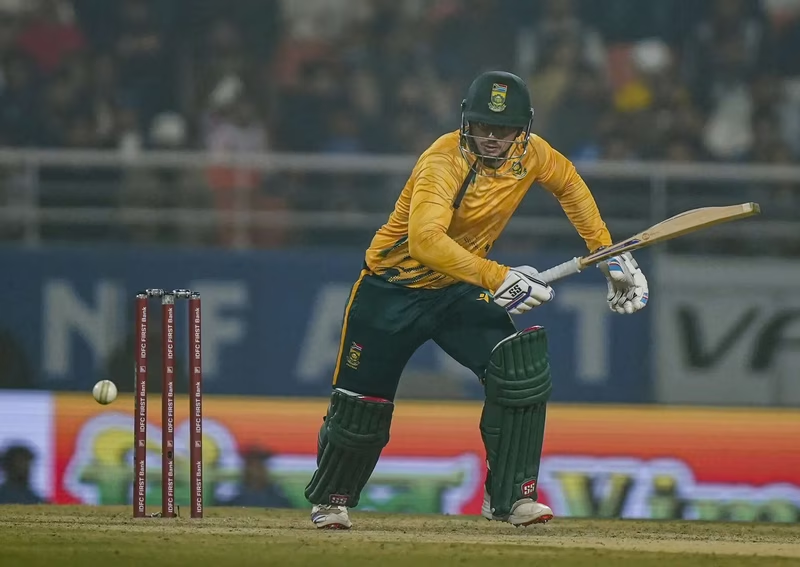
The results are already showing. In the first T20I against India, de Kock walked in at No. 3 and played with the freedom of a man unburdened by expectation. His 48 off 31 balls included crisp cover drives, clever ramps, and sharp glovework behind the stumps.
More than the runs, it’s his intensity that’s noteworthy. He’s diving to stop singles, marshaling the field, and celebrating teammates’ wickets with palpable joy. The hunger is back.
“I’m not just playing to be present,” he said. “I’m playing to win every match.”
Why a Step Back Was Necessary
De Kock’s experience reflects a growing trend among modern cricketers. The calendar is brutal—T20 leagues, bilateral series, World Cups—all demanding 100% physical and mental output. Without strategic rest, even the fittest athletes crack.
Consider these recent examples:
- David Warner took a mental health break in 2023 and returned to lead Australia in the World Cup.
- Ben Stokes stepped away from ODIs in 2022 to preserve his body for Test cricket—and came back stronger.
- Rohit Sharma retired from T20Is post-2024 World Cup to focus on limited formats sustainably.
As the International Cricket Council (ICC) notes, player workload management is now a core component of national team planning. De Kock’s break wasn’t weakness—it was wisdom.
Playing All Formats as a Sustainability Strategy
Surprisingly, de Kock believes that continuing to play all three formats—Tests, ODIs, and T20Is—is actually key to longevity. “When you only play one, you get stale,” he explained. “Switching formats keeps your brain and body adaptable.”
This flies in the face of the growing “format specialization” trend, where players like Jos Buttler focus solely on white-ball cricket. But for de Kock, the variety is the antidote to burnout.
His strategy hinges on three pillars:
- Periodic micro-breaks between series, not full-year sabbaticals.
- Strict recovery protocols—including sleep tracking and mental coaching.
- Playing with purpose, not just presence.
[INTERNAL_LINK:south-africa-t20-squad-analysis] This holistic approach could redefine how veteran players extend their careers beyond the typical 32–34 age ceiling.
Impact on South Africa’s T20I Campaign
South Africa’s batting order has long leaned on de Kock for explosive starts. With him revitalized, the Proteas gain not just runs but stability at the top.
His presence also lifts younger players like Tristan Stubbs and David Miller, who thrive when the pressure is shared. Coach Rob Walter called his return “a game-changer for our balance.”
In a high-stakes series against India—a team packed with young guns like Vaibhav Suryavanshi—de Kock’s experience and renewed form could be the X-factor.
What This Means for the 2026 T20 World Cup
All eyes are on 2026. South Africa, still chasing its first ICC trophy, sees the T20 World Cup as a golden opportunity. A fit, focused de Kock at 33 could be the anchor they’ve lacked in past tournaments.
History shows that veteran keepers often peak late in T20 cricket—see MS Dhoni (36 in 2019) or Kumar Sangakkara (35 in 2014). If de Kock maintains this trajectory, he could lead South Africa’s charge in Sri Lanka and Bangladesh next year.
Conclusion: A Veteran Recharged
Quinton de Kock’s story is more than a mid-career rebound—it’s a blueprint. In an era where athletes are expected to be machines, he chose humanity: rest, reflection, and return. His Quinton de Kock career revival proves that sometimes, the bravest move isn’t to push harder—but to pause, recalibrate, and come back with everything to play for.
Sources
- Times of India: Now I feel I can prolong my career: Quinton De Kock
- Cricket South Africa: Official Player Statements & Team Updates
- International Cricket Council (ICC): Player Workload Management Guidelines
- ESPNcricinfo: Quinton de Kock Career Stats & Match Reports