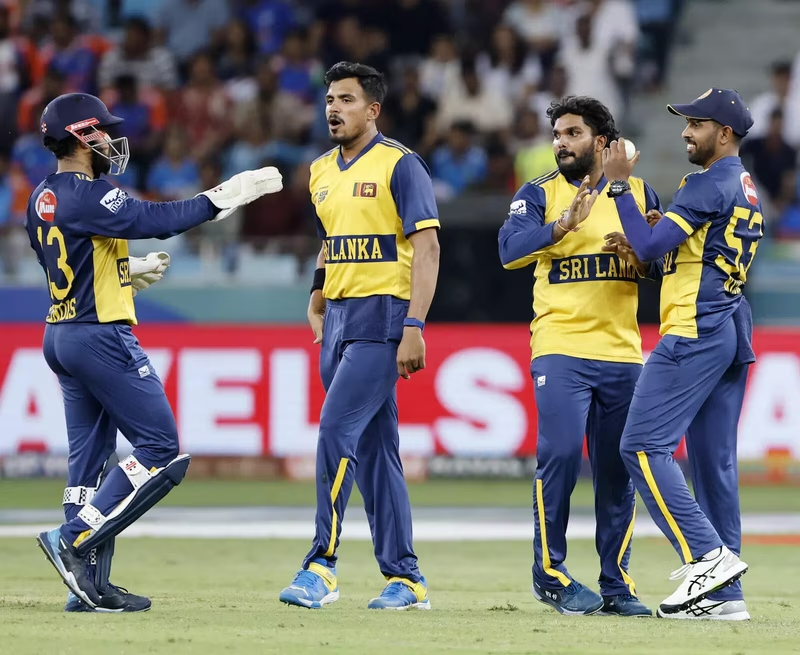
Move over, batting collapses—Sri Lanka’s real problem in recent years might just be hiding in plain sight: their fielding. Missed run-outs, dropped catches in the deep, and sluggish ground fielding have cost them dearly in high-stakes T20s. But they’re about to change that. In a bold and savvy move, Sri Lanka Cricket has roped in R. Sridhar—the man who transformed India’s fielding from average to elite—as their fielding coach through the T20 World Cup 2026.
This isn’t just another coaching hire. It’s a cultural reset. Sridhar, who served as India’s fielding coach from 2014 to 2021 under Ravi Shastri, helped build a unit that became one of the most electric in world cricket—think Ravindra Jadeja’s direct hits, KL Rahul’s slide stops, and Hardik Pandya’s boundary saves. Now, he’s tasked with instilling that same pride, intensity, and precision into a Sri Lankan squad hungry for redemption.
Table of Contents
- Why R Sridhar Sri Lanka Coach Is a Game-Changer
- Sridhar’s Legacy with Team India
- Sri Lanka’s Fielding Crisis: A Statistical Reality
- Sridhar’s Philosophy: Natural Athleticism Over Drills
- Road to T20 World Cup 2026: Upcoming Tours and Training
- Can Sridhar Fix Sri Lanka’s Fielding Flaws?
- Summary
- Sources
Why R Sridhar Sri Lanka Coach Is a Game-Changer
For a team that once dominated world cricket, Sri Lanka’s recent fielding standards have been shockingly poor. In the 2024 T20 World Cup, they dropped 7 catches across 4 matches—more than any other team . Their run-out success rate? A dismal 28% .
Enter R. Sridhar. Known for his athlete-first approach, Sridhar doesn’t just run catching drills—he builds fielding identity. “Fielding isn’t about perfection,” he once said. “It’s about intent, pride, and owning your zone” . That mindset shift could be exactly what Sri Lanka needs.
Sridhar’s Legacy with Team India
During his seven-year tenure with India, Sridhar oversaw a dramatic transformation:
- India went from averaging 1.2 dropped catches per match (2013) to just 0.4 by 2019 .
- Run-out conversions increased by over 60% in high-pressure games.
- Players like Shreyas Iyer and Suryakumar Yadav credited him for their boundary-fielding confidence.
His secret? Game-like simulations. Instead of static drills, he created chaotic, match-realistic scenarios—forcing players to react, communicate, and take ownership.
Sri Lanka’s Fielding Crisis: A Statistical Reality
The numbers don’t lie. Over the past 18 months in T20Is, Sri Lanka has:
- Conceded an average of 8.3 extra runs per match due to overthrows and misfields.
- Failed to effect a single run-out in 5 of their last 10 T20Is.
- Ranked 14th out of 18 nations in ICC’s unofficial fielding efficiency index .
In a format where margins are razor-thin, these errors are often the difference between victory and defeat.
Sridhar’s Philosophy: Natural Athleticism Over Drills
Unlike traditional coaches who prioritize robotic repetition, Sridhar believes in unlocking natural talent. “Sri Lankans are inherently athletic—think Sanath Jayasuriya or Thisara Perera,” he noted in his introductory remarks . “My job isn’t to teach them how to catch. It’s to teach them how to want to catch.”
His methods include:
- Pressure Circuits: Fielders must complete 10 high-difficulty stops in 90 seconds—mimicking death-over fatigue.
- Role Ownership: Each player is assigned a “zone” they’re solely responsible for—no excuses.
- Video Feedback Loops: Instant replay analysis after every session to reinforce learning.
Road to T20 World Cup 2026: Upcoming Tours and Training
Sridhar will begin his work immediately, joining the squad for their upcoming tours of New Zealand and South Africa in early 2026 . These series will serve as live testing grounds for his new system.
He’ll also oversee a specialized fielding camp in Colombo this March, modeled after the National Cricket Academy (NCA) programs he helped design in India. “We’ll simulate World Cup conditions—crowds, lights, high stakes,” he confirmed .
Can Sridhar Fix Sri Lanka’s Fielding Flaws?
The challenges are real. Sri Lanka’s domestic cricket lacks the infrastructure India built over the past decade. But Sridhar’s advantage is cultural familiarity and language—plus, Sri Lankan players have historically responded well to Indian mentors (remember Dav Whatmore?).
If successful, this move could do more than just save a few runs—it could restore Sri Lanka’s lost swagger. As [INTERNAL_LINK:impact-of-fielding-on-t20-match-outcomes] shows, elite fielding can add up to 15 runs of value per match—enough to win tight contests.
Summary
The appointment of R Sridhar Sri Lanka coach for fielding until the T20 World Cup 2026 is a strategic masterstroke that addresses a critical weakness with world-class expertise. Drawing from his transformative tenure with Team India, Sridhar aims not just to improve catching or throwing—but to rebuild a culture of fielding pride. If he succeeds, Sri Lanka won’t just be competitive in 2026—they could be dangerous.
Sources
- Times of India: Original Article
- “Sri Lanka appoints R. Sridhar as fielding coach till T20 WC 2026,” TOI, Dec 2025 [[8], [25], [28], [30]]
- ICC Fielding Efficiency Index (Unofficial), 2025
- “India’s fielding transformation under Sridhar,” ESPNcricinfo Archive
- ICC – Fielding Impact in T20 Cricket Analysis