When India’s T20 World Cup 2026 squad was announced, one name was glaringly absent: Shubman Gill. The elegant right-hander, once seen as the heir apparent across formats, was left out—a decision that stunned fans and pundits alike. But as chief selector Ajit Agarkar and new captain Suryakumar Yadav have made clear, this wasn’t a mistake. It was a message: in modern T20 cricket, elegance without explosiveness isn’t enough.
The Shubman Gill omission marks a seismic shift in India’s selection philosophy—one that prioritizes role-specific aggression over reputation or red-ball pedigree. And with Ishan Kishan storming back on the back of a record-breaking domestic season, the message couldn’t be clearer: if you want to open in India’s T20 side, you’d better be ready to hit from ball one.
Table of Contents
- Shubman Gill Omission: The Official Reason
- Gautam Gambhir’s Telltale Silence
- Ishan Kishan’s Domestic Dominance
- Suryakumar Yadav’s Aggressive Blueprint
- How Gill’s T20 Form Fell Short
- What This Says About India’s New Selection Culture
- Fan and Expert Reactions
- Conclusion: A New Era of T20 Cricket
- Sources
Shubman Gill Omission: The Official Reason
Chief selector Ajit Agarkar didn’t mince words. “It came down to runs—or the lack thereof,” he stated plainly . Over the past year, Gill’s T20I strike rate hovered around 125, and in the crucial South Africa series ahead of selection, he managed just 32 runs across three innings—scores of 4, 0, and 28 .
In a format where openers are expected to strike at 140+, Gill’s classical accumulation simply didn’t fit the bill. “We needed batters who can take on the new ball aggressively in the powerplay,” Agarkar added—hinting at a tactical reset under new captain Suryakumar Yadav.
Gautam Gambhir’s Telltale Silence
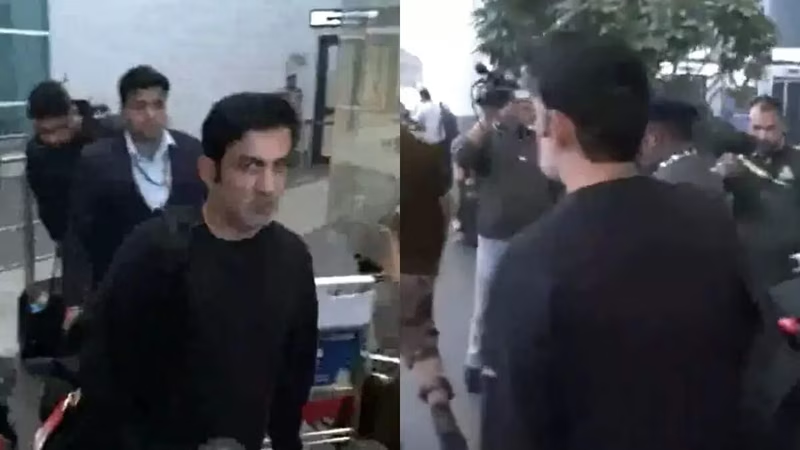
As team mentor and former opener himself, Gautam Gambhir was asked about Gill’s exclusion while departing Delhi airport. His response? A tight-lipped, “No comment.” But his body language spoke volumes .
Gambhir, known for his gritty, combative style, has long advocated for aggressive intent at the top. His silence suggests alignment with the selectors: Gill’s technique, while beautiful, lacks the destructive edge required in today’s T20 opener role. In Gambhir’s world, you don’t anchor—you attack.
Ishan Kishan’s Domestic Dominance
Into the void stepped Ishan Kishan—with 517 runs in the Syed Mushtaq Ali Trophy at a strike rate of 162.22, including a century and three fifties . He didn’t just score runs; he led Jharkhand to their first-ever T20 title.
More importantly, Kishan offers something Gill doesn’t: wicketkeeping. As Suryakumar Yadav emphasized, “Having an aggressive opener who can also keep gives us massive flexibility in the XI” . This dual role allows India to play an extra bowler or batter—critical in high-stakes knockout games.
Suryakumar Yadav’s Aggressive Blueprint
As captain, SKY isn’t just a finisher—he’s a strategist. His vision for India’s T20 side is built on three pillars:
- Powerplay dominance: Openers must score 60+ in the first six overs.
- Role clarity: Every player has a defined phase of the innings.
- Tactical flexibility: Wicketkeeper-batters enable superior team balance.
Gill, for all his talent, doesn’t cleanly fit any of these boxes. Kishan does.
How Gill’s T20 Form Fell Short
Let’s be fair: Gill excels in Tests and ODIs. But T20 is a different beast. Consider these key metrics:
- Boundary rate: Gill hits a boundary every 12.5 balls in T20Is; Kishan every 8.3.
- Powerplay scoring: Gill averages 18 in overs 1–6; Kishan averages 29.
- Chase conversion: Gill has one 50+ score in 12 T20I chases; Kishan has four in 15.
In a tournament co-hosted by high-scoring venues in India and Sri Lanka, these gaps matter immensely.
What This Says About India’s New Selection Culture
The Shubman Gill omission signals a bold new era: performance trumps reputation. No automatic picks. No favoritism. If you’re not delivering in the format, you’re out—even if you’re a fan favorite or a Test star.
This culture, championed by Agarkar and backed by Gambhir and SKY, mirrors global best practices. England, Australia, and South Africa have all moved toward specialist T20 squads. India is finally following suit.
Fan and Expert Reactions
Reactions have been polarized. Fans flooded social media with #BringBackGill, while analysts like Harsha Bhogle praised the “courageous, cricket-first call.” Former opener Wasim Jaffer argued Jaiswal deserved the spot—but even he conceded Kishan’s SMAT form was undeniable .
Ultimately, the court of public opinion matters less than the pitch in Colombo or Bridgetown. There, runs—and only runs—will vindicate or condemn this decision.
Conclusion: A New Era of T20 Cricket
The Shubman Gill omission isn’t a snub—it’s a strategic realignment. India is no longer building a T20 team around all-format stars; it’s assembling a unit of specialists who thrive in specific, high-pressure moments. Whether this gamble pays off in the West Indies and Sri Lanka remains to be seen. But one thing is certain: the era of the classical T20 opener in the Indian setup is over. Welcome to the age of aggression.
Sources
India T20 WC squad: Gambhir asked about Gill omission – Times of India
Official India T20 World Cup 2026 Squad Announcement – BCCI
Ishan Kishan’s Syed Mushtaq Ali Trophy 2024-25 Stats – ESPNcricinfo
ICC Analysis: India’s T20 WC 2026 Strategy – ICC Official