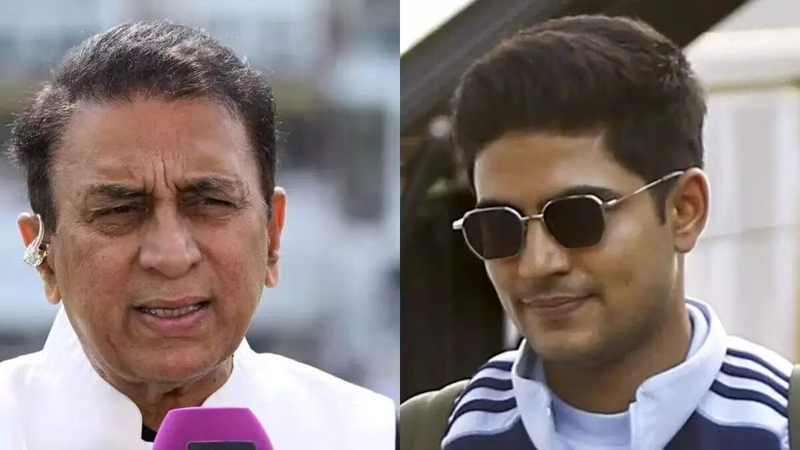
Gavaskar Stunned by ‘Strange’ Injuries: Why Shubman Gill Was Axed from T20 World Cup Squad
In a move that sent shockwaves through the cricketing world, star batter Shubman Gill has been left out of India’s T20 World Cup 2026 squad. And now, batting legend Sunil Gavaskar has added a layer of intrigue to the decision, openly questioning the nature of Gill’s recent injuries and labeling them as “strange” .
Speaking with characteristic candor, Gavaskar didn’t just accept the selectors’ verdict—he analyzed it, contextualized it, and urged the young opener to treat it not as a setback, but as a necessary course correction. This high-profile Shubman Gill T20 World Cup omission has ignited fierce debate among fans, pundits, and former players alike, raising questions about form, fitness, and the future of India’s batting lineup in the shortest format.
Table of Contents
- The Decision: Why Gill Was Omitted
- Gavaskar’s Take: “His Injuries Have Been Strange”
- Gill’s Recent Form: A Statistical Reality Check
- What Is a “Course Correction” and Why It Matters
- Ajit Agarkar’s Role in the Decision
- Historical Precedents: Stars Dropped Before World Cups
- What Next for Shubman Gill?
- Summary: A Tough-Love Message from Gavaskar
- Sources
The Decision: Why Gill Was Omitted
The official reasons cited for Gill’s exclusion are twofold: consistently poor form in T20Is and recurring injury concerns. Over the past year, Gill’s strike rate in T20 internationals has hovered below 120—an alarming figure for a top-order batter in a format that demands explosive starts .
Compounding this was a series of unexplained fitness issues. Gill missed key bilateral series and IPL matches with what were described as “niggles” and “strains,” none of which had a clear diagnosis or consistent recovery timeline. For a tournament as high-stakes as the T20 World Cup, the selectors, led by chief selector Ajit Agarkar, opted for reliability over reputation.
Gavaskar’s Take: “His Injuries Have Been Strange”
It’s Gavaskar’s specific phrasing that has captured headlines. “His injuries have been strange,” he remarked, implying a lack of clarity or pattern in Gill’s physical setbacks . This comment suggests skepticism—not about Gill’s pain, but about whether these issues reflect underlying preparation, workload management, or other off-field factors.
Crucially, Gavaskar didn’t condemn Gill. Instead, he framed the omission as a wake-up call. “This is not the end,” he emphasized. “His future remains very bright.” The legend believes that a temporary step back could lead to a stronger, more focused return.
Gill’s Recent Form: A Statistical Reality Check
Let’s look at the numbers that likely influenced the selection panel:
- Last 10 T20I innings: Avg. 18.40, SR 117.2
- IPL 2025 (for Gujarat Titans): 287 runs in 14 matches, SR 125.3
- Dismissals in powerplay: 6 out of 10 T20Is (failing to anchor or accelerate)
Compare this to emerging contenders like Yashasvi Jaiswal (SR 142 in last 5 T20Is) or Ruturaj Gaikwad (consistent 40+ scores), and the selectors’ dilemma becomes clear. In T20 cricket, opportunity cost is real—and Gill wasn’t maximizing his.
What Is a “Course Correction” and Why It Matters
Gavaskar’s use of the term “course correction” is telling. It’s not punishment—it’s recalibration. Great players often need moments of adversity to reassess technique, mindset, and priorities.
Think of Virat Kohli’s 2014 T20 World Cup exclusion (he was dropped for the final!), or MS Dhoni’s lean patches before his 2007 T20 WC triumph. These weren’t endpoints—they were turning points. Gavaskar is suggesting Gill use this time to rebuild, refocus, and return hungrier.
Ajit Agarkar’s Role in the Decision
As chief selector, Ajit Agarkar is reported to have personally communicated the decision to Gill . This reflects a professional yet compassionate approach—avoiding public ambiguity and giving the player direct feedback.
Agarkar, known for his no-nonsense attitude and emphasis on current performance, appears to be building a T20 unit that prioritizes in-form players who can execute specific roles under pressure. Sentimentality has no place in his calculus—and that’s a message every player in the current setup must heed.
Historical Precedents: Stars Dropped Before World Cups
Gill isn’t the first big name to miss a World Cup. Consider:
- Sachin Tendulkar was dropped from the 2007 ODI World Cup squad after a string of low scores.
- Harbhajan Singh missed the 2017 T20 WC due to form and fitness.
- Shikhar Dhawan was axed before the 2022 T20 World Cup.
Each case was controversial at the time—but often led to rejuvenated careers or squad cohesion. For more on how selectors balance legacy and performance, see our feature on [INTERNAL_LINK:India-Cricket-Selection-Controversies].
What Next for Shubman Gill?
Gill now faces a critical crossroads. He can either dwell on the snub—or use it as fuel. The domestic circuit, the Duleep Trophy, and future IPL seasons offer ample platforms to prove his T20 worth.
Technical tweaks—like opening his stance for quicker rotation or improving his strike rate against spin in the middle overs—could make all the difference. More importantly, demonstrating consistent fitness will be non-negotiable. The 2027 ODI World Cup and beyond remain within his reach, but only if he responds with maturity and resilience.
Summary: A Tough-Love Message from Gavaskar
The Shubman Gill T20 World Cup omission is more than a selection update—it’s a moment of reckoning for a generational talent. Sunil Gavaskar’s candid remarks about “strange” injuries and the need for a “course correction” aren’t meant to wound, but to wake up. In the high-stakes world of international cricket, even the brightest stars must earn their place every single day. For Gill, this could be the painful but necessary pause before his next great chapter.
Sources
- Times of India: ‘His injuries have been strange’: Gavaskar on Gill’s omission from WC squad
- ESPNcricinfo Stats: Shubman Gill T20I Batting Records
- ICC Official: India Announces T20 World Cup 2026 Squad