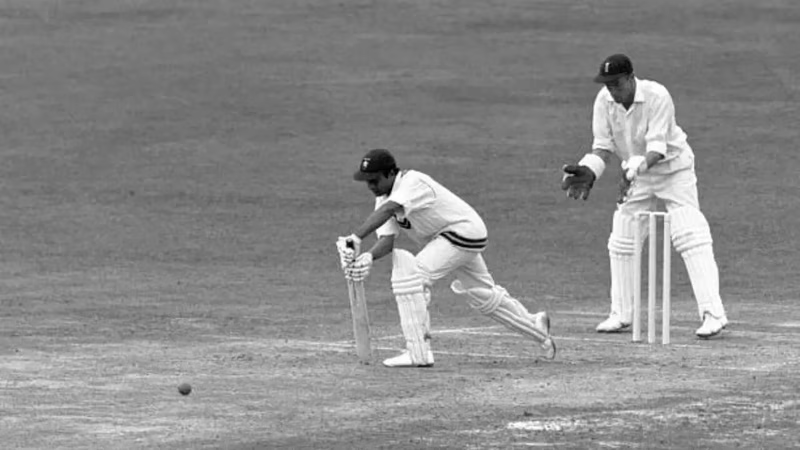
Hanif Mohammad: The Original ‘Little Master’ Who Defined Pakistani Cricket
Before Sachin Tendulkar earned the title, before the world knew what a ‘Little Master’ truly meant in cricketing terms, there was Hanif Mohammad—Pakistan’s first and perhaps most resilient batting icon. Known for his impenetrable defense, marathon innings, and unshakeable temperament, Hanif didn’t just play cricket; he redefined what it meant to represent a young nation on the global stage .
In an era when Pakistan was still finding its feet as a sovereign state, Hanif became its sporting conscience. His legendary 337 against the West Indies in 1958—a painstaking, 970-minute vigil—was more than a world record; it was a masterclass in mental fortitude and national pride. This wasn’t just batting. It was resistance.
Table of Contents
- Who Was Hanif Mohammad? Pakistan’s First Superstar
- The Legendary 337: A Masterpiece of Resilience
- Hanif Mohammad: The Architect of Pakistani Grit
- Career Highlights Beyond the Record Innings
- Legacy and Influence on Modern Pakistani Batters
- Hanif vs. Sachin: The Two ‘Little Masters’ Compared
- Summary: Why Hanif Mohammad Still Matters Today
- Sources
Who Was Hanif Mohammad? Pakistan’s First Superstar
Born in 1934 in Junagadh (pre-partition India), Hanif Mohammad migrated to Pakistan in 1948 and quickly rose through the ranks of domestic cricket. He made his Test debut in 1052 against India at just 18 years old and instantly showcased the patience and technique that would become his hallmarks.
As the eldest of the famed “Mohammad brothers”—four siblings who all played Test cricket for Pakistan—Hanif carried the weight of family legacy and national expectation. But he didn’t buckle; he built.
The Legendary 337: A Masterpiece of Resilience
No discussion of Hanif Mohammad is complete without revisiting his iconic innings at Kensington Oval, Bridgetown, in January 1958. Pakistan had been bowled out for 106 in their first innings, with the mighty West Indies replying with 639. Facing a massive deficit, defeat seemed inevitable.
But Hanif walked in and refused to yield. Over the course of 16 hours and 10 minutes spread across three days, he batted with monk-like focus, scoring 337 runs off 691 balls. His innings included just 24 boundaries—proof that this was about survival, not spectacle.
Key facts about the innings:
- Highest individual score by a Pakistani in Tests (still stands in overseas conditions)
- Longest individual innings by time in Test history at the time
- Only triple-century in the fourth innings of a Test match (a record that stood for decades)
This knock didn’t just save the match—it saved Pakistan’s pride and announced to the cricketing world that this new nation had spine.
Hanif Mohammad: The Architect of Pakistani Grit
Hanif’s approach went beyond personal glory. He instilled a culture of resilience in Pakistani cricket. As the Times of India notes, he “taught the nation how not to lose” . In a country where resources were scarce and international recognition hard-won, Hanif’s style—defensive, patient, and unyielding—became the blueprint for success.
He believed cricket was a reflection of life: you don’t always win, but you never give up. This philosophy permeated Pakistan’s cricketing identity for generations, influencing batters like Javed Miandad and even modern-day players like Babar Azam in high-pressure chases.
Career Highlights Beyond the Record Innings
While the 337 defines his legacy, Hanif’s overall career was stellar:
- Test Matches: 55
- Test Runs: 3,915 at an average of 46.99
- Centuries: 12 (including two double-centuries)
- First-Class Career: 19,852 runs at 52.86, with 55 centuries
He also captained Pakistan in 13 Tests and later served as a national selector and coach, ensuring his influence extended far beyond his playing days.
Legacy and Influence on Modern Pakistani Batters
Today’s aggressive Pakistani stroke-makers may seem worlds apart from Hanif’s stoic style, but his DNA runs through them. The ability to absorb pressure—seen in Azhar Ali’s long innings or Shan Masood’s recent comebacks—echoes Hanif’s ethos.
The PCB has honored him with the Hanif Mohammad Award for the best first-class batter annually. Statues, stadiums, and documentaries keep his memory alive. For a deeper dive into Pakistan’s batting evolution, see [INTERNAL_LINK:Evolution-of-Pakistani-Batting-Styles].
Hanif vs. Sachin: The Two ‘Little Masters’ Compared
Though separated by decades, both Hanif and Sachin Tendulkar earned the “Little Master” tag for their compact frames and colossal impacts. But their styles differed vastly:
- Hanif: Defense-first, attritional, built innings like fortresses.
- Sachin: Attack-oriented, technically flawless, dominated all formats.
Yet both carried their nations’ hopes on tiny shoulders. Sachin himself has called Hanif an “inspiration” and visited his grave in Karachi—a touching tribute from one legend to another.
Summary: Why Hanif Mohammad Still Matters Today
Hanif Mohammad was more than Pakistan’s first great Test batter—he was its first sporting soul. In an age of T20 fireworks and instant highlights, his legacy reminds us that cricket, at its core, is a test of character. His 337 wasn’t just runs; it was a declaration that Pakistan belonged. And for that, he remains, forever, the original ‘Little Master.’
Sources
- Times of India: The original ‘Little Master’: Hanif Mohammad, Pakistan’s first great Test batter
- ESPNcricinfo: Hanif Mohammad Profile & Career Stats
- ICC Cricket Hall of Fame: Inductee: Hanif Mohammad