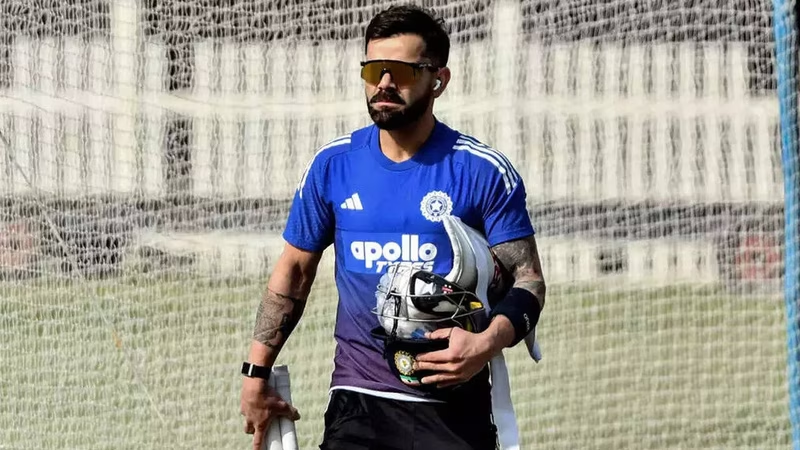
Imagine this: Virat Kohli, in whites, stepping back onto his home turf at the M. Chinnaswamy Stadium after years. The stands should be a sea of red and gold, roaring his name. But instead? Silence. Empty seats. No chants. No applause. Just the sharp crack of the bat echoing in an eerie void.
That’s the reality for Kohli’s long-awaited return to the Vijay Hazare Trophy—a match that will be played behind closed doors. The Karnataka government, acting on heightened security protocols, has barred all spectators from attending the game, citing lingering concerns from a past crowd-control disaster . For fans who’ve waited a decade to see their king in domestic whites, it’s a gut punch.
Table of Contents
- Why Are Fans Banned? The Real Reason Behind the Decision
- What This Means for Kohli’s Comeback and the Vijay Hazare Trophy
- The Shadow of the Past: Stampedes and Stadium Safety
- Fan Reactions: Outrage and Heartbreak Flood Social Media
- Will Other Vijay Hazare Trophy Matches Be Affected?
- Conclusion: A Homecoming Without a Home
Why Are Fans Banned? The Real Reason Behind the Decision
Despite initial plans to allow a limited number of spectators—reportedly up to 10,000 fans—the Karnataka state authorities reversed course just days before the match. According to a report from the Times of India, the decision stems from unresolved trauma around a previous stampede incident at a major sporting event in the city .
Officials from the state’s Home Department and the Bengaluru City Police held emergency consultations and concluded that crowd management at the M. Chinnaswamy Stadium during high-profile matches remains a significant risk. This is especially true for an event involving a global superstar like Kohli, whose presence alone can trigger massive, spontaneous gatherings.
“Given the history and the potential for uncontrolled crowds, the safest option is zero public access,” a senior police official anonymously told reporters . The decision, while unpopular, falls under the state’s emergency public safety powers.
What This Means for Kohli’s Comeback and the Vijay Hazare Trophy
Kohli’s participation in the Vijay Hazare Trophy isn’t just a sentimental gesture—it’s a direct consequence of the BCCI’s new policy requiring centrally contracted players to play domestic cricket to stay in national contention . His return for Karnataka is widely seen as preparation for the 2027 ODI World Cup.
But playing in an empty stadium robs the moment of its emotional weight. For Kohli, who thrives on crowd energy, it’s a strange and sterile environment. For young domestic players sharing the field with him, it’s a missed opportunity to feed off the electric atmosphere that usually accompanies his presence.
For the tournament itself, the ban sets a worrying precedent. The Vijay Hazare Trophy has long struggled with visibility and fan engagement compared to the IPL. This high-profile match was supposed to be a turning point—a chance to showcase the depth of Indian cricket beyond T20s. Instead, it’s happening in a vacuum.
The Shadow of the Past: Stampedes and Stadium Safety
While the exact incident hasn’t been publicly named in recent reports, Bengaluru has faced crowd-control issues in the past during high-stakes cricket matches. The M. Chinnaswamy Stadium, located in the heart of the city, has narrow access roads and limited emergency egress points—a known challenge during packed matches.
In 2013, a minor stampede during an India-Sri Lanka ODI at the venue left several fans injured when gates were opened late, causing a surge . Though not catastrophic, it exposed critical gaps in emergency planning. Since then, authorities have been ultra-cautious, especially for matches expected to draw massive, emotionally charged crowds.
According to the National Disaster Management Authority (NDMA), large public gatherings require a detailed “Crowd Management Plan” approved by multiple agencies—something that reportedly couldn’t be finalized in time for Kohli’s match .
Fan Reactions: Outrage and Heartbreak Flood Social Media
Cricket fans across India—and especially in Karnataka—have voiced their disappointment. Social media exploded with hashtags like #LetFansIn and #EmptyChinnaswamy, with many calling the decision “excessive” and “disrespectful to loyal supporters.”
- “We waited 10 years. Just let us see him bat, even from the stands,” tweeted a fan with over 5,000 likes.
- Others pointed out that IPL matches at the same venue regularly draw 30,000+ fans without incident.
- Some questioned if the ban was political optics rather than genuine safety planning.
The Karnataka State Cricket Association (KSCA) has remained silent, likely to avoid escalating tensions with the government. But behind the scenes, sources say they were “deeply disappointed” by the last-minute reversal .
Will Other Vijay Hazare Trophy Matches Be Affected?
As of now, the spectator ban applies only to Kohli’s opening match for Karnataka at the M. Chinnaswamy Stadium. Other venues across India—including Ahmedabad, Jaipur, and Rajkot—are proceeding with normal attendance protocols.
However, if crowd estimates surge for matches featuring other stars like Rohit Sharma (Mumbai) or Shubman Gill (Punjab), local authorities might reassess. For now, Bengaluru remains the only city under restriction—but it’s a cautionary signal for tournament organizers.
For fans hoping to attend future games, it’s wise to check local police advisories and official KSCA announcements before making travel plans.
Conclusion: A Homecoming Without a Home
Virat Kohli’s return to the Vijay Hazare Trophy should have been a celebration of Indian cricket’s roots—a bridge between global stardom and domestic grit. Instead, it’s become a case study in how safety concerns, however valid, can override fan passion and emotional connection.
While security must always come first, this decision highlights a deeper issue: the lack of modern, crowd-ready infrastructure at even India’s most iconic cricket venues. Until that changes, moments like these will remain bittersweet—historic, yet hollow. For now, fans will have to settle for watching their hero from afar, as his homecoming unfolds in silence.