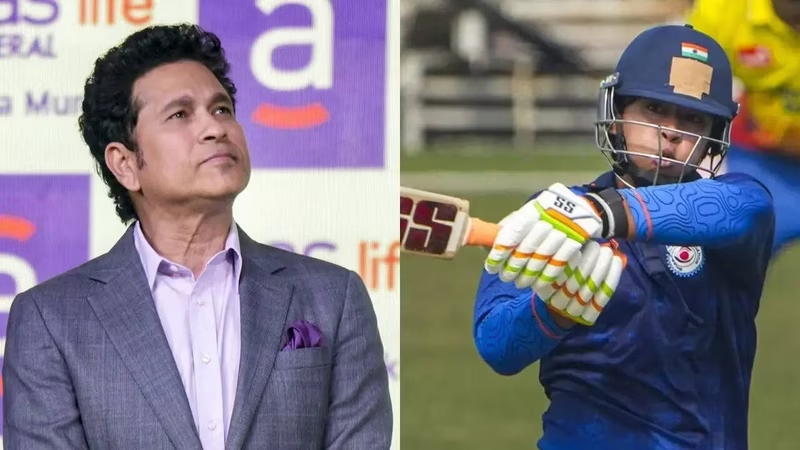
When a 14-Year-Old Makes Parliamentarians Talk Cricket
In the high-octane world of Indian domestic cricket, a new name has exploded onto the scene with the force of a supernova: Vaibhav Sooryavanshi. At just 14 years old, this Bihar batter didn’t just score runs—he redefined what’s possible for a schoolboy on the senior men’s stage. His recent, jaw-dropping 190 in the Vijay Hazare Trophy has done more than win matches; it’s drawn comparisons to none other than the “God of Cricket” himself, Sachin Tendulkar—and the person making that claim? Veteran politician and intellectual, Shashi Tharoor .
Tharoor, known for his eloquence and deep love for cricket, didn’t mince words. After watching Sooryavanshi’s 36-ball century en route to 190, he declared on social media: “It was Sachin Tendulkar.” That single line has sent ripples through the cricketing community, sparking both excitement and healthy skepticism. Who is this phenom, and does the Vaibhav Sooryavanshi phenomenon deserve the Tendulkar tag?
Table of Contents
- The Innings That Shook Indian Cricket
- Vaibhav Sooryavanshi: The Boy Behind the Bat
- Shashi Tharoor’s Claim: A Compliment or a Curse?
- How He Compares to Young Sachin and Other Prodigies
- The Pressure Cooker of Early Fame in Indian Cricket
- What Next for Bihar’s Teenage Sensation?
- Conclusion: Talent Is Real—but Patience Is Key
- Sources
The Innings That Shook Indian Cricket
Playing for Bihar in the Vijay Hazare Trophy, Vaibhav Sooryavanshi stunned fans and experts alike with an innings that combined childlike freedom with veteran-like composure. His 190 came off just 119 balls, but the most astonishing part? He raced to a century in only 36 deliveries—a feat that would be remarkable even for seasoned professionals, let alone a Class 9 student .
His knock included 16 fours and 12 sixes, showcasing clean striking, 360-degree shot-making, and nerves of steel under pressure. This wasn’t just aggressive hitting; it was intelligent, calculated domination. In a tournament filled with Ranji Trophy regulars and IPL hopefuls, Sooryavanshi stood out like a comet in a cloudy sky.
Vaibhav Sooryavanshi: The Boy Behind the Bat
Born in 2011 in Patna, Vaibhav Sooryavanshi has been breaking age-related records since he was 11. Some of his milestones include:
- Youngest player to score a century in U-16 CK Nayudu Trophy.
- First 13-year-old to play in a senior men’s List A match (Vijay Hazare Trophy).
- Holds the record for the fastest century by an under-15 batter in any official Indian domestic fixture.
Coaches describe him as “obsessively disciplined,” with a work ethic that belies his age. He trains six hours a day, studies match footage of Tendulkar and Kohli, and reportedly reads books on mental toughness. His family has shielded him from excessive media, focusing instead on education and gradual development—a model that contrasts sharply with the instant-celebrity culture of today .
Shashi Tharoor’s Claim: A Compliment or a Curse?
When Shashi Tharoor—Member of Parliament, author, and lifelong cricket connoisseur—tweeted, “It was Sachin Tendulkar,” he wasn’t just praising a performance. He was evoking an emotional memory for millions of Indians who grew up watching Tendulkar dismantle bowling attacks with similar flair at a young age .
But while the comparison is flattering, it’s also dangerous. The “next Sachin” tag has haunted dozens of Indian prodigies—Reetinder Sodhi, Manvinder Bisla, even Yuvraj Singh early on. The weight of that expectation can crush raw talent before it fully blooms.
Tharoor himself likely meant it as poetic admiration, not a literal prophecy. As he later clarified in an interview: “I meant the *spirit*, the fearlessness, the purity of strokeplay—not that he will replicate Sachin’s 24-year career.” Still, the cricketing world is now watching Vaibhav with Tendulkar-tinted glasses.
How He Compares to Young Sachin and Other Prodigies
Sachin Tendulkar made his Ranji debut at 15 and his international debut at 16. By 14, he was already scoring heavily in domestic cricket—but never in senior List A matches. Sooryavanshi’s achievement of playing—and dominating—at 14 in the Vijay Hazare Trophy is, by that metric, unprecedented .
Other modern prodigies like Rishabh Pant (century in Duleep Trophy at 18) or Prithvi Shaw (161 on Test debut at 18) were older when they broke through. Even Pakistan’s Shahid Afridi, famous for his 37-ball ODI century at 16, was two years Sooryavanshi’s senior.
What sets Vaibhav apart isn’t just age—it’s the **quality of opposition**. The Vijay Hazare Trophy features seasoned professionals, many with IPL experience. To dominate them as a 14-year-old is extraordinary.
The Pressure Cooker of Early Fame in Indian Cricket
India has a complicated relationship with child prodigies. We celebrate them, but we also devour them. Social media amplifies every failure, and selectors often rush talent into higher levels before they’re emotionally ready.
For Vaibhav Sooryavanshi, the path forward must be handled with extreme care:
- Delay IPL auctions—let him mature in age-group and domestic cricket first.
- Limit media exposure—protect his mental space and childhood.
- Focus on education—cricket should complement, not replace, his schooling.
As former India captain Rahul Dravid, known as “The Wall” and now a mentor to young cricketers, often says: “Talent is common. What’s rare is patience.”
What Next for Bihar’s Teenage Sensation?
With the Vijay Hazare Trophy ongoing, Sooryavanshi will face even sharper scrutiny. Every ball he faces will be analyzed, every dismissal dissected. But if he continues his current form, national selectors may find it impossible to ignore him—even for U-19 World Cup squads.
For fantasy cricket enthusiasts, he’s already a trending pick in domestic leagues. Keep an eye on our Vijay Hazare Trophy young talents to watch guide for updates.
Beyond stats, his real value lies in inspiration. In a state like Bihar, where cricket infrastructure is still developing, Vaibhav’s rise is a beacon for thousands of aspiring players who now believe they, too, can reach the top.
Conclusion: Talent Is Real—but Patience Is Key
Is Vaibhav Sooryavanshi the next Sachin Tendulkar? No. And that’s okay. He doesn’t need to be. What he is—right now—is a once-in-a-generation talent with the skill, temperament, and humility to forge his own legacy.
Shashi Tharoor’s comparison was a moment of poetic awe, not a burden to carry. The best gift India can give Vaibhav Sooryavanshi is space—to grow, to fail, to learn, and to become not the “next Sachin,” but the first Vaibhav.