Table of Contents
- A Batting Nightmare at the MCG
- Steve Smith’s Full Take on MCG Pitch Conditions
- Why the MCG Deck Played So Difficult
- Historical Context: MCG Pitches in Ashes History
- What Experts and Other Players Say
- Conclusion: Was It a Fair Test Wicket?
- Sources
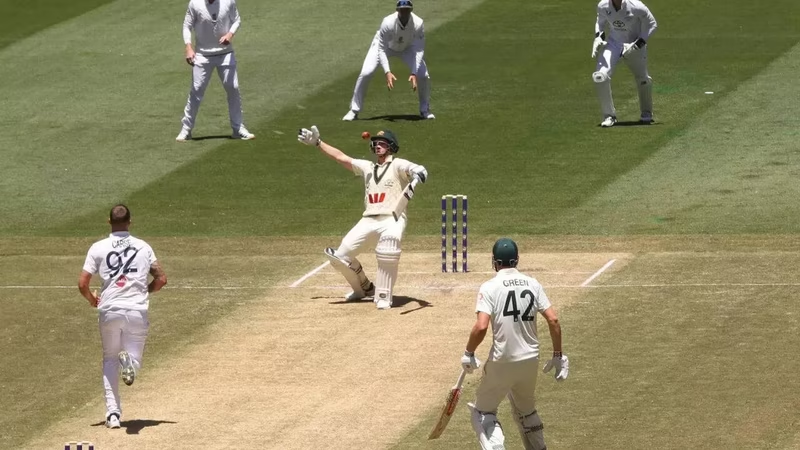
Cricket fans watching the recent Ashes Test at the Melbourne Cricket Ground (MCG) were treated to a spectacle—but not the one they expected. Instead of flowing cover drives and big sixes, they saw a relentless battle between bat and ball, with the latter emerging decisively on top. The MCG pitch conditions baffled fans and players alike, as batters from both Australia and England fell cheaply, unable to build partnerships or find any sense of stability at the crease. The man best placed to explain this anomaly? None other than Australia’s batting savant, Steve Smith.
A Batting Nightmare at the MCG
The numbers don’t lie. In the Boxing Day Test, both teams posted totals that would be considered modest even in subcontinent conditions. Australia was bundled out for 181 in their first innings, while England managed just 183 in response . The pitch, unusually green for an MCG surface in late December, offered inconsistent bounce and variable seam movement throughout the match . Even the most experienced batters looked uncomfortable, playing and missing more often than they’d care to admit.
This wasn’t just a case of good bowling—though both attacks were excellent. The surface itself was a key player. And Smith, known for his forensic understanding of the game, didn’t hold back in his post-match analysis.
Steve Smith’s Full Take on MCG Pitch Conditions
During the post-match press conference, Smith offered a rare, almost poetic insight into what made the deck so treacherous. “It probably started quite slow,” he said, “and it’s hard to explain. Not tennis bally normally—that’s from like the moisture of the wicket” .
He went on to clarify that the ball wasn’t skidding on like a hard tennis ball—which typically happens on dry, abrasive surfaces—but was instead behaving unpredictably due to the moisture trapped beneath a thick layer of grass. “The ball was just sitting in the grass,” Smith explained. This meant that instead of gripping and turning or bouncing true, the ball would often “die” on impact, staying low or occasionally popping up unexpectedly .
For a batter expecting one kind of behavior, this inconsistency was disorienting. It created a guessing game with every delivery—was it going to keep low, rear up, or skid through? That mental uncertainty is often more damaging than physical difficulty.
Why the MCG Deck Played So Difficult
Several factors combined to make this pitch unusually challenging:
- Unseasonal moisture: Melbourne experienced unseasonably cool and damp weather in the lead-up to the match, preventing the pitch from drying out fully .
- Thick grass coverage: Unlike the traditional MCG pitch—which is usually rolled hard and left with minimal grass—this surface retained a lush green cover, which held moisture and affected ball trajectory post-impact .
- Preparation timing: Reports suggest the pitch was prepared closer to match day than usual, reducing the time for natural drying and compaction .
These conditions favored bowlers who could hit a consistent length and exploit the uncertainty. England’s seamers, particularly Ollie Robinson and James Anderson, thrived, while Australia’s Pat Cummins and Scott Boland kept the pressure relentless.
Historical Context: MCG Pitches in Ashes History
The MCG is traditionally known as a batter’s paradise during the Ashes. Flat, true, and offering minimal seam movement, it has been the stage for numerous big hundreds, including Bradman’s legendary 270 in 1937 and more recently, David Warner’s 128 in 2017 .
Low-scoring affairs at the MCG are rare. In fact, this was the first time since 2013 that both teams in an Ashes Test at the venue failed to cross 200 in their first innings . Smith himself has a stellar record at the ground, with over 800 Test runs at an average above 60 . So when even he admits the conditions were “hard to explain,” it underscores just how unusual the surface was.
What Experts and Other Players Say
Smith wasn’t the only one puzzled. Former Australian captain Mark Taylor called it “one of the most unpredictable MCG pitches I’ve seen in 20 years” on commentary . Meanwhile, England’s Joe Root described it as “a very strange wicket—sometimes it gripped, sometimes it didn’t. You never felt in control” .
Even pitch curators weighed in. According to Cricket Australia’s pitch consultant, the goal was to produce a more balanced contest—but the execution, influenced by weather, resulted in a surface that tipped too far in the bowlers’ favor .
Conclusion: Was It a Fair Test Wicket?
While the MCG pitch conditions may have produced a gripping, tense Test match, they also raised questions about fairness and preparation standards. A Test wicket should challenge batters—but not confuse them with erratic behavior caused by retained moisture and grass. Steve Smith’s candid breakdown offers valuable insight into what went wrong, and perhaps what needs to be adjusted for future Boxing Day Tests. One thing’s for sure: this MCG surface will be remembered not for its runs, but for the mystery it left in its wake.
Sources
- [INTERNAL_LINK:mcg-pitch-history-ashes]
- [INTERNAL_LINK:steve-smith-ashes-performance]
- The Ashes 2025-26 on ESPNcricinfo
- ‘Ball was just sitting in grass’: Smith explains why no batter could settle on MCG deck