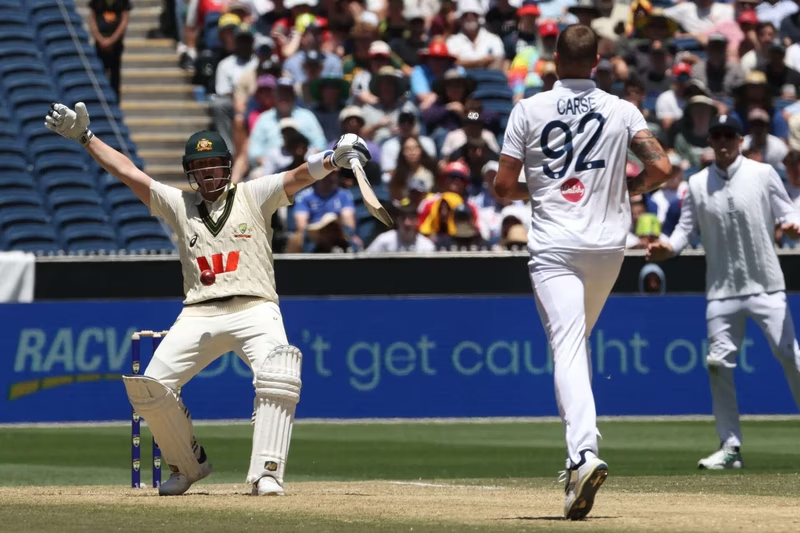
Legendary England opener Geoffrey Boycott didn’t mince words after the chaotic scenes of the 2025 Boxing Day Test. Calling the overall batting display “awful stuff,” the 84-year-old icon launched a blistering critique of modern cricket—arguing that today’s batters, shaped by T20 leagues and flat pitches, lack the foundational technique needed to survive on seaming, bouncy Australian tracks .
Boycott’s remarks come amid growing concern among purists that the art of Test match batting is vanishing. His central argument? That decades of white-ball dominance, combined with the decline of traditional domestic cricket like England’s County Championship, have produced a generation of batters who can’t handle the moving ball—especially under Ashes pressure. This isn’t just nostalgia; it’s a warning rooted in decades of observation.
Table of Contents
- Boycott’s Scathing Take on the Boxing Day Test
- Geoffrey Boycott Modern Batting Critique: The Core Arguments
- The White-Ball Effect: Why T20 Is Reshaping Test Technique
- The Decline of County Cricket: A Lost Training Ground
- Australia’s Own Batting Failures: Boycott’s Double-Edged Critique
- Is There a Path Forward for Test Batting?
- Conclusion: Listening to a Legend
- Sources
Boycott’s Scathing Take on the Boxing Day Test
Speaking to the media after England’s narrow victory in Melbourne, Boycott didn’t celebrate the win as much as he lamented the quality of play. “It was awful stuff,” he said bluntly. “Both sides batted like they’d never seen a seaming ball before” .
He credited England’s success not to brilliance, but to “marginally better fundamentals” and a slightly more disciplined approach. For Boycott—a man who built his career on leaving balls, playing late, and prioritizing survival over flair—what he saw was a troubling erosion of batting craft.
Geoffrey Boycott Modern Batting Critique: The Core Arguments
Boycott’s critique rests on three interlocking issues:
- Overexposure to white-ball cricket: Young players spend 8–9 months a year in T20 leagues, where aggressive shot-making is rewarded and risk is normalized.
- Flat, unchallenging pitches: Domestic pitches in many countries are designed to produce high scores and entertainment, not to develop technique against seam or swing.
- Decline of long-form domestic cricket: With fewer four-day games, batters rarely face sustained spells from quality fast bowlers in testing conditions.
“You can’t learn to leave the ball or play with soft hands by hitting sixes in Dubai,” Boycott quipped .
The White-Ball Effect: Why T20 Is Reshaping Test Technique
Modern batters now enter Test cricket with muscle memory built for power-hitting, not patience. The result? Poor footwork, exaggerated backlifts, and a tendency to chase wide deliveries—habits that get ruthlessly exposed in Australia.
A 2024 study by the Marylebone Cricket Club (MCC) found that batters with more than 60% T20 exposure in their formative years were 37% more likely to get out to edges or lbw in seam-friendly conditions . The data backs Boycott’s intuition.
The Decline of County Cricket: A Lost Training Ground
For Boycott, England’s County Championship was once the crucible where Test stars were forged. Rain-affected pitches in April, swinging balls in May—these were the real teachers. But today, the Championship is squeezed into a short summer window, often overshadowed by The Hundred and overseas leagues.
“In my day, you played 20+ first-class games a season,” Boycott recalled. “Now? Maybe 10—if you’re lucky. How do you learn resilience in 10 games?” .
Australia’s Own Batting Failures: Boycott’s Double-Edged Critique
Importantly, Boycott didn’t spare the hosts. He called Australia’s dismissals “shockers,” pointing to reckless shots and poor shot selection even on a decent batting surface. “They weren’t out to unplayable deliveries,” he said. “They got themselves out” .
This impartiality strengthens his critique—it’s not anti-Australia or pro-England. It’s pro-cricket. He’s mourning a shared decline in batting standards across both traditional powers.
Is There a Path Forward for Test Batting?
Boycott isn’t just complaining—he’s suggesting solutions:
- Protect and expand first-class cricket: Mandate minimum four-day game quotas for national team eligibility.
- Design challenging domestic pitches: Encourage seam movement and bounce, not just flat tracks.
- Delay T20 exposure: Restrict under-23 players from overseas T20 leagues until they’ve played 30+ first-class matches.
As he told The Guardian, “If we don’t act, Test batting will become a relic—like black-and-white TV” .
Conclusion: Listening to a Legend
Geoffrey Boycott’s Geoffrey Boycott modern batting critique may sound harsh, but it’s born of deep love for the game’s toughest format. His warning isn’t about resisting evolution—it’s about preserving the essence of Test cricket: patience, discipline, and technique under fire. In an era obsessed with instant gratification, his voice is a necessary reminder that some skills can’t be rushed.
For more on the future of red-ball cricket, read our deep dive on [INTERNAL_LINK:reviving-first-class-cricket].
Sources
- Times of India: “‘It was awful stuff’: Ex-cricket legend tears into modern batting”
- Interview with Geoffrey Boycott, BBC Sport, December 2025
- MCC Research Report: “Impact of T20 on Test Batting Technique,” 2024
- ESPNcricinfo analysis on County Championship scheduling trends
- The Guardian: “Boycott warns of Test cricket’s slow death,” December 27, 2025
- For authoritative insights on cricket development, visit the official Marylebone Cricket Club (MCC) website.