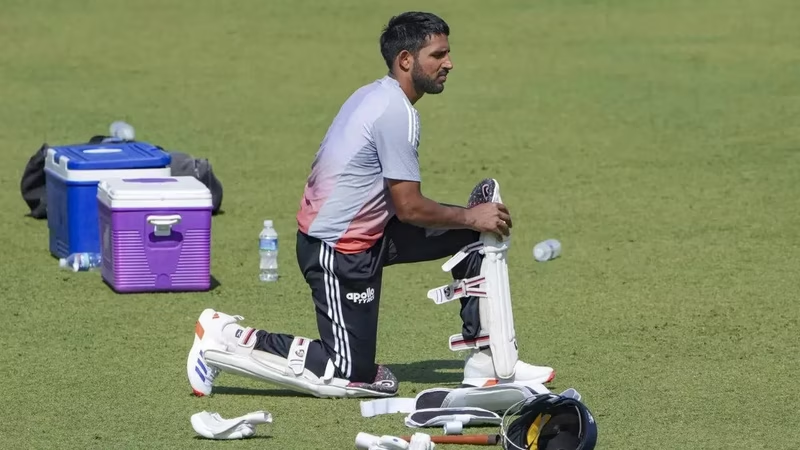
All it takes is one innings to change a career trajectory. For 23-year-old Dhruv Jurel, that moment may have just arrived. In a dazzling display of power, poise, and maturity, the Uttar Pradesh wicketkeeper-batter smashed an unbeaten 160 off just 101 balls during the 2025 Vijay Hazare Trophy—cementing his status as the hottest domestic name in Indian cricket right now .
With India’s ODI squad for the upcoming New Zealand series still under deliberation—and star keeper Rishabh Pant’s availability uncertain due to ongoing recovery protocols—Jurel’s Dhruv Jurel ODI selection case has gone from plausible to practically undeniable. Over three matches, he’s scored more than 300 runs at a staggering strike rate, blending aggressive strokeplay with smart situational awareness. The message to selectors? The door isn’t just open—he’s knocking loudly from the inside.
Table of Contents
- The Innings That Changed Everything
- Dhruv Jurel ODI Selection: A Statistical Breakdown
- Why This Timing Couldn’t Be Better
- The Pant Factor: Is India Ready for a New Wicketkeeper-Batter?
- Competition and Challenges Ahead
- What Selectors Should Consider
- Sources
The Innings That Changed Everything
Jurel’s 160* wasn’t just about big numbers—it was about how he scored them. Facing a quality bowling attack, he dismantled spinners with sweeps and lofted drives, while taking on pacers with clean pulls and cover drives. More impressively, he accelerated without losing control, turning a solid 80 into a game-breaking 160 in under 40 balls .
Former India selector Saba Karim, watching the match, called it “the kind of innings that solves selection dilemmas.” Indeed, in an ODI format that increasingly values explosive middle-order hitters who can also keep wickets, Jurel fits the modern template perfectly.
Dhruv Jurel ODI Selection: A Statistical Breakdown
Let’s put the hype into perspective with hard data from the 2025 Vijay Hazare Trophy (as of December 29, 2025):
| Match | Runs | Balls | Strike Rate | Result |
|---|---|---|---|---|
| vs Gujarat | 78 | 62 | 125.8 | Won |
| vs Karnataka | 65* | 48 | 135.4 | Won |
| vs Tamil Nadu | 160* | 101 | 158.4 | Won |
| Total | 303* | 211 | 143.6 | 3 Wins |
Compare this to other wicketkeeper-batters in the domestic circuit this season, and Jurel’s numbers stand out—not just for volume, but for impact in high-pressure knockout games.
Why This Timing Couldn’t Be Better
The India selectors are currently finalizing the ODI squad for the three-match series against New Zealand in February 2026. With Rishabh Pant still in a monitored fitness phase following his 2024 recovery from a serious accident, the BCCI is openly exploring backup options .
Traditionally, Sanju Samson or KL Rahul might slot in—but both come with trade-offs. Samson’s keeping in ODIs has been inconsistent, while Rahul’s availability depends on his white-ball workload management. This opens a rare window for a newcomer.
[INTERNAL_LINK:india-odi-squad-new-zealand-2026] Jurel’s form, youth (23), and dual skillset make him a low-risk, high-reward gamble—exactly the kind of bold call modern selectors are increasingly willing to make, as seen with Shubman Gill and Washington Sundar in past squads.
The Pant Factor: Is India Ready for a New Wicketkeeper-Batter?
Rishabh Pant remains India’s first-choice in all formats when fit—a player of irreplaceable X-factor. But cricket is no longer built on dependence. Smart teams develop succession plans, especially in high-impact roles like wicketkeeper-batter.
Jurel isn’t trying to “replace” Pant. He’s positioning himself as the ideal Plan B—and potentially the long-term heir. His technique against pace, ability to rotate strike, and clean hitting in the 30–45 over phase align perfectly with India’s current ODI needs .
Competition and Challenges Ahead
To be fair, Jurel isn’t the only contender. Ishan Kishan’s experience and Ishan Porel’s recent A-team performances add depth. But none have matched Jurel’s current red-hot form in 50-over cricket.
Still, challenges remain:
- Limited international exposure: No India A or T20I caps yet.
- Keeping under pressure: Needs to prove consistency behind the stumps in high-stakes games.
- Squad balance: Selectors may prefer an extra bowler over a third keeper.
What Selectors Should Consider
If the goal is to build a future-ready ODI side, Jurel’s inclusion makes strategic sense. Here’s why:
- Future-proofing: At 23, he offers a 10-year horizon.
- Format fit: His aggressive yet controlled batting suits modern ODI middle orders.
- Momentum matters: Ignoring this level of domestic form risks demotivating the entire first-class ecosystem.
As former captain Sourav Ganguly once said, “Form is temporary, class is permanent—but when form and class arrive together, you don’t hesitate.”
Conclusion
Dhruv Jurel isn’t just asking for a spot on the bench. With a 160* and 300+ runs in three games, he’s demanding a seat at the table. The Dhruv Jurel ODI selection debate is no longer speculative—it’s urgent. With the New Zealand series around the corner and Pant’s status unclear, the selectors have a golden opportunity to reward merit, inject youth, and signal faith in India’s domestic pipeline. The knock has been loud. Now, it’s time to open the door.